


Huang Huan-chang (黃煥彰) was once nearly run over by an angry business owner whom he reported on for polluting a fish farm. The long-time environmental activist is used to threats, and vividly recounts the time a factory boss trapped him inside a complex, and he had to use a hammer to smash a lock and escape.
Although Huang sees himself as a crow, tirelessly cawing at the government and industry for the past 26 years to protect the environment, his opponents call him a ghost. He earned the moniker in the early 2010s after he revealed that Taiwan Alkali Industrial Corp (TAIC, 台鹼公司) was polluting tilapia fish farms in Tainan with dioxin and mercury.
“From 2010 to 2015, I was constantly there,” Huang says. “I recorded them testing the soil. I followed them when they investigated runoff to fisheries. I shadowed their every move, and they began saying, ‘we’ve been possessed by a ghost!’ The most vital part of environmental activism is being on site. I’ve been closely following some of these cases for 20 years, and if government officials want to argue with me, I know exactly how to rebuke them.”
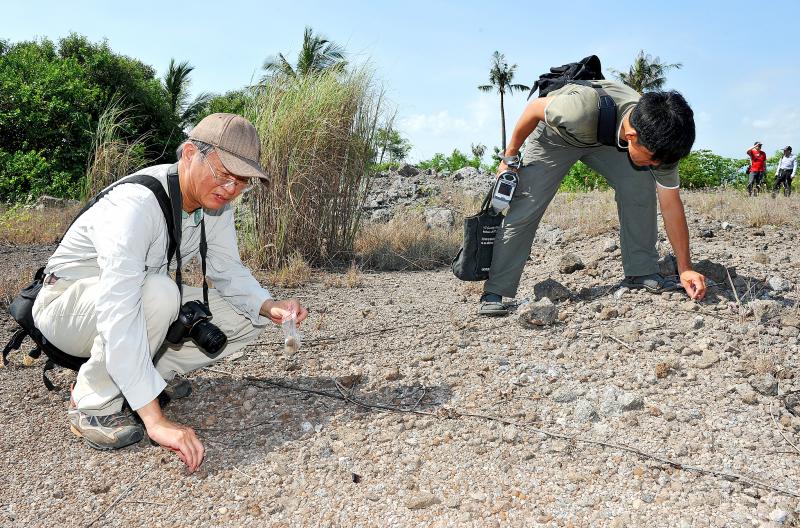
Photo: Chien Jung-fong, Taipei Times
Huang won the Lifetime Environmental Protection Award earlier this month at the Environmental Non-Governmental Organizations Convention in Taipei, earning him a three-minute audience with President Tsai Ing-wen (蔡英文), where he discussed lax government policy and ongoing issues regarding industrial waste disposal.
Although Huang has drawn public attention to land use issues, he laments that the overall situation hasn’t improved in the last 26 years because the worst offenders have gotten sneakier in their dumping practices. Instead of piling up mounds of waste as they did in the old days, they now use loopholes in the law to get away with burying it — often without proper treatment — on farmland and in fisheries.
“It’s a serious threat to food safety, and we’re stealing our descendants’ future,” Huang says.
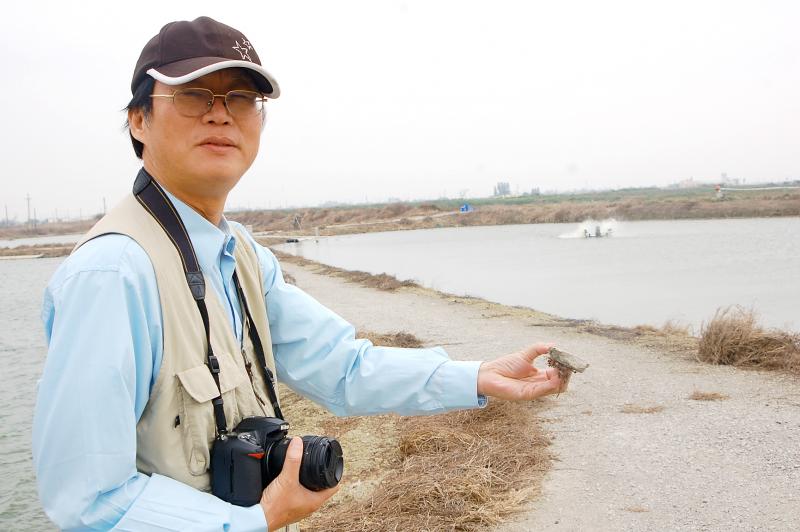
Photo: Tsai Wen-chu, Taipei Times
COLORFUL RIVERS
Huang, who turns 60 this year, has dedicated nearly half of his life to environmental activism. His early passion in photography brought him in the mid-1990s to the Erjen River (二仁溪) on the Tainan-Kaohsiung border, where he saw a 3km stretch of dead fish in waters heavily polluted by years of dumping electronic waste.
“I cried for 20 minutes when I saw that scene. I decided that I had to do something about this. I gave up my goals of furthering my career, abandoned my research plans and delved into environmental activism,” Huang says. “That’s why I’m still an assistant professor.”
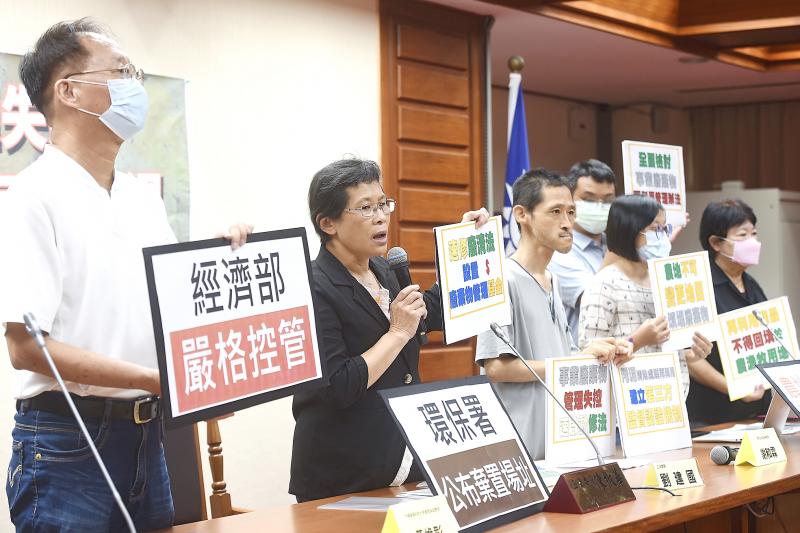
Photo: Chien Jung-fong, Taipei Times
Huang gave up the nation’s pretty scenery for its “colorful” waters — red for waste acid, milk-blue for strong alkali, reddish-purple for incinerator residue and emerald green for steel furnace slag.
The Erjen river is much cleaner now, Huang says, but he remains busy with countless other cases. He estimates that he’s exposed about 300 cases of wrongdoing so far — most notably the “dioxin duck” incident in 2009, when he found that thousands of animals were raised on a farm in Kaohsiung contaminated with slag from a steel furnace.
Huang rattles off a list of memorable “finds” from Taiwan’s north to south: illegally dumped alkaline soil in the Shimen Reservoir (石門水庫), hazardous incinerator residue at the mouth of the Dadu River (大肚溪), and excessive amounts of chromium in the rice paddies of Tainan’s Houbi District (後壁), to name a few.
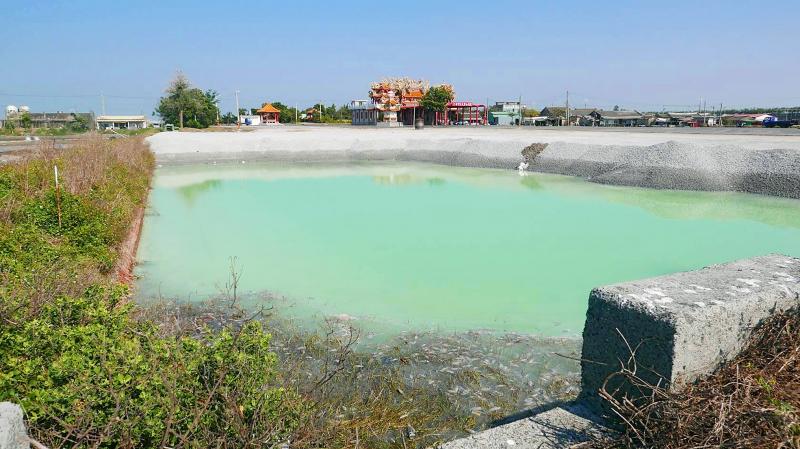
Photo courtesy of Huang Huan-chang
The Taiwan Alkali case is notable because Huang was able to find direct proof that the pollutants entered the food chain from the water and directly affected hundreds of factory workers and local residents, many of whom were suffering from tumors and cancer due to record breaking dioxin levels in their blood.
“I hope that Taiwan remembers this shameful record,” he says.
Huang says being persistent is key. The government initially denied wrongdoing, so in addition to presenting evidence and data, Huang held press conferences on a weekly basis, each one featuring a victim, until the authorities responded to their demands.
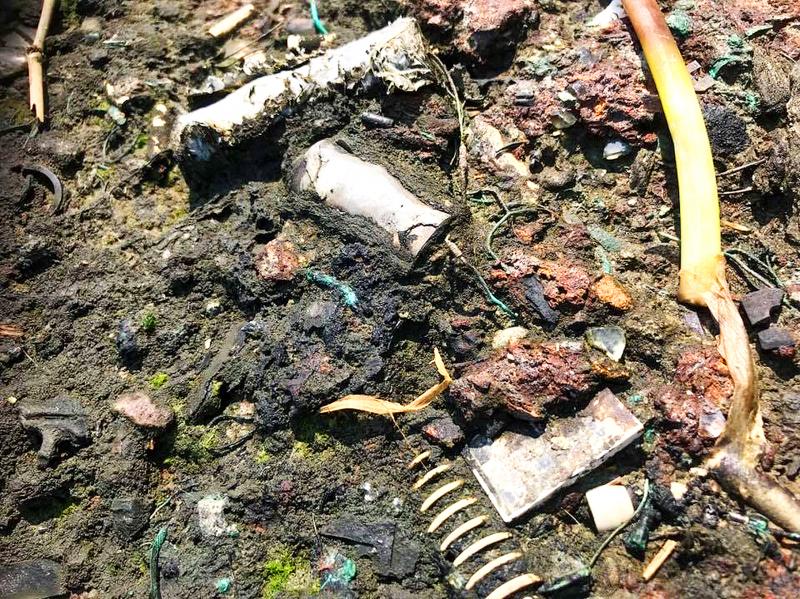
Photo courtesy of Huang Huan-chang
WASTE LOOPHOLES
Huang says it was better in the bad old days when the disposal of hazardous waste was more visible and its impact easier to assess. Today it is much worse. Waste is commonly scattered on farms and waters bodies, making it harder to detect.
Huang says the government’s broad designation of certain types of industrial waste as “reusable” in the name of sustainable development is problematic. Too often, these materials are not reused but mixed with soil and rocks and used to backfill farmland. Many gravel pits are actually fronts for carrying out these operations, Huang says.
More alarming is the hazardous waste that’s designated as reusable, Huang says. For example, printed circuit boards can be recyclable but only if treated properly. But too often, he adds, the circuits are often crudely crushed and filtered and then dumped into the land.
Loopholes in the legislation allows company owners, who illegally dispose of waste, to get away with small fines and little punishment. For example, those who dispose of waste deemed reusable are generally only fined NT$6,000, which is practically nothing when compared to their profits.
The company that was caught in 2015 dumping 400,000 tonnes of steel furnace slag in a field in Tainan’s Syuejia District (學甲), for example, was only fined NT$6,000 and ordered to clean it up. The government hit them with another NT$72,000 last year after finding more waste. The fine pales in comparison to the NT$200 million the company earned from its illegal dumping.
“We talk about a circular economy, but it’s circulating poison into the soil,” Huang says.
Waste disposal laws need to change for this to be fixed, Huang says, as the land is being polluted much faster than it’s being cleaned up. Also problematic is the soil sampling and testing methods, which often aren’t thorough or effective enough, he adds.
Aside from painstaking investigations and lobbying the government, Huang is spreading civic awareness through his environmental education classes at Tainan Community University, where students help with his documentation and restoration efforts.
Change is slow, Huang says, and the government still often denies his reports. But he will keep pushing.
“I just can’t let go of the land like this,” he says.
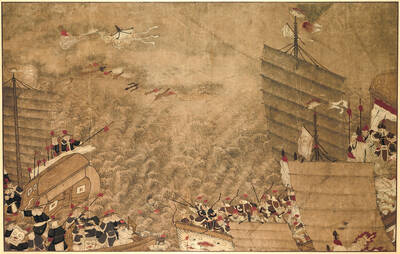
For many centuries from the medieval to the early modern era, the island port of Hirado on the northwestern tip of Kyushu in Japan was the epicenter of piracy in East Asia. From bases in Hirado the notorious wokou (倭寇) terrorized Korea and China. They raided coastal towns, carrying off people into slavery and looting everything from grain to porcelain to bells in Buddhist temples. Kyushu itself operated a thriving trade with China in sulfur, a necessary ingredient of the gunpowder that powered militaries from Europe to Japan. Over time Hirado developed into a full service stop for pirates. Booty could

Politically charged thriller One Battle After Another won six prizes, including best picture, at the British Academy Film Awards on Sunday, building momentum ahead of Hollywood’s Academy Awards next month. Blues-steeped vampire epic Sinners and gothic horror story Frankenstein won three awards each, while Shakespearean family tragedy Hamnet won two including best British film. One Battle After Another, Paul Thomas Anderson’s explosive film about a group of revolutionaries in chaotic conflict with the state, won awards for directing, adapted screenplay, cinematography and editing, as well as for Sean Penn’s supporting performance as an obsessed military officer. “This is very overwhelming and wonderful,” Anderson



 RSS
RSS