


Mark Lester Reyes suffered chemical burns to his face and body just two months into his job at a shoe factory in Taoyuan. With his mother and siblings in the Philippines relying on his income, Reyes kept the accident a secret for years and learned how to put on makeup to conceal the scars.
Seven years later, Reyes is still working long hours at another factory, but his makeup skills have led to him becoming one of the Filipino migrant community’s most sought-after fashion designers. He generally works on his costumes after his 12-hour graveyard shifts, and spends the few weekends he has off putting on runway shows, many of them charity events to help people in need back home.
“The accident didn’t change my plan, which was to work in Taiwan … I’ve always wanted to do that since we had many neighbors who worked in Taiwan and their houses were big and beautiful,” Reyes says. “But it added another plan for me and opened new doors.”

Photo courtesy of One-Forty
On Sunday, Reyes will be showcasing his creations to a broader audience at Huashan 1914 Creative Park as part of the Mix Music Festival (混音樂祭), which is organized by One-Forty, a nonprofit dedicated to providing skills training to migrant workers and facilitating intercultural understanding.
The festival features music in three languages by Indonesian factory worker outfit Uniband, Hoklo (also known as Taiwanese) rockers Amazing Show (美秀集團) and Aboriginal Amis crooner Suming. It is the first of several events for One-Forty’s “Your Shining Moment” (四十分之一的時刻) initiative this year to promote the various endeavors that migrant workers in Taiwan pursue despite their scant free time, ranging from creative activities to cleaning beaches.
According to a survey by the organization, 96.8 percent of Taiwanese respondents see Southeast Asian migrant workers primarily as “caregivers, factory workers and fishers” and few can imagine that they can also be artists, writers and musicians.

Photo courtesy of One-Forty
“I think this event will be an eye-opener to Taiwanese,” Reyes says. “Even though we may not speak their language, we can entertain them and make them clap [for us] because we have talent.”
Shortly after Reyes’ accident, a friend asked him to help out with the makeup at a Filipino beauty pageant. He was reluctant since he only learned the skill to cover his scars, but one thing led to another and soon he was tasked with designing the costumes for the Manila Economic and Cultural Office’s official Independence Day festivities. His hometown of Bulacan is famous for its colorful floral parades, and he drew from those elements as well as his graphic design background to create stunning pieces.
And through his charity events, he’s helped COVID-19 frontline workers back home, typhoon victims and most recently a young child suffering from liver failure.
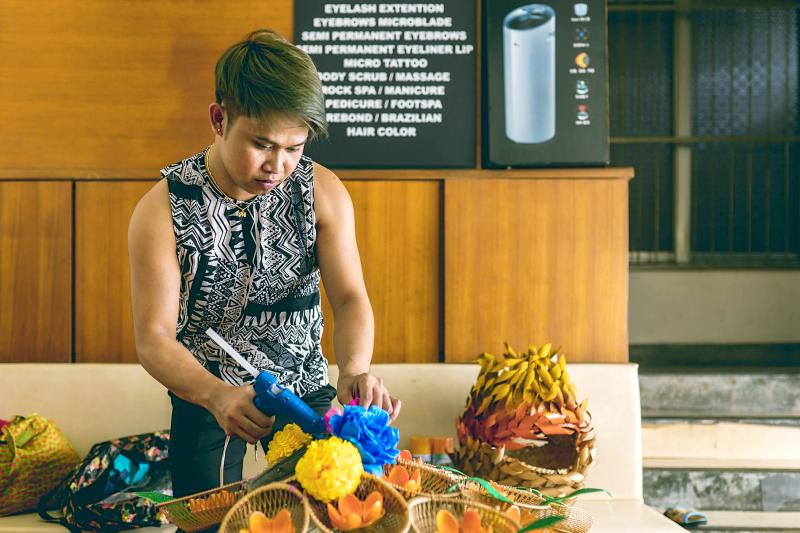
Photo courtesy of One-Forty
“I’m not just showcasing my talents [on Sunday], I also want to show Taiwanese how beautiful and colorful Filipino culture is,” he says.
It is now busy season at the factory and Reyes often has to work six to seven days a week, but he’s glad that his boss generally allows him to take time off whenever he is needed at a fashion event, which is quite often — there have been several in the past few weeks, he says.
Other migrant workers aren’t as fortunate, as One-Forty’s statistics show that the average migrant worker is given less than a day of free time per month. However, more than 95 percent of respondents to the survey believe that one needs at least three to five days per month to adequately develop their personal interests and grow. Still, the migrant workers are able to make do with what they have.
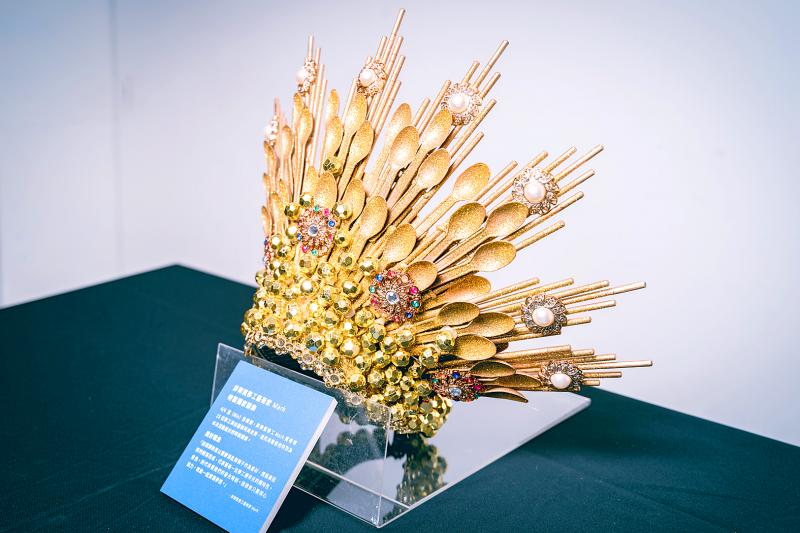
Photo courtesy of One-Forty
“Because of One-Forty, we can show that we’re not just migrant workers, we also have talent and we also have dreams we want to pursue,” Reyes says.
Recently the Chinese Nationalist Party (KMT) and its Mini-Me partner in the legislature, the Taiwan People’s Party (TPP), have been arguing that construction of chip fabs in the US by Taiwan Semiconductor Manufacturing Co (TSMC, 台積電) is little more than stripping Taiwan of its assets. For example, KMT Legislative Caucus First Deputy Secretary-General Lin Pei-hsiang (林沛祥) in January said that “This is not ‘reciprocal cooperation’ ... but a substantial hollowing out of our country.” Similarly, former TPP Chair Ko Wen-je (柯文哲) contended it constitutes “selling Taiwan out to the United States.” The two pro-China parties are proposing a bill that

March 9 to March 15 “This land produced no horses,” Qing Dynasty envoy Yu Yung-ho (郁永河) observed when he visited Taiwan in 1697. He didn’t mean that there were no horses at all; it was just difficult to transport them across the sea and raise them in the hot and humid climate. “Although 10,000 soldiers were stationed here, the camps had fewer than 1,000 horses,” Yu added. Starting from the Dutch in the 1600s, each foreign regime brought horses to Taiwan. But they remained rare animals, typically only owned by the government or

It starts out as a heartwarming clip. A young girl, clearly delighted to be in Tokyo, beams as she makes a peace sign to the camera. Seconds later, she is shoved to the ground from behind by a woman wearing a surgical mask. The assailant doesn’t skip a beat, striding out of shot of the clip filmed by the girl’s mother. This was no accidental clash of shoulders in a crowded place, but one of the most visible examples of a spate of butsukari otoko — “bumping man” — shoving incidents in Japan that experts attribute to a combination of gender
Last month, media outlets including the BBC World Service and Bloomberg reported that China’s greenhouse gas emissions are currently flat or falling, and that the economic giant appears to be on course to comfortably meet Beijing’s stated goal that total emissions will peak no later than 2030. China is by far and away the world’s biggest emitter of greenhouse gases, generating more carbon dioxide than the US and the EU combined. As the BBC pointed out in their Feb. 12 report, “what happens in China literally could change the world’s weather.” Any drop in total emissions is good news, of course. By


 RSS
RSS