


Something strange has been happening in the Taiwan Daily News in English discussion forum on Facebook recently. To those familiar with this 33,500-strong group, this might sound ingenuous. “Strange,” after all, has described the tone of much of the interaction from the onset. The admins have had a thankless task at the best of times.
Yet the US presidential election has dragged things to new depths, drawing in participants with murky motives. As the election nears, articles attacking President Donald Trump and, more commonly, his Democrat opponent Joe Biden have been posted with increasing frequency. Often, in lieu of any discernible news, a flamebait statement is posted, then immediately followed up with a volley of similar comments by the original poster, clearly designed to hasten confrontation.
The tone of the anti-Biden posts is uniform: “Beijing Biden” will sell Taiwan across the strait; voting for Uncle Joe makes you a Chinese Communist Party proxy; and, most preposterously, those defending the Democrat candidate from these claims, must be wumao (五毛, the 50-centers who derive their name from the alleged amount of money they receive for each post). In many cases, there is evidence to suggest these posts come from fake accounts, though who is responsible and to what purpose is not clear.
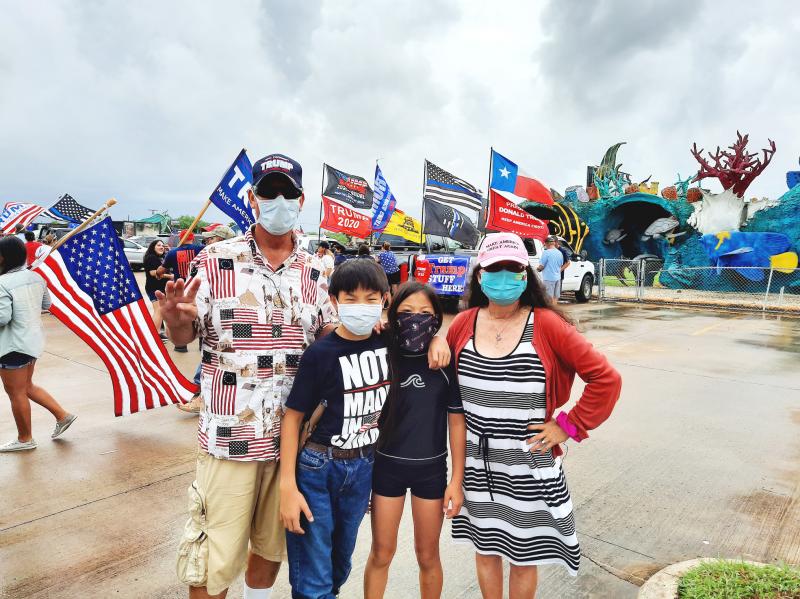
Photo courtesy of Joanna Chen Bryant
Hostile state elements are a possibility. A survey last year from the University of Gothenburg’s V-Dem Institute indicated that Taiwan is the world’s number one target for disinformation, with China the main culprit. Under Minister Without Portfolio Audrey Tang (唐鳳), who is responsible for digital technology, Taiwan has introduced measures designed to fight fake news, including the introduction of media literacy education to the school curriculum and the creation of the civic activist hoax-busting initiative Co-Facts.
VOCAL TRUMP SUPPORTERS
Yet, many of the broadsides against Biden appear to come from genuine accounts: Trump supporters, in and outside Taiwan, who believe the election of the Democrat candidate would spell disaster for Taiwan. Among these, Taiwanese and Taiwanese-Americans have been increasingly vocal, with several posting links to pro-Trump Facebook groups, one with over 2,800 members.
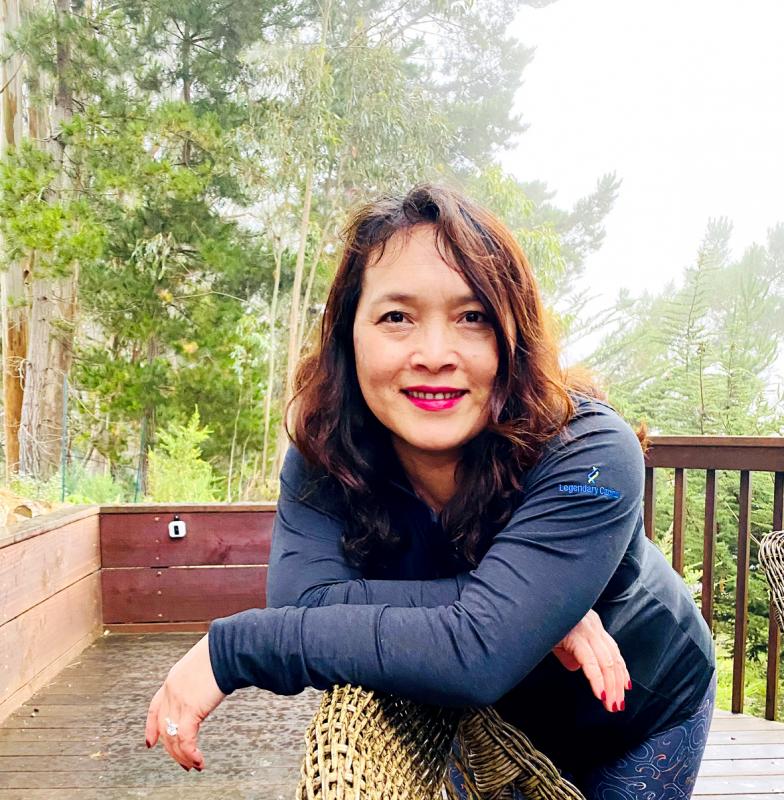
Photo courtesy of Judy Surmaitis
Trawling through the “information” shared in these groups is disconcerting: a clumsily patched-together collage purports to show Joe Biden’s son Hunter engaged in sex acts with former President Barack Obama’s daughter Malia alongside a cocaine-smeared credit card bearing her name; anti-Semitic memes of Facebook CEO Mark Zuckerberg depicted as Hitler bear the caption: “You can’t post zat!”
Across these groups, a statement-cum-petition has been shared hailing Trump as Taiwan’s sole hope against the “existential threat” posed by “the Communist iron fist.” He is also portrayed as the last bastion against “radical mobs” and “Marxist globalization” in America. (The “evil forces” of globalism and globalists — a well-known dog whistle for Jews — are mentioned several times.)
Extreme language aside, Taiwanese seem to hold Trump in high regard. Recent polls by British-based data firm YouGov showed Taiwan as the only country among 15 in Europe and Asia where support for Trump outweighed that for Biden. It did so handily, with 42 percent backing Trump versus 30 percent for his opponent. Even in Hong Kong, where Trump might be expected to score well, Biden edged it.
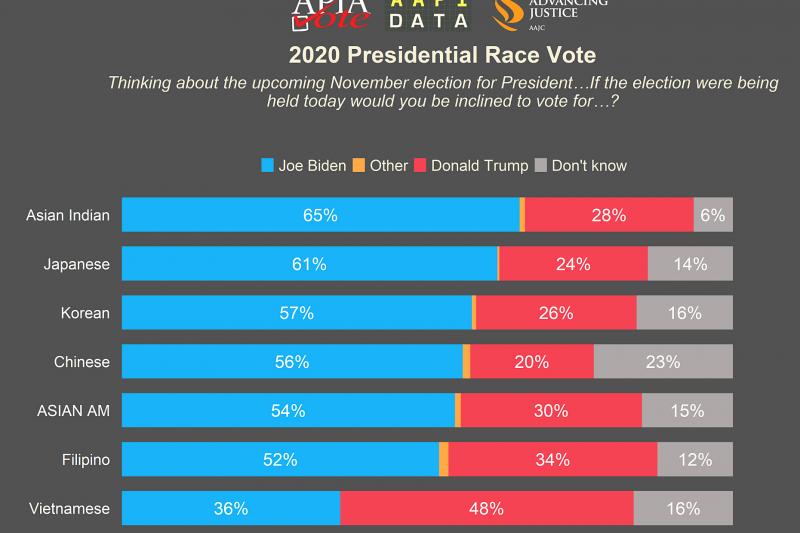
Photo: Screenshot
Among independence-leaning Taiwanese, support for Trump is pronounced. A poll by the Taiwan Public Opinion Foundation released on Tuesday showed an 80-20 split in Trump’s favor among supporters of the ruling Democratic Progressive Party. For the opposition Chinese Nationalist Party (KMT), the figures were 70-19 for Biden.
Its political marginality notwithstanding, the Taiwan Solidarity Union has spoken out for Trump. Meanwhile, independent Legislator Freddy Lim (林昶佐) was part of Taiwan’s delegation to Trump’s inauguration and told the Washington Post that this might be “the best time for Taiwan to strengthen ties with the United States.”
“Trump is against China and many Taiwanese love that,” says Daniel Wu (吳國嵩), a Taipei-based education consultant who, like everyone quoted in this story, I interviewed for a piece on pro-Trump Taiwanese-Americans ahead of the 2016 election.
Although Taiwanese in the San Francisco Bay Area have traditionally voted Democrat, there are signs of change.
“The Asian community generally dislikes Trump because his ‘China virus’ comments caused major discrimination,” says Wu, noting that his friends were involved in the Asian Lives Matter protests led by rapper China Mac. “But if you’re anti-China, you won’t mind him saying ‘China virus.’”
Wu also believes personal interest plays a role.
“Before COVID, my middle-class and rich friends made good money from real estate, investments and small businesses,” he says. “So, I think the majority of those will support Trump. Those who work 9-to-5’s will vote Biden.”
As in 2016, Wu has decided on principle not to vote, because of his permanent residence in Taiwan, but he is “leaning for Trump” because of an investment that has done better than at any time since he made it in 2009.
“He promised to cut tax. That’s the only reason,” says Wu.
Among the US-based Taiwanese-Americans I interviewed in 2016, not one has flinched in their support of Trump.
“He has exceeded our expectations,” says Joanne Chen Bryant (陳昭娟), a Chicago native. “He has shown himself to be a true friend to Taiwan and extremely tough on China.”
COVID-19
Bryant touts Trump’s economic achievements pre-COVID-19, and believes he did his best to combat the pandemic.
“We live in society, [so] we will all eventually get this virus,” she says, citing her background as an emergency physician. “The reality is some of us will live, some of us will die — unless we live in a bubble forever, which is unreasonable.”
Judy Surmaitis (張瓊穗), a case manager at her husband’s Bay Area law firm, agrees.
“It’s easy to criticize,” she says. “But what happened is unprecedented and there have been different approaches. For example, Switzerland (sic) focused on herd immunity."
Surmaitis says Trump “faced a headwind in his efforts” because of personal animosity. “Nancy Pelosi must have been aware of COVID-19 by January. Instead, enormous effort was put into impeaching the president.”
As in 2016, Surmaitis’s daughter, Alison Chan (詹涵茜), is at odds with her mother.
“She’s too liberal,” Surmaitis says, also lamenting that the family “lost one vote for Trump” in the form of her younger son Ian “who has been brainwashed by four years of college.”
Elder son Kyle is a registered Republican but won’t vote Trump, Surmaitis adds.
Highlighting Trump’s dismissal of the virus as a “hoax” and his recommendation of bleach injections, Chan calls him “careless and negligent.”
She also echoes remarks made by vice-presidential candidate Kamala Harris during her debate with Vice President Mike Pence about a potential vaccine.
“I won’t be first in line, unless health officials say it’s okay,” Chan says. “Like VP [candidate] Harris says, if Trump says to take the vaccine, I will not.”
Regarding Taiwan, Chan gives the president credit. “As much as it hurts me to admit it, I do respect Trump’s relationship with Taiwan,” she says. “The fact that someone is sticking their neck out and not conceding to China’s threats on Taiwan is great,” she adds, noting that Taiwan’s COVID-19 success has earned respect.
Charles Chaung (莊佳禾), an American-born business analyst, agrees but sees room for improvement. “I would love to see more progress — perhaps the US and Taiwan can start by forming a new world health organization together!” he says. Describing Trump’s actions against China as a “pivotal moment,” he believes the US must work with allies to reduce China’s global clout. “The COVID-19 fiasco further cements the reasons we need to stop being friendly with such a notorious human rights abuser,” Chaung says.
On the issue of race, most of the interviewees are more guarded. “Race relations at present are not good,” says Surmaitis. “But Mr. Trump did not create feelings which have existed for many years.”
Her daughter sees things differently.
“Groups that despise people of color and minorities definitely existed before Trump, but they are now more outspoken,” she says, adding that Trump “jumps around” the issue for fear of losing votes.
Others agree that this is a reinfected wound.
“It’s been like that since I was a kid,” says Wu. “But it’s worse now. Things are a mess.”
Interestingly, he suggests that negative perceptions of Harris’ time as district attorney for San Francisco played into the race equation.
“We didn’t get a good impression of her because she supposedly favored the African-American community much more than the Asian community back then,” he says of Harris, the daughter of an Indian mother and black Jamaican father.
For Chaung, the accusations of racism are unfair. He says Trump’s travel ban on people from “terrorist-infested countries” was “a pragmatic solution,” and that opponents attacked his character rather than offering viable alternatives.
“I’m not saying he’s a saint,” says Chaung. “Trump has a big mouth, but the policies he pushes for do not seem bigoted to me.”
Stopping short of outright praise for Trump’s handling of race relations, the US-based supporters echo their president in refocusing the argument. Surmaitis mentions far-right “anarchy” but is more concerned with “far left-leaning socialists, creating destruction”; Chaung says “progressivism has shown its true colors through the violence spread by antifa and Black Lives Matter.”
Taipei-based teacher Eddy Chun Hsu (徐雋) goes further, making a comparison that is popular with Beijing and its supporters.
“The Hong Kong protests and human rights issues are not so bad compared with what’s going on all across USA now,” says California-raised Hsu who has also decided not to vote while living in Taiwan. “My view isn’t the popular American view, nor is it the popular Taiwanese view,” he admits.
Having said that Trump would be competent during our 2016 interview, Hsu now brands him a “criminal” who has caused immense harm. “I couldn’t imagine the damage he would do,” he says.
Of the 2016 interviewees, only Hsu has changed his views. Surmaitis, Bryant and Chaung are more firmly behind their man, Chan has moved even farther away from the views of her mother, and Wu remains on the fence.
A September poll by AAPI Data, a publisher of research on Asian-Americans and Pacific Islanders, showed 54 percent of Asian-Americans favoring Biden, with just 30 percent backing Trump and the rest undecided or plumping for other candidates. Within the individual groups polled, Trump came top only among Vietnamese-Americans.
As Taiwanese-Americans are seldom treated as a separate demographic, polling figures for the group are hard to come by. (Indeed, even the numbers for people identifying as Taiwanese-Americans are fuzzy.) Their increased visibility on social media in support of Trump chimes with his “Twitter Presidency.” Rather than showing a growing voter base, it may signify greater confidence in going public.
In 2016, Chaung offered his thoughts anonymously following hostility from acquaintances.
“I am fine with sharing my identity now because over time, I’ve come to the decision that those who alienate or discriminate against someone just for supporting Trump are not people I need to appease,” says Chaung. “I don’t need their approval or friendship.”
May 11 to May 17 Traversing the southern slopes of the Yushan Range in 1931, Japanese naturalist Tadao Kano knew he was approaching the last swath of Taiwan still beyond colonial control. The “vast, unknown territory,” protected by the “fierce” Bunun headman Dahu Ali, was “filled with an utterly endless jungle that choked the mountains and valleys,” Kano wrote. He noted how the group had “refused to submit to the measures of our authorities and entrenched themselves deep in these mountains … living a free existence spent chasing deer in the morning and seeking serow in the evening,” even describing them as

As a different column was being written, the big news dropped that Chinese Nationalist Party (KMT) caucus whip Fu Kun-chi (傅?萁) announced that negotiations within his caucus, with legislative speaker Han Kuo-yu (韓國瑜) of the KMT, party Chair Cheng Li-wun (鄭麗文), Taichung Mayor Lu Shiow-yen (盧秀燕) and Taiwan People’s Party (TPP) Chair Huang Kuo-chang (黃國昌) had produced a compromise special military budget proposal. On Thursday morning, prior to meeting with Cheng over a lunch of beef noodles, Lu reiterated her support for a budget of NT$800 or NT$900 billion — but refused to comment after the meeting. Right after Fu’s

Yesterday, the Democratic Progressive Party (DPP) nominated legislator Puma Shen (沈伯洋) as their Taipei mayoral candidate, the Chinese Nationalist Party (KMT) put their stamp of approval on Wei Ping-cheng (魏平政) as their candidate for Changhua County commissioner and former legislator Tsai Pi-ru (蔡壁如) of the Taiwan People’s Party (TPP) has begun the process to also run in Changhua, though she has not yet been formally nominated. All three news items are bizarre. The DPP has struggled with settling on a Taipei nominee. The only candidate who declared interest was Enoch Wu (吳怡農), but the party seemed determined to nominate anyone
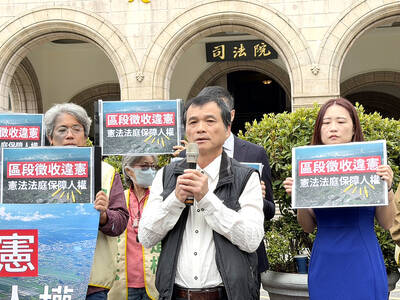
What government project has expropriated the most land in Taiwan? According to local media reports, it is the Taoyuan Aerotropolis, eating 2,500 hectares of land in its first phase, with more to come. Forty thousand people are expected to be displaced by the project. Naturally that enormous land grab is generating powerful pushback. Last week Chen Chien-ho (陳健和), a local resident of Jhuwei Borough (竹圍) in Taoyuan City’s Dayuan District (大園) filed a petition for constitutional review of the project after losing his case at the Taipei Administrative Court. The Administrative Court found in favor of nine other local landowners, but


 RSS
RSS