


A textbook used in some Victorian schools includes portions that repeat Chinese Communist party propaganda and features a controversial map in which China claims most of the South China Sea in contradiction of Australian government policy.
Concerns about the material have prompted the publisher, Cengage Learning Asia, to recall unsold copies of the textbook, which the Melbourne-based authors said they had written to suit the course design of the Victorian senior school subject Chinese language, culture and society.
While the textbook is not listed by Victorian education authorities as a prescribed text for undertaking the course, it is being used in at least 11 schools in the state, including prestigious private schools Camberwell Grammar School and Ruyton Girls’ School.
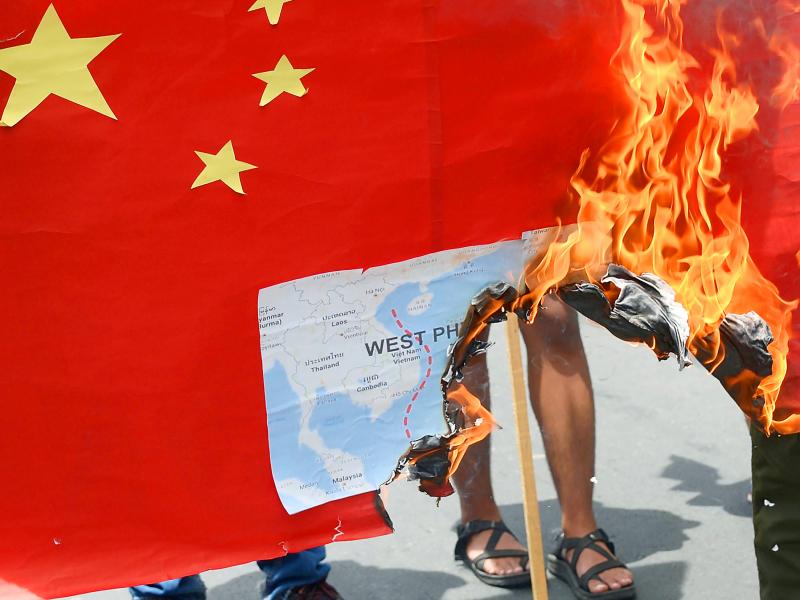
Photo: AFP
The publisher confirmed 633 copies had been sold in Australia and 100 outside Australia.
Among the concerns with the textbook is the inclusion of the “nine-dash line” map which shows China claiming most of the South China Sea — a position contested by Australia and numerous countries in the region and challenged by an international tribunal. It is labeled in the book as “map of China”.
“It is highly misleading to portray the nine-dash line in an educational textbook as a legitimate map of China and the region,” said Prof Rory Medcalf, the head of the Australian National University’s national security college.
Photo: AFP
“For it to appear in a textbook in Australia puts it at odds not only with the sensitivities of much of the region, but also with international law and Australian government policy.”
But the Victorian curriculum authority emphasizes it has never endorsed the book, while the publisher, Cengage, maintains the inclusion of the map in the Senior Chinese Course: Chinese Language, Culture and Society textbook was “an editorial oversight.”
A Cengage spokesperson said a different version of the map, without the nine-dash line, was replaced when the editors “could not identify the copyright owner.”
Photo: AP
They said the current map was then inserted without anyone noticing the nine-dash line around the South China Sea.
“We apologize to readers for this carelessness,” Cengage said in a written response. “We have requested a stock recall, and assigned an editorial colleague to review the title, and its ancillaries.”
The publisher expects to recall about 750 copies from Australia and Singapore.
Photo: Reuters
Further investigation revealed the same nine-dash line map in two further Cengage textbooks written by the same authors for potential use in VCE Chinese studies, titled Learn Chinese 1 and Learn Chinese 2.
The textbook’s authors — Xu Jixing and Ha Wei, the heads of Chinese at two of Melbourne’s most prestigious private schools, Scotch College and Camberwell Grammar — said they never included that map, confirming that the publisher did.
PARTY PLAYBOOK
Xu also said that he and Ha did not intend the book “to constitute any propaganda for [the] Chinese Communist party at all” and that they “never intended to take a political stance” and that the purpose of the course was to help Australian students have a better understanding of Chinese language and culture.
The concerns about the textbook were first investigated by the Citizen, a publication of the University of Melbourne’s Center for Advancing Journalism. Given the matters of public interest involved, the Citizen brought it to the Guardian’s attention and the findings are being published jointly by both outlets.
While initial investigation focused on the map, the Citizen’s subsequent inspection of the final chapter uncovered messaging that China expert John Fitzgerald described as “straight out of the party playbook.”
The book devotes two pages to the “Chinese Dream” — a concept promoted by Xi Jinping (習近平) since 2012 and incorporated into school textbooks in China at the direction of the CCP’s propaganda chief, Liu Yunshan (劉雲山), who wanted to ensure it “enters students’ brains.”
The textbook describes the Chinese Dream as China “becoming equal to any other nation on the international stage,” saying this has “transcended all the differences that exist in the country to become the greatest calling for the Chinese” and a uniting force “propelling the nation forward.”
It says the Chinese people believe the country can develop “only when the nation is united and led by a strong government” and China views the way forward as “democracy under a socialist system with Chinese characteristics.”
The theme “Socialism with Chinese characteristics for a new era” was at the center of a Xi-authored body of political thought written into the Communist party charter in 2017.
Portions of the Chinese Dream section are very similar to a 2013 article on the state-run news organization China.org.cn, written by the deputy director of the Chinese Marxism Institute at Shanghai Academy of Social Sciences, Fang Songhua.
Fitzgerald said the Chinese Marxism Institute was “a boilerplate Leninist Communist party propaganda operation.”
The Shanghai Academy of Social Sciences has been alleged by the FBI to have links to Chinese intelligence operatives. There is no suggestion that either the publisher or the authors of the textbook have any such links.
The textbook’s authors, Xu and Ha, are the president and vice president respectively of the Chinese Language Teachers Association of Victoria, and Xu is chief examiner for VCE Chinese as a second language.
Both authors were key figures in the development of the VCE Chinese language culture and society subject, designed to attract students from non-Chinese backgrounds.
The preface says the authors wrote the textbook because teachers were calling for material “that can guide the teaching and learning of this course.”
The subject is taught at 37 Victorian schools in 2020. While it’s not clear precisely how many use the textbook, schools that show it on their publicly available book list include Lauriston Girls’ School, Trinity
Grammar, Werribee Secondary and Alkira Secondary.
Xu said he and Ha had never intended “to include any political propaganda in our book as we don’t have any political stance towards any political party or any political organization. We used the most resources that we could find at the time when we were writing the book.”
Xu said he had been in Australia for almost 30 years “and love the politically free atmosphere of my life here in Australia.”
“I won’t speak, or in your words, propagandize for any political party or politician as I am not interested in politics at all and don’t have any political stance for any political party or organization,” Xu said.
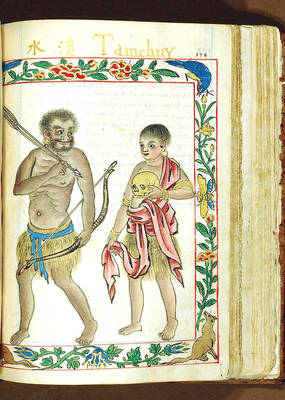
The Portuguese never established a presence on Taiwan, but they must have traded with the indigenous people because later traders reported that the locals referred to parts of deer using Portuguese words. What goods might the Portuguese have offered their indigenous trade partners? Among them must have been slaves, for the Portuguese dealt slaves across Asia. Though we often speak of “Portuguese” ships, imagining them as picturesque vessels manned by pointy-bearded Iberians, in Asia Portuguese shipping between local destinations was crewed by Asian seamen, with a handful of white or Eurasian officers. “Even the great carracks of 1,000-2,000 tons which plied
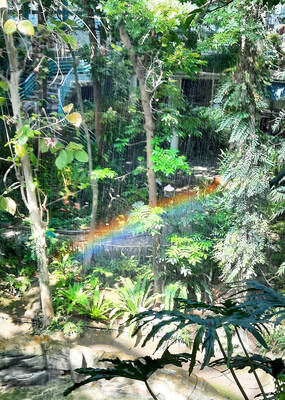
It’s only half the size of its more famous counterpart in Taipei, but the Botanical Garden of the National Museum of Nature Science (NMNS, 國立自然科學博物館植物園) is surely one of urban Taiwan’s most inviting green spaces. Covering 4.5 hectares immediately northeast of the government-run museum in Taichung’s North District (北區), the garden features more than 700 plant species, many of which are labeled in Chinese but not in English. Since its establishment in 1999, the site’s managers have done their best to replicate a number of native ecosystems, dividing the site into eight areas. The name of the Coral Atoll Zone might
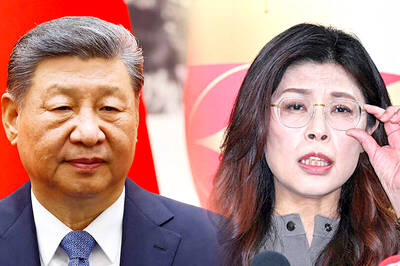
On Monday morning, in quick succession, the Chinese Communist Party (CCP) and the Chinese Nationalist Party (KMT) released statements announcing “that the Central Committee of the Communist Party of China and General Secretary Xi Jinping (習近平) have invited KMT Chairwoman Cheng Li-wun (鄭麗文) to lead a delegation on a visit to the mainland” as the KMT’s press release worded it. The KMT’s press release added “Chairwoman Cheng expressed her gratitude for the invitation and has gladly accepted it.” Beijing’s official Xinhua news release described Song Tao (宋濤), head of the Taiwan Work Office of the CCP Central Committee, as
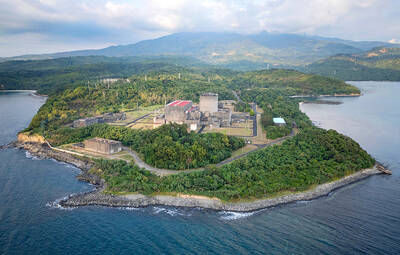
Nuclear power is getting a second look in Southeast Asia as countries prepare to meet surging energy demand as they vie for artificial intelligence-focused data centers. Several Southeast Asian nations are reviving mothballed nuclear plans and setting ambitious targets and nearly half of the region could, if they pursue those goals, have nuclear energy in the 2030s. Even countries without current plans have signaled their interest. Southeast Asia has never produced a single watt of nuclear energy, despite long-held atomic ambitions. But that may soon change as pressure mounts to reduce emissions that contribute to climate change, while meeting growing power needs. The


 RSS
RSS