


Out of about 170,000 practicing nurses in the nation, fewer than 500 belong to a labor union — a unionization rate of less than 0.3 percent.
This is a far cry from the national average of about 7 percent, with the largest, Taiwan Nursing and Medical Industries Union (台灣護師醫療產業工會, TNMIU), boasting just 315 members.
Even though the nursing industry is notorious for its heavy workload, long hours and low wages, workers have remained slow to mobilize at the grassroots level and demand better treatment. While the root of the problem is the lack of labor rights in nursing education and overemphasis on the Florence Nightingale ideal of self-sacrifice, other factors include fear of retribution by employers, high turnover rates and a lack of cohesion. For example, there are currently three nursing labor unions, which further prevents nurses from uniting as a single labor force.
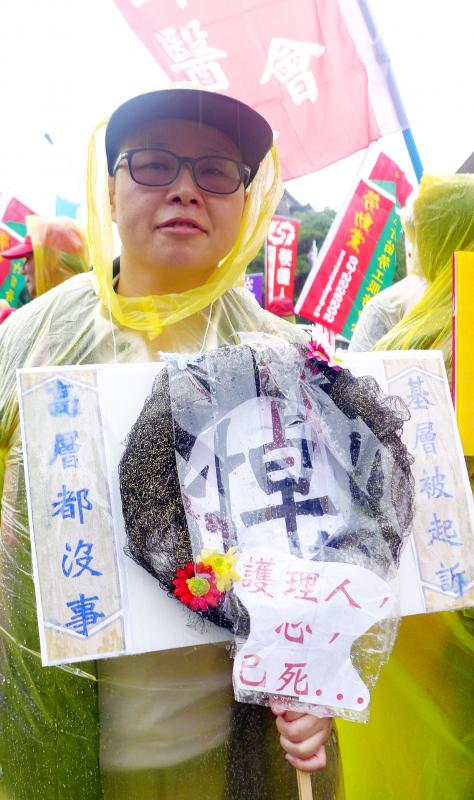
Photo: Lee Ya-wen, Taipei Times
The awareness that nurses deserve better working conditions has only emerged recently. The Taiwan Union of Nurses Association (中華民國護理師護士公會全國聯合會, TUNA), which all practicing nurses are required by law to join, began lobbying the government for better working conditions in 2008; the first labor union was launched in 2012.
TUNA is not a labor union, but rather an umbrella organization that represents 24 local nursing associations. While its mission statement includes “protecting the rights of nurses,” nursing labor activists tell the Taipei Times that the association isn’t effective.
Doctor unions also see low participation rates. Since only unions can strike, the low member count has prevented such efforts in the medical field as a whole. Additionally, hospital staff face the social stigma of disregarding their patient’s lives, even if they guarantee to keep vital operations running during a strike.

Photo: CNA
Nursing labor activists often stress that they are not just fighting for themselves, but for their patients as well. Numerous international and domestic studies have shown that inadequate nurse staffing and overwork leads to higher patient mortality rates.
“I know many people who believe that they have to take care of themselves first so they have the energy and attention to take better care of the patients,” says Chang Tzu-heng (張子珩), a former nurse who continues to advocate for labor rights through the Taiwan Nurses Union (台灣護理產業工會, TNU).
UNINFORMED AND AFRAID
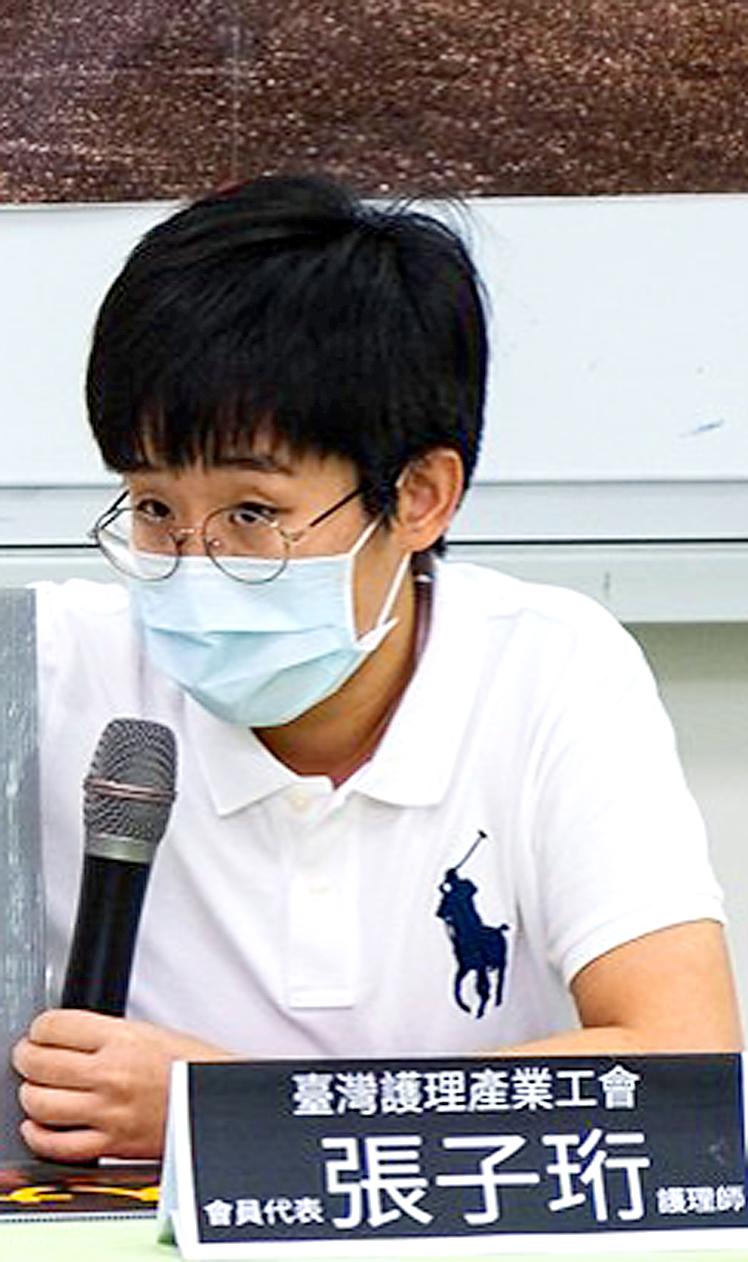
Photo courtesy of Chang Tzu-heng
“The key to [gaining leverage] is to develop a healthy and effective union. But whether a union will mature depends on the labor awareness among nurses and the awakening of their collective autonomy,” Hu Fang-hsiang (胡方翔) writes in the 2013 study, Equal Rights on Taiwan Nursing Profession from a Gender Perspective (從性別平權觀點重建台灣護理專業).
Seven years later, progress remains slow.
Chen Ching-min (陳靜敏), a professor at National Cheng Kung University’s Department of Nursing and a former legislator-at-large, says that part of the passivity comes from the outdated message that nurses are supposed to live a life of servitude to others.
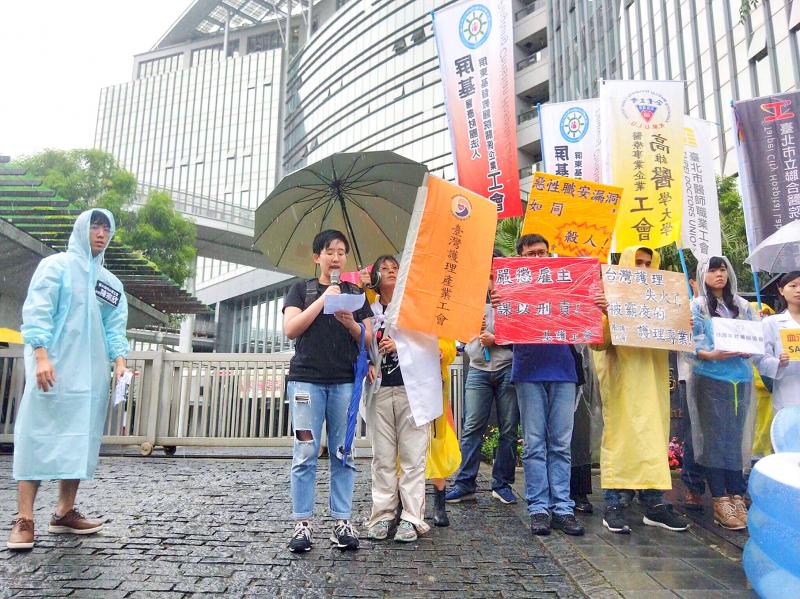
Photo courtesy of Chang Tzu-heng
“This is changing. We tell our students now that we can devote ourselves to our patients, but we don’t have to self-sacrifice. We don’t need to set ourselves on fire to be a light for other people,” she says.
Chen says there was virtually no education on labor rights in schools. While she has integrated the topic into her curriculum, there’s only time to teach it over one class session.
“Once they start practising in the field, how much [of that one class] would they remember?” she asks.
Chen Yu-feng (陳玉鳳), head of TNMIU, says that the government should allow unions to lead the development of labor rights education in nursing schools, especially since the government is the industry’s largest employer with its numerous public hospitals and health facilities.
Unlike its counterparts, TNMIU takes action by filing legal suits against offending employers. Chen Yu-feng says they’ve won 18 civil cases in the past three years, mostly involving compensation issues, including overtime pay.
“Because we did not know our rights, we often got the short end of the stick,” she says. “Before we started, few knew that taking legal action was a viable route. People were afraid of retribution from the hospital administration and reluctant to speak out. We want to show people that we are protected by the law.”
Chang says that she only became acquainted with labor rights as a student through the Medical Labor Condition Group (醫勞小組), a group of medical staff and students who aim to improve the field’s working conditions.
She joined TNU once she graduated, but she didn’t become active until her second year after she acclimated to the workload. The union only has 50-odd members after six years of operation.
In addition to a lack of education, many nurses don’t plan to stay in the industry for long due to the poor working conditions, and are therefore reluctant to invest their time and energy into improving the field, Chang says.
Echoing Chen Yu-feng, Chang says even more nurses worry about being unfavorably targeted by their employers, who tend to see union members as “troublemakers.”
“Nobody enjoys holding news conferences and staging demonstrations on the streets,” Chang says. “We’re not troublemakers. We are identifying problems and trying to solve them.”
Chang says numbers matter in defending themselves against potential mistreatment.
“When 15 out of a department of 20 people are in a union, there’s really nothing the higher ups can do about it. Then people will be less afraid to join,” she adds.
LACK OF UNITY
Chen Ching-min is also an officer in TUNA. Since membership is mandatory and it is led by managerial-level staff, Chen says most union members do not trust, nor think much of, the association’s ability to advocate for their rights.
“They don’t trust the higher ups because that’s who they’re fighting against. So they can’t imagine that we would want to speak up for them,” Chen says.
Both Chen Ching-min and Chang say that many members feel that “all they get from their annual dues are the presents they receive every International Nurses Day.”
Negative comments criticizing the association’s lack of progress also flood its Facebook page.
Chen Ching-min says that they have trouble moving forward because of this lack of confidence and participation. Even when they do something significant, such as meeting with President Tsai Ing-wen (蔡英文) last month to discuss work environment issues, its members generally fail to notice, she adds.
Chen Yu-feng says that the government is friendlier toward TUNA than the unions. Chen Ching-min says that because of this leverage, both sides can and should work together since they bring different functions to the table. So far, it hasn’t happened.
Chen Ching-min says this apathy extends to her political endeavors. Despite being the only legislator with a nursing background during her term, which ended in January, she says nurses rarely sought her out.
“We need to be more proactive so that the government realizes that they need to treat us well to win our vote,” she says.
Meanwhile, there are still those like Chang, who has made it her mission to improve industry working conditions even though she’s no longer a nurse. She is now pursuing her master’s degree in public health and health management at the University of New South Wales in Australia to fulfill her goal.
“It’s because I like nursing so much that I feel compelled to do something to improve the situation,” she says. “You can’t keep putting new fish into a dirty pond to replace the dead ones. You have to clean the water.”

Michael slides a sequin glove over the pop star’s tarnished legacy, shrouding Michael Jackson’s complications with a conventional biopic that, if you cover your ears, sounds great. Antoine Fuqua’s movie is sanctioned by Jackson’s estate and its producers include the estate’s executors. So it is, by its nature, a narrow, authorized perspective on Jackson. The film ends before the flood of allegations of sexual abuse of children, or Jackson’s own acknowledgment of sleeping alongside kids. Jackson and his estate have long maintained his innocence. In his only criminal trial, in 2005, Jackson was acquitted. Michael doesn’t even subtly nod to these facts.
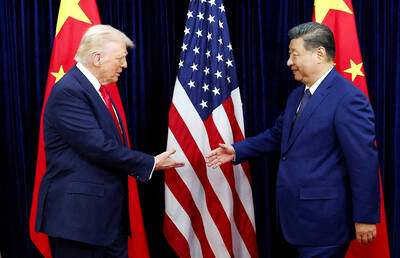
The March/April volume of Foreign Affairs, long a purveyor of pro-China pablum, offered up another irksome Beijing-speak on the issues and solutions for the problems vexing the People’s Republic of China (PRC) and the US: “America and China at the Edge of Ruin: A Last Chance to Step Back From the Brink” rang the provocative title, by David M. Lampton and Wang Jisi (王緝思). If one ever wants to describe what went wrong with US-PRC relations, the career of Wang Jisi is a good place to start. Wang has extensive experience in the US and the West. He was a visiting
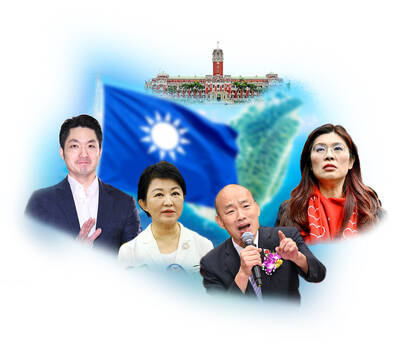
The January 2028 presidential election is already stirring to life. In seven or eight months, the primary season will kick into high gear following this November’s local elections. By this point next year, we will likely know the Democratic Progressive Party (DPP) candidate and whether the Taiwan People’s Party (TPP) will be fielding a candidate. Also around this time, the Chinese Nationalist Party (KMT) will either have already completed their primary, or it will be heading into the final stretch. By next summer, the presidential race will be in high gear. The big question is who will be the KMT’s

If one asks Taiwanese why house prices are so high or why the nation is so built up or why certain policies cannot be carried out, one common answer is that “Taiwan is too small.” This is actually true, though not in the way people think. The National Property Administration (NPA), responsible for tracking and managing the government’s real estate assets, maintains statistics on how much land the government owns. As of the end of last year, land for official use constituted 293,655 hectares, for public use 1,732,513 hectares, for non-public use 216,972 hectares and for state enterprises 34 hectares, yielding


 RSS
RSS