


I’m not interested in remnants of the colonial period as much as Chinese Nationalist Party (KMT) efforts after World War II to erase the Japanese imprint. Recently, I was thrilled to learn of a few old houses in the south that bear Republic of China (ROC) embossed flags on their facades — but where the post-1945 paint job is now so faded it’s possible to see Hinomaru (the Japanese flag) emblems that were the original adornments.
The KMT’s animosity toward Japan was understandable given Japanese aggression and wartime atrocities when it ruled Taiwan as a colony from 1895 to 1945. After 1949, however, Japan was a key trading partner and an important investor. What’s more, Taipei and Tokyo were both closely aligned with Washington. However, Japan’s 1972 decision to break off diplomatic ties with the ROC and establish formal relations with the People’s Republic of China provoked a fresh wave of anti-Japanese sentiment, at least among the ROC leaders.
In his chapter in the 2002 book New Asian Marxisms titled “Making Time: Historic Preservation and the Space of Nationality,” sociologist Marshall Johnson writes that a 1974 ROC Ministry of Interior edict, Main Points on the Elimination of Taiwan Japanese Era Colonial Rule Memorials and Historical Remains Manifesting Japanese Imperialism’s Sense of Superiority, commanded that Shinto shrines be destroyed, as well as the complete elimination of memorials and tablets.
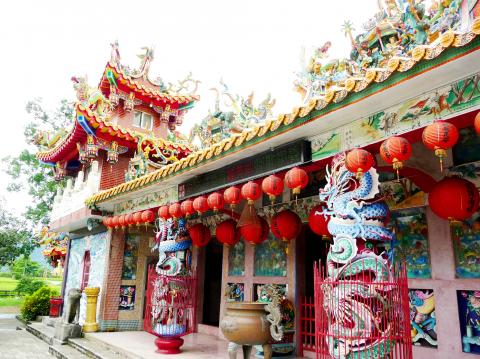
Photo: Steven Crook
Several years ago, after hearing about this edict, I wrote the government and asked if they could tell me how many locations had been affected by the policy, and when (if ever) it had been canceled.
“We have never heard of [such an edict],” they replied. Perhaps they didn’t want to admit that the government had behaved in such a petty manner. Maybe they couldn’t be bothered to find the correct answer. But I should be fair to Taiwan’s bureaucrats: Almost every time I’ve sought information from one or another department, they’ve been helpful.
According to Johnson, “All Japanese stone lanterns and similar fixtures in temples and other public buildings were to be altered (removing the aesthetic quality making them nationally Japanese) or else destroyed,” as were Japanese calendrical inscriptions.
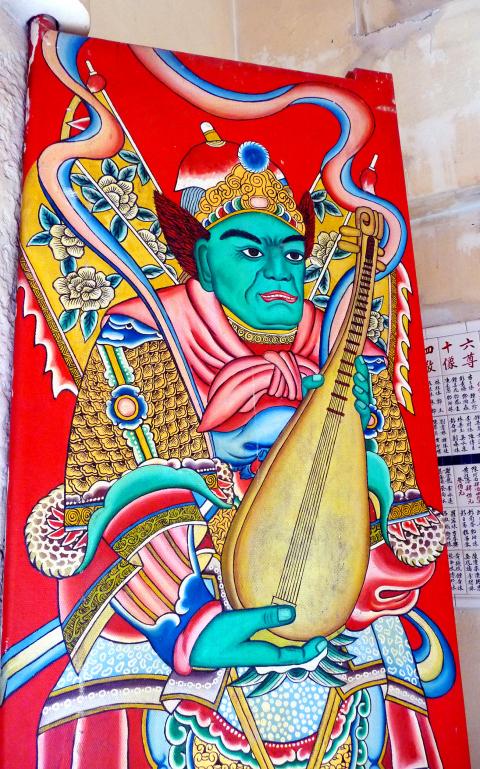
Photo: Steven Crook
One landmark given a Japanese-to-Han makeover years before the rupture in Tokyo-Taipei relations is Bilian Temple (碧蓮寺) in Fengtian (豐田), part of Hualien County’s Shoufeng Township (壽豐鄉).
Even today, this part of eastern Taiwan is thinly populated. Shoufeng has fewer than 18,000 residents. It’s hardly surprising that, when the government of overcrowded Japan took control of Taiwan, they identified this area as suitable for the development of immigrant villages.
The first batch of Japanese settlers arrived in what the colonial regime dubbed Toyota (豐田 in Japanese script, hence “Fengtian” 豐田 in Chinese) in 1913. In addition to housing for immigrants, the authorities built a police station, an elementary school and clinics.
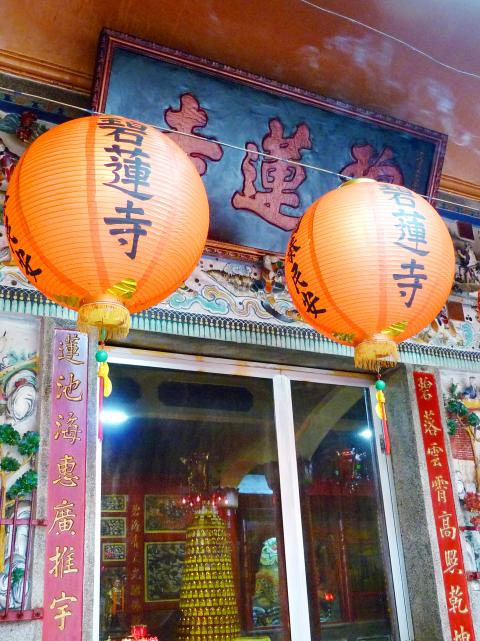
Photo: Steven Crook
A Shinto shrine was consecrated in 1915 and dedicated to the Three Kami Deities of Cultivation (開拓三神), a trio of gods commonly worshiped in frontier regions of the Japanese Empire. Also enshrined here was Prince Kitashirakawa Yoshihisa (1847-1895), a distant relative of an 18th-century emperor and commander of an Imperial Japanese Army division during the 1895 invasion of Taiwan. The prince caught malaria and died near Tainan, after which he was elevated to a kami venerated by Shintoists.
Initially, the shrine’s major annual festival day was June 5. However, this coincided with the busiest time of year for farmers. Also, the heat made additional exertion unwise, so it was changed to Oct. 25.
Soon after the end of World War II, almost all of the Japanese citizens living in Taiwan were repatriated to Japan. Fengtian’s non-Japanese residents converted the Shinto shrine into a Buddhist place of worship. Local elders, it’s said, resisted proposals to demolish or extensively modify the building or its grounds.
However, in 1958 Super Typhoon Winnie blasted a path across Taiwan. The temple’s main building collapsed, so funds were raised to rebuild it as a Chinese-style place of worship. The new structure (address: 1 Mincyuan Street, 民權街1號) was completed in 1962, but several Japanese-era relics were left in place, and it’s these that make the temple worth visiting.
The traditional approach to the Shinto shrine would have been from the intersection of the thoroughfares now called Jhongshan Road (中山路) and Mincyuan Street. The torii gate (舊豐田神社鳥居) erected there a century ago was allowed to stand, because in 1946 it was repurposed as an entrance arch for Bilian Temple.
From the ex-torii, you need to go almost 800m to the southwest to find the temple. As you get close, you’ll see several daidoro, stone or concrete columns more than a meter in height. Kerosene lamps placed inside them illuminated the approach to the Shinto shrine. Bird, moon, and fire motifs are still visible, but the columns bear scars where Japanese-language inscriptions were expunged or covered with cement.
Right in front of the temple, where you’d expect to find guardian lions, there’s a pair of komainu (often called “lion-dogs”). Rather than face outward like guardian lions, they face each other across the temple’s central doorway.
The temple is on the edge of the town, and the fields nearby attract a variety of birds, including Malayan night-herons, Black-winged stilts, and Oriental Pratincoles.
Some other colonial-period buildings within walking distance of Fengtian Train Station have been preserved. The kendo training hall on the campus of Fongli Elementary School (豐裡國民小學) was thoroughly renovated less than two years ago.
A more unusual remnant is the “Wailing Wall” (哭牆) at 29 Dongping Street (東坪街29號), about 1km southeast of Bilian Temple. A Japanese family surnamed Tano (田野) lived here, but the wife died as a result of her second pregnancy. Her grieving husband visited this wall, and with his finger wrote the character tian (田) in the still-wet cement. If you search for it carefully, you’ll find it.

If a leisurely afternoon of high-end dining and watching the scenery roll by from the comfort of a plush armchair sounds like a good time to you, consider a trip on the Sea Breeze (海風號). This culinary, cultural and scenic experience is the perfect setting for a date, a celebratory outing with a small group of friends or a relaxing solo ride. The price tag is steep, especially if you consider the short distance the train actually covers over the 3.5-hour journey. But what you’re paying for on the Sea Breeze isn’t transportation; it’s the comfort, the service, the exclusivity, the

June 15 to June 21 According to legend, a giant from Orchid Island (Lanyu, 蘭嶼) named Si Mangangavang once built a large tatala canoe capable of carrying 16 people. He set sail southward to the Batanes in the Philippines, where he traded with the local Ivatan people. One of the goods they coveted was cowhide, which the Tao people of Orchid Island used to make armor. Through continued trade, the Tao and Ivatan forged close ties, and Si Mangangavang became good friends with a Batanes giant named Si Vakag. This story, collected in a 1998 book by ethnologist Yu Guang-hong (余光弘)
Taiwan’s renewable shortfall is a problem of execution, not resources. Japan’s long-cycle, joined-up energy planning is the model worth studying — but what Taiwan can borrow is the institutional machinery, not the politics. When Nvidia CEO Jensen Huang (黃仁勳) used his visit to Taipei last month to warn that the country needs far more electricity, he was naming a constraint its own planners already know well: Taiwan Power Co (Taipower, 台電) expects demand from the semiconductor and artificial intelligence (AI) sector alone to exceed 5 gigawatts (GW) by 2030. The harder question is not whether to build more capacity but which

One of the wildest things about the reception of Chinese Nationalist Party (KMT) Chair Cheng Li-wun (鄭麗文) in the international media is the way her words are presented without being contextualized, let alone challenged. The Financial Times, for example, interviewing her during her visit to New York, said that she blamed the halt to exchanges between Taiwan and the People’s Republic of China (PRC) for raising tensions. “There has been no dialogue, so you can see that the situation is almost on the brink of war,” the Financial Times quoted her as saying, without any hint that the PRC, not


 RSS
RSS