


Russia is engaged in “classic asymmetric warfare” in Syria by using its military clout to prop up Syrian President Bashar al-Assad, while saying it is attacking Islamic State (IS) militants, British Foreign Secretary Philip Hammond said on Sunday.
Russia last week began striking targets in Syria — a dramatic escalation of foreign involvement in the civil war that has been criticized by the West as an attempt to prop up al-Assad, rather than its purported aim of attacking IS fighters.
“It looks like a classic bit of Russian asymmetric warfare — you have a strong propaganda message that says you’re doing one thing, while in fact you are doing something completely different and when challenged you just flatly deny it,” Hammond said in an interview in Manchester, England.
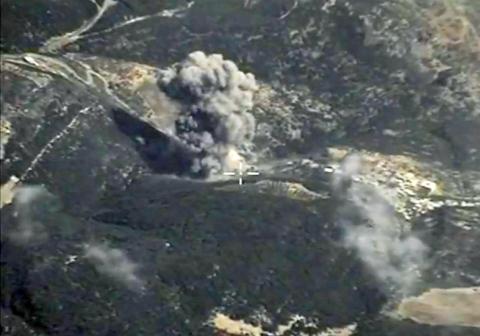
Photo: EPA
He said Britain had held discussions with Russia, but kept on getting the same response — that Moscow was attacking IS militants in Syria.
“You try talking to the Russians,” he said. “They just keep repeating their position — that is by the way also the Iranian position — and it is just incredible.”
He said that Britain needed “absolute clarity” that al-Assad would not be part of Syria’s future.
“That’s not some random bee in the bonnet that I’ve got; it’s that without that commitment, we will never get the broad spectrum of Syrian opposition groups to sit down and agree around a table how we take forward the discussion about Syria’s future,” he said.
Hammond dismissed proposals put forward by Russia and Iran for elections, saying Syria was “a million miles away” from being able to hold a free and fair vote.
“In a country where 250,000 people have been killed and 12 million people have been displaced, half of them outside the country, how can you talk about free and fair elections?” he said.
Hammond said the key to ending the suffering caused by the four-year civil war was a managed transition to peace — even if it meant al-Assad retained power temporarily.
“If the price for doing that is that we have to accept that Assad will remain as titular head of state for a period of time, do I really care if that’s three days, three weeks, three months or even longer? I don’t think I do,” he said.
However, Hammond said that for such a transition, al-Assad should make a pledge not to run in any future election and that he would give up control over Syria’s security apparatus.
He added that there was no agreement with Moscow and Tehran on such a transition.
“The key is that there must be a transition — at the moment there is no agreement with the Russians and the Iranians even that there should be a transition,” he said.
Hammond also said Russia represented a threat to the international system upon which Britain’s security depended, saying it had shown that it did not respect diplomatic norms.
He pointed to Moscow’s annexation of Ukraine’s Crimea region last year as an example of Russian President Vladimir Putin’s approach to international law.
However, he said that Moscow still had an important role to play in the Middle East and that Britain could not afford to ignore Russia’s role in negotiating peace in Syria.
“It would not be in our own interests to say that we will not talk to the Russians about the situation in Syria because we object so strongly to what they are doing in Ukraine,” he said.
“We have to compartmentalize these disputes,” calling for Russia to re-engage with the international system, he said.
“We just need a Russia that accepts there are rules in the system, and you can’t throw your toys out of the pram and resort to military force every time you don’t get your way,” he said.

‘CROSSING THE LINE’: China’s embassy in Seoul criticized US Forces Korea Commander General Xavier Brunson, asking if his ‘hostile’ remarks were authorized by Washington South Korea and the US are in talks over recent public remarks by the commander of US Forces Korea, Seoul’s presidential office said yesterday, after the comments drew sharp criticism from China. In a recent podcast interview, US Forces Korea Commander General Xavier Brunson described South Korea as “the dagger in the heart of Asia” from China’s east coast, prompting the Chinese embassy in Seoul to say that he had “truly crossed the line.” The interview came amid growing speculation that Washington might seek to expand the role of US Forces Korea in countering the growing regional influence of China, a key

Through the noise of rushing papers and whirring belts at a print factory in Kyoto, two creators watch their photo essay come to life in broadsheet form — part of an effort to win new audiences in the age of artificial intelligence (AI). Despite the decline of the publishing industry, self-publication and handmade “zine” magazines are growing in popularity in Japan, reflecting the nation’s enduring love of paper in the digital era. While speaking to Agence France-Presse at the plant, his hands black with ink, one of the creators, Kazuma Obara, said: “I think [paper] is a medium that engages all five

Australian researchers have trained lab-grown brain cells on a silicon computer chip to play the 1990s shooter game Doom and said they are just scratching the surface of what the neurons could be capable of doing. It is the science-fiction work of biotech boffins at Cortical Labs, who researched and developed the technology that harnesses the workings of the brain’s networking system. Each so-called “biological computer” contains about 200,000 living human brain cells, grown from stem cells that were harvested from blood donations. Having mastered the simple computer game Pong, where a paddle is moved up and down to send a ball

France experienced its hottest spring on record, the French weather service said on Tuesday, after an exceptional early heat wave that also broke highs for the season in England and Wales. Meteo-France said the average nationwide temperature over March to May was 13.8°C — about 1.7°C above the norm, and surpassing records set in 2011 and 2020. “The warmest spring since records began in 1900,” it said in a bulletin. All three months were warmer than average, but the onset of an “unprecedented heatwave” late last month pushed the mercury to highs typically seen at the height of the summer. “Our country had never


 RSS
RSS