


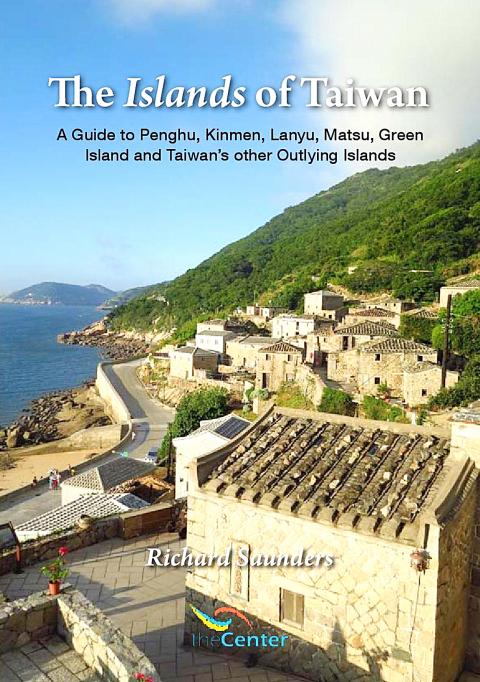
Richard Saunders is back at it again, penning in-depth advice to English-speakers on how to get to and enjoy Taiwan’s most delectable places. He really can’t put a foot wrong, and nor will you if you follow his instructions. He’s the perfect guide — knowledgeable, witty, thorough, and very readable. Those who have followed his hiking guides will immediately know what to expect.
Saunders’ crucial strength, indeed his central characteristic, is his enthusiasm. He invariably makes you want to go to the places he describes, and then keeps you company when you get there. The Islands of Taiwan will consequently be worth its weight in gold to anyone venturing off-shore.
For example, a useful chart at the start grades the islands with marks out of five under a number of heads. For “English Language Friendliness” Orchid Island or Lanyu (蘭嶼) as it is also known, gets one mark, while Green Island (綠島) and Penghu (澎湖島) receive three each. But for “Natural Beauty,” all of the islands are either a four or five. Saunders is nothing if not appreciative.
Saunders is simultaneously amusing and useful. Of one Penghu homestay he writes: “This one is strictly for couples in love and lovers of Taiwan’s unique brand of kitsch cuteness.” Adding to that, he writes about how the island boasts “the best prickly pear cactus smoothie in town. Try the kind with a scoop of cactus ice cream plopped on top — fantastic!”
Penghu’s Magong City is given very thorough treatment and credited with having the best selection of food in all the outlying islands. Penghu’s North Sea and East Sea Islands which are usually only visited by tour groups are also given detailed coverage.
Saunders is both scholarly and responsive to modern-day realities. The latter he usually appreciates rather than decries, referring to one McDonald’s as a “useful landmark.” But he does think the proposal for a casino accepted by Matsu’s (馬祖列島) residents as being an “appalling offer.”
Saunders is outspoken elsewhere too. Of the islands of Dungyin (東引島) and Xiyin (西引島) in the Matsu Islands, he writes that though they are “often considered the most scenic of the Matsu islands,” the interior of Dungyin is “still heavily militarized; and until nature is allowed to take over and soften many a cruel blemish and scar, it’s not a pretty sight.” Lanyu’s Nuclear Waste Storage Facility gets similarly straightforward treatment.
The description of each island is preceded by a short “Don’t Miss” section, followed by “What’s Great” and “What’s Not So Great” sections. Getting to Lanyu is “tricky to arrange” by plane and “uncomfortable” by boat. He recommends trying standby to get a flight to Orchid Island if all else fails — often a good ruse in my experience in other parts of the world. These sorts of remarks by Saunders may be opinionated, but they are useful nonetheless.
Approaching the end of the book, he describes Keelung Island (基隆嶼), Turtle Island (龜山島), Pengjia (彭佳嶼), Mianhua (棉花嶼), and the Huaping Islands (花瓶嶼). Of the lighthouse on the highest tip of Keelung Island he writes: “Up close it’s actually quite a small, stubby little thing. It’s unmanned, of course, and not nearly as romantic as the wonderful, historic old lighthouses on Dongju (東莒) and Dungyin in Matsu, or the fine one on Lanyu.” But the view back to the Taiwan mainland is “tremendous.”
For the rest, there’s “A Short History of Green Island’s Notorious Prisons,” a warning about taking notice of the tide times when crossing certain Penghu causeways uncovered only at low tide. Saunders also says that Kinmen (金門) has “probably the best collection of historic buildings in Taiwan.” Green Island is “Taiwan’s perfect holiday island”, while Matsu is “Taiwan’s best island-hopping destination.”
As for travel onwards from Kinmen to Xiamen in mainland China, it is “quick and simple these days, so long as you’ve arranged a visa before leaving the main island of Taiwan.” This book is awash with useful tips like this.
Typical of Saunders’ flair for giving information in a way that’s likely to be most useful is his description of how to find the office for booking seats on the boat back from Kinmen to Keelung — “behind 7-Eleven; look for the building with large golden characters above the door.” He’s also notably aware of what families with small children need, and hands out advice to them accordingly.
You would never guess from reading this book that Saunders is also an accomplished concert pianist. The late writer Harry Griffin, who used to contribute articles on the UK’s Lake District to The Guardian, was reputed at the time of his death to be planning a book on the Lake District and classical music, identifying this route or that mountain with beloved musical moments. I wonder if Saunders has ever contemplated such a work. He now seems to have covered every Taiwan mountain trail and forsaken island, so he must be wondering what next to turn his hand to.
The book ends with the remote Pratas Islands which, despite Dongsha (東沙), a tiny islet and the only inhabited point, having been designated Taiwan’s seventh National Park in 2007, are currently off-limits to the public.
Writers of guidebooks frequently find that they are engaged on something that’s halfway between a list of phone numbers and a sequence of purple passages. But Saunders navigates this difficult writer’s territory with ease, constantly informing, and then equally touching us with his infectious love for the place.
This is a magnificent book. The tragic plane accident off Penghu in July should not deter visitors to these and other islands, which must constitute some of the most attractive parts of all of Taiwan. If you’re an English-only speaker, this is undoubtedly the book to take with you, but because of its up-to-date-ness and thoroughness it is very likely to prove of interest to Chinese-speakers as well.

During the administration of president Ma Ying-jeou (馬英九) of the Chinese Nationalist Party (KMT), the government began work on the Taoyuan Aerotropolis, a massive project to turn land around Taoyuan airport into a freeport via the largest land expropriation for a single project in Taiwan’s history. For the US$15 billion, 4,700 hectare project, around 3,200 hectares of land were to be seized, displacing over 40,000 people, along with schools and other public infrastructure. The project was a Ma administration centerpiece, announced with great fanfare in 2009 “to lead economic takeoff,” it was later said, while by 2014 then-transportation and communications

People from the US, Taiwan, Vietnam and beyond have paid tribute to Bradley Winterton, 86, a long-time contributor to the Taipei Times, who passed away in Saigon on June 1. He was 86. A veteran journalist, traveler and all-around Renaissance man, Winterton worked for Time Out magazine in Paris, was a book reviewer at Hong Kong’s South China Morning Post, establishing “100 books for Christmas,” before becoming a regular contributor to the Taipei Times, where he drew on his astonishing knowledge of literature and classical music to review books and performances. “Classical music, opera and theater were his passions,” says Terence

On Christmas Eve 2022, Peter Chesson and his wife, Sheue Chiou-rong (許秋容), received some alarming news. The couple learned that the owner of a plot of land adjacent to the one on which they live in Nantou County’s Guosing Township (國姓) had decided to sell, and was telling prospective buyers the site would make an excellent campground. Chesson and Sheue — both hold academic posts in National Chung Hsing University’s (NCHU) Department of Life Sciences — and their neighbors feared that a campsite would bring in more traffic than the area’s narrow roads could handle. What’s more, noisy campers

In Tainan’s Annan District (安南), a pond-pocked wedge of land juts out into the Yanshui Estuary (鹽水溪口). Salt scents the breeze and the soft slapping of water against mangroves is broken only by the occasional dinosaur squawk of an egret in flight. Gazing seawards from the tip of this wedge, Sicao Bridge (四草大橋) separates the observer from the Taiwan Strait, while at the levee’s leeward base, an unassuming sign states, “Mountains to Sea Greenway — 0km.” Casual visitors would likely cycle past without stopping, but for some, this spot marks the beginning of a multi-day adventure from the coast to the


 RSS
RSS