


The sounds, sights and smells of nature have always been a key element to attending a performance by U-Theatre (優人神鼓) at their mountain home on Laoquanshan (老泉山) in Muzha (木柵), Taipei.
Same goes for the hike up the path from the road to the complex. The path is steep, winding and not well lit, which makes flashlights a must for coming back down. What is needed going up, however, is the mantra: “It’s not much farther, we can sit down once there [pause to grab a view breaths while pretending to admire the view] and the show will be more than worth it.”
Since Zen practice and awareness are central tenets of the almost ascetic drumming group, which is famous for its meditation-based movements and long walks around Taiwan and in other countries, encouraging audience members to focus “in the moment” as they huff and puff up the path is all part of the experience.
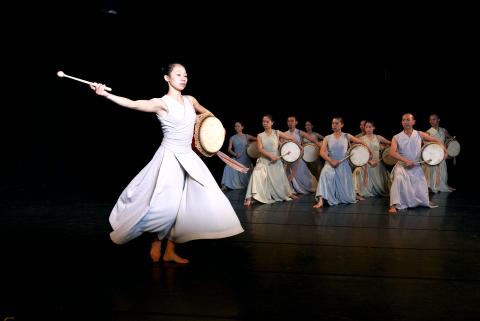
Photo courtesy of U-Theatre
However, this year the troupe is giving people something else to focus on besides pain and shortness of breath.
On the way up to watch Sound of Light (感光。優), the audience will see the illustrations from the Ten Ox Herding Pictures, a sequence of 10 poems and pictures depicting the stages of Zen practice.
They tell of a man who goes looking for his ox, his struggles to tame it (and thereby himself ) and his eventual return home a changed person.
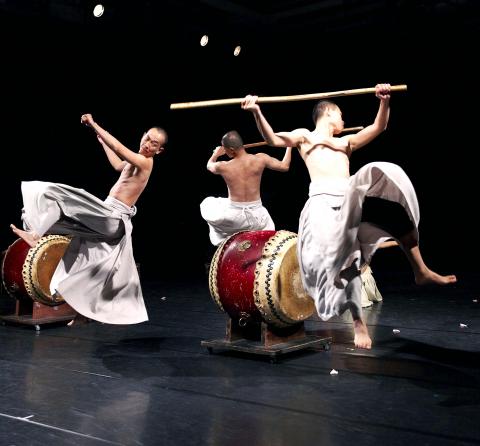
Photo courtesy of U-Theatre
The illustrations will be specially lit, and there will be a real ox, company founder and artistic director Liu Ruo-yu (劉若瑀) said.
The actual 50-minute show itself, divided into four segments, will also incorporate more lighting elements than usual, she said, adding that the goal was to get the audience to “feel the light” as they hear (and feel) the drumming.
The main themes for the music and choreography were also derived from the Ten Ox Herding Pictures.
The show is being coproduced by the Coretronic Culture and Arts Foundation, which was founded last year to encourage light-related research and artistic creations using light and shadows.
As with all their Laoquanshan shows, the troupe is encouraging its audience to use public transportation instead of driving up the mountain. It has arranged for shuttle buses from the Taipei Zoo MRT Station (捷運動物園站) exit 2; look for a staff member wearing a U-Theatre T-shirt or holding a placard. The shuttles will return to the MRT station after the show.

The Portuguese never established a presence on Taiwan, but they must have traded with the indigenous people because later traders reported that the locals referred to parts of deer using Portuguese words. What goods might the Portuguese have offered their indigenous trade partners? Among them must have been slaves, for the Portuguese dealt slaves across Asia. Though we often speak of “Portuguese” ships, imagining them as picturesque vessels manned by pointy-bearded Iberians, in Asia Portuguese shipping between local destinations was crewed by Asian seamen, with a handful of white or Eurasian officers. “Even the great carracks of 1,000-2,000 tons which plied
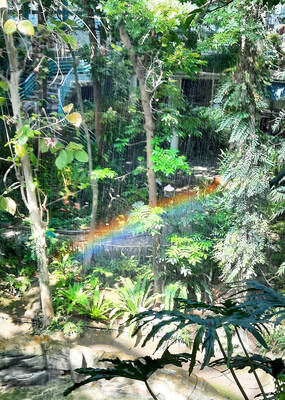
It’s only half the size of its more famous counterpart in Taipei, but the Botanical Garden of the National Museum of Nature Science (NMNS, 國立自然科學博物館植物園) is surely one of urban Taiwan’s most inviting green spaces. Covering 4.5 hectares immediately northeast of the government-run museum in Taichung’s North District (北區), the garden features more than 700 plant species, many of which are labeled in Chinese but not in English. Since its establishment in 1999, the site’s managers have done their best to replicate a number of native ecosystems, dividing the site into eight areas. The name of the Coral Atoll Zone might

On Monday morning, in quick succession, the Chinese Communist Party (CCP) and the Chinese Nationalist Party (KMT) released statements announcing “that the Central Committee of the Communist Party of China and General Secretary Xi Jinping (習近平) have invited KMT Chairwoman Cheng Li-wun (鄭麗文) to lead a delegation on a visit to the mainland” as the KMT’s press release worded it. The KMT’s press release added “Chairwoman Cheng expressed her gratitude for the invitation and has gladly accepted it.” Beijing’s official Xinhua news release described Song Tao (宋濤), head of the Taiwan Work Office of the CCP Central Committee, as
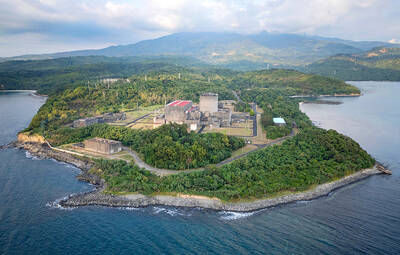
Nuclear power is getting a second look in Southeast Asia as countries prepare to meet surging energy demand as they vie for artificial intelligence-focused data centers. Several Southeast Asian nations are reviving mothballed nuclear plans and setting ambitious targets and nearly half of the region could, if they pursue those goals, have nuclear energy in the 2030s. Even countries without current plans have signaled their interest. Southeast Asia has never produced a single watt of nuclear energy, despite long-held atomic ambitions. But that may soon change as pressure mounts to reduce emissions that contribute to climate change, while meeting growing power needs. The


 RSS
RSS