


Comida Ligera (西班牙市場) is a curious establishment. While it offers diners a perfectly respectable menu of Spanish appetizers, the interior decoration does not bear the slightest resemblance to a sunny cantina in Madrid, or a dimly lit tapas bar in Taipei. First-time patrons are likely to be surprised by the restaurant’s homely appearance and subdued ambiance.
But this less-than-appetizing environment hasn’t deterred food bloggers from putting in good words for the tapas bar, which was set up by seasoned chef Jackie Chou (周維德), who led the kitchen of the Hestia Tapas Bar’s (西班牙小酒館) a year ago and previously served as the executive chef at the Spring Park Urai Spa and Resort (春秋烏來).
Comida Ligera exudes the casualness of a local diner. The restaurant’s blog promises a display case full of the fresh tapas on offer, but on the Monday I visited, it was empty. There was only one young waitress serving three tables of diners, including us, a party of three, for the whole evening. She was helpful, but the hip-hop music she chose to play in the background didn’t mesh with my concept of a tapas bar.
Thankfully, the fare did not disappoint. I ordered eight dishes, which were more than enough.
One of my favorites was the dried coconut and dates with cream cheese (NT$120). Some would say stuffing cream cheese into dates doesn’t require any special culinary skill, but the snack was simply delicious.
The corn and minced chicken balls (NT$60) won unanimous approval with its fragrant sauce made of garlic, saffron and mayonnaise, while the squid salad with tomato and olives (NT$150) just passed muster.
The menu also features a section of stews that includes vegetable and lamb shank (NT$230) and red wine, cherry and bacon (NT$230) versions. The meats on both plates were succulent and bursting with flavor.
Other dishes range from squid and ink paella with grilled squid (NT$320), coca bread (NT$150), shellfish with herbs au gratin (NT$80) and assorted ham and chorizo (NT$380) to fried squid with aioli (NT$150) and potato and chorizo stew (NT$150).
We ordered the highly recommended sweet flan (NT$100), a vanilla egg custard topped with caramel sauce, to wrap up our satisfying meal.
By the time we had polished off a few glasses of sangria (NT$130 each), the restaurant didn’t look so shabby after all.
The drinks menu includes a limited selection of white, red and sparkling wines (NT$1,000 and NT$1,200 per bottle) as well as a decent variety of cocktails (NT$150 to NT$250).
For those who fancy a more formal dining experience, Chou recently opened Cocina de Jackie (傑克廚房), located opposite to Comida Ligera. The new establishment serves a more “creative” menu of Spanish cuisine, according to the restaurant’s blog.
Comida Ligera offers delicious food at wallet-friendly prices, and, luckily, appearances aren’t everything. Be prepared to spend some time locating the restaurant as it is hidden in a maze of alleys near Zhongshan Junior High School MRT Station (中山國中捷運站), where addresses aren’t easy to find.


Yesterday, the Democratic Progressive Party (DPP) nominated legislator Puma Shen (沈伯洋) as their Taipei mayoral candidate, the Chinese Nationalist Party (KMT) put their stamp of approval on Wei Ping-cheng (魏平政) as their candidate for Changhua County commissioner and former legislator Tsai Pi-ru (蔡壁如) of the Taiwan People’s Party (TPP) has begun the process to also run in Changhua, though she has not yet been formally nominated. All three news items are bizarre. The DPP has struggled with settling on a Taipei nominee. The only candidate who declared interest was Enoch Wu (吳怡農), but the party seemed determined to nominate anyone

In a sudden move last week, opposition lawmakers of the Chinese Nationalist Party (KMT) and Taiwan People’s Party (TPP) passed a NT$780 billion special defense budget as a preemptive measure to stop either Chinese leader Xi Jinping (習近平) or US President Donald Trump from blocking US arms sales to Taiwan at their summit in Beijing, said KMT heavyweight Jaw Shaw-kong (趙少康), speaking to the Taipei Foreign Correspondents Club on Wednesday night in Taipei. The 76-year-old Jaw, a political talk show host who ran as the KMT’s vice presidential candidate in 2024, says that he personally brokered the deal to resolve
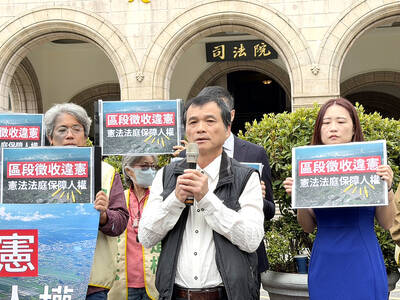
What government project has expropriated the most land in Taiwan? According to local media reports, it is the Taoyuan Aerotropolis, eating 2,500 hectares of land in its first phase, with more to come. Forty thousand people are expected to be displaced by the project. Naturally that enormous land grab is generating powerful pushback. Last week Chen Chien-ho (陳健和), a local resident of Jhuwei Borough (竹圍) in Taoyuan City’s Dayuan District (大園) filed a petition for constitutional review of the project after losing his case at the Taipei Administrative Court. The Administrative Court found in favor of nine other local landowners, but

The Chinese Nationalist Party (KMT) and its sock puppet, the Taiwan People’s Party (TPP), passed their version of the government’s proposed supplementary defense spending bill last week, engendering much commentary. While all eyes were on the defense budget, the PRC’s assault on Taiwan was advancing on other fronts. The removal of domestic drone production and other technologies critical to the nation’s asymmetrical defenses from the list of items purchased in the “compromise” bill shows how the KMT-TPP alliance appears to be serving the People’s Republic of China (PRC). Ironically, the cuts will impact industries heavily represented by tech firms in areas run




 RSS
RSS