


Collecting art may seem like an unaffordable luxury for the average office worker. But for the organizers of Young Art Taipei 2009, buying a piece of art should and can be made as easy as purchasing a laptop computer. Billed as the first contemporary art fair held at a hotel in Taiwan, Young Art Taipei aims to position itself as a venue where novice collectors and art dilettantes meet emerging artists whose work they can afford.
Organized by Taiwan Contemporary Art Link (台灣當代藝術連線), a group consisting of local galleries including Dynasty Art Gallery (朝代藝術) and Aki Gallery (也趣畫廊), the three-day event starts today at Sunworld Dynasty Hotel Taipei (台北王朝大酒店) with 42 participating galleries from Taiwan, China, Japan and South Korea. As implied by the name, a hotel art fair showcases art in hotel rooms, where the space best accommodates small- to medium-sized pieces.
“This particular form of exhibition space encourages creative and unconventional approaches to arranging art works. One can be laid on a bed, hung on the wall or put in the bathroom. Small pieces like toy figurines can easily stand out as visitors inspect each part of the room,” the event’s chief organizer, Natasha Lo (羅健毓), explained.
The low cost for participating galleries — a mere NT$65,000 — also makes it easier for them to promote young and relatively unknown artists.
“To attend an art fair like Art Taipei, a gallery needs to throw in at least NT$500,000 to NT$600,000,” said Dynasty Art Gallery owner Frank Liu (劉忠河). “It is not economical for galleries to bring works that are priced at only NT$20,000. But if you lower the fee, young artists have a better chance to come to the front.”
At the hotel art fair, the key words are contemporary and young, and the focus is on art ranging from video and sculpture to installation and multi-media works by artists aged 45 and under. Prices are NT$8,000 to NT$100,000.
Though Taiwan’s contemporary artists have gained recognition on the international art scene, the market for their art didn’t take off here until three years ago. According to Liu and Galerie Grand Siecle owner Richard Chang (張學孔), the local art market traditionally has been dominated by oil paintings. Contemporary art works accounted for only a fraction of art on display as gallery owners and curators saw them more as museum pieces than works with commercial value. The rise of the Chinese contemporary art market over the past half-decade changed that, and made local collectors interested in contemporary Taiwanese art.
Many collectors turned to Taiwanese art because they believe the market for contemporary Chinese art is already saturated, Chang said.
“The market for Taiwanese art started to skyrocket about two years ago, but because of the global financial crisis, the bubble appears to have burst,” he said.
According to Chang, though most artists under the age of 45 have not had their work sold at auction houses, or on the so-called secondary market, which means their works are relatively affordable, these are the artists who are competitive when it comes to the international market.
“Figures like Chen Chieh-jen (陳界仁) and Michael Lin (林明弘) are always at top of the list when international art publications evaluate Taiwanese artists. Clearly, our strength lies in contemporary art,” Chang said.
Both Liu and Chang agree that local galleries need to join forces with young artists to become a force on the global stage, and Young Art Taipei is a platform for achieving this goal. With a jury comprised of artists and scholars, the art fair aspires to become a professional, touring event that gives local galleries and artists exposure in other countries.
There is no shortage of A-listers on the relatively small and cozy stage of Young Art Taipei. Most noticeable is the presence of Mizuma Art Gallery, a leading Japanese gallery, and its top artist Makato Aida, who has already gained a measure of recognition at auction houses worldwide. Osaka-based Gallery IDF will bring the works of Kiriko Lida, and Gallery Tsubaki will send a few by Mayuka Yamamoto. Both artists are favorites of local collectors. For urban vinyl enthusiasts, Art-U Room will present designer/artist team Tokyo Kanmen’s latest collection, which was inspired by Noh theater.
Platform China Contemporary Art Institute (站台中國) will showcase works by young emerging Chinese artists. Triumph Art Space (藝˙凱旋) makes an interesting contrast by presenting pieces by more established figures in China such as Zhang Kai (張凱).
There are 20 local galleries participating in the fair. In addition to established artists like Tseng Yu-chin (曾御欽), Hua Chien-chiang (華建強), Yao Jui-chung (姚瑞中), Su Meng-hung (蘇孟鴻) and Kuo I-chen (郭奕臣), emerging artists from different parts of Taiwan will gain exposure through galleries such as Quan Artist Agency (有寬藝術), Arthis Fine Art (金禧美術) and Da Xiang Art Space (大象藝術空間館) from Taichung, and Tainan’s Inart Space (加力畫廊).
Many artists, gallery owners and curators will attend, as will delegations from art fairs including Japan’s Art Osaka, Tokyo 101 and Art @Agnes, and South Korea’s Asia Top Gallery Hotel Art Fair.
Artist and jury member Wang Jun-jieh (王俊傑) says Japanese galleries excelled during the review process because they seemed to best understand the strengths and limitations of a hotel art fair.
“One of our [the five jury members’] suggestions is to include curated sections in future editions [of Young Art Taipei],” Wang said. “All well-known art fairs around the world have curated sections that define what [the organizers] want to encourage and emphasize.”
EXHIBITION NOTES:
WHAT: Young Art Taipei 2009 — Contemporary Hotel Art Fair (台北國際當代藝術博覽會)
WHEN: Today to Sunday from 11am to 8pm
WHERE: Sunworld Dynasty Hotel Taipei
(台北王朝大酒店), 100 Dunhua N Rd, Taipei City (台北市敦化北路100號)
ADMISSION: NT$120 at the door
ON THE NET: www.youngarttaipei.com/en/index.html
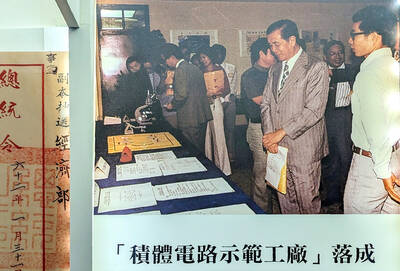
Oct. 27 to Nov. 2 Over a breakfast of soymilk and fried dough costing less than NT$400, seven officials and engineers agreed on a NT$400 million plan — unaware that it would mark the beginning of Taiwan’s semiconductor empire. It was a cold February morning in 1974. Gathered at the unassuming shop were Economics minister Sun Yun-hsuan (孫運璿), director-general of Transportation and Communications Kao Yu-shu (高玉樹), Industrial Technology Research Institute (ITRI) president Wang Chao-chen (王兆振), Telecommunications Laboratories director Kang Pao-huang (康寶煌), Executive Yuan secretary-general Fei Hua (費驊), director-general of Telecommunications Fang Hsien-chi (方賢齊) and Radio Corporation of America (RCA) Laboratories director Pan
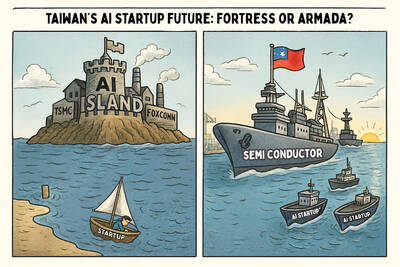
President William Lai (賴清德) has championed Taiwan as an “AI Island” — an artificial intelligence (AI) hub powering the global tech economy. But without major shifts in talent, funding and strategic direction, this vision risks becoming a static fortress: indispensable, yet immobile and vulnerable. It’s time to reframe Taiwan’s ambition. Time to move from a resource-rich AI island to an AI Armada. Why change metaphors? Because choosing the right metaphor shapes both understanding and strategy. The “AI Island” frames our national ambition as a static fortress that, while valuable, is still vulnerable and reactive. Shifting our metaphor to an “AI Armada”
The consensus on the Chinese Nationalist Party (KMT) chair race is that Cheng Li-wun (鄭麗文) ran a populist, ideological back-to-basics campaign and soundly defeated former Taipei mayor Hau Lung-bin (郝龍斌), the candidate backed by the big institutional players. Cheng tapped into a wave of popular enthusiasm within the KMT, while the institutional players’ get-out-the-vote abilities fell flat, suggesting their power has weakened significantly. Yet, a closer look at the race paints a more complicated picture, raising questions about some analysts’ conclusions, including my own. TURNOUT Here is a surprising statistic: Turnout was 130,678, or 39.46 percent of the 331,145 eligible party

The older you get, and the more obsessed with your health, the more it feels as if life comes down to numbers: how many more years you can expect; your lean body mass; your percentage of visceral fat; how dense your bones are; how many kilos you can squat; how long you can deadhang; how often you still do it; your levels of LDL and HDL cholesterol; your resting heart rate; your overnight blood oxygen level; how quickly you can run; how many steps you do in a day; how many hours you sleep; how fast you are shrinking; how


 RSS
RSS