


This is an outstanding book, quite possibly the best general book on modern China to have appeared in the last few years. The author is a 38-year-old native of Missouri who's been freelancing in China since 1999, mostly for The New Yorker. His first book, River Town described his life teaching English in the Sichuan Province. Oracle Bones is his second book, and it spans the whole of China, in place and time.
Hessler's aim is to show the country through the lives of ordinary individuals. But he also has academic interests - in history, ethnology and especially in the evolution of written Chinese. So the book's structure is a loose assemblage of varied experiences - preparations for the Beijing Olympics, filming in the Gobi desert, visiting the North Korean border, life in Shenzhen, even a trip to Taiwan - but with continuity provided by the changing fortunes of key individuals. Added to this is the evolving story of the discovery, interpretation and preservation of the oldest existing examples of written Chinese, the inscribed divinatory fragments known as oracle bones.
The book holds the reader tenaciously with this two-pronged approach. You settle down to it knowing you'll find something new and intriguing, but also anxious to find out how a former student is getting on with his girlfriend, or how an Uighur drinking companion is faring as a wheeler-dealer immigrant in Washington DC.
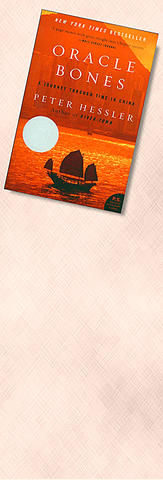
The book opens with the bombing of the Chinese embassy in Belgrade in 1999. No one he meets believes it was accidental - how could an advanced country like America make such an elementary mistake? The author warms to a young Uigher money-changer in Beijing when the youth challenges a restaurant full of angry Chinese by asking why, if the US was so advanced and so malicious in intent, it only managed to kill three journalists? The pair walk out to stunned silence. The Uigher goes on to fly to the US, armed with doubtful documents, and successfully claim political asylum.
Hessler studied English Literature at both Princeton and Oxford, but he wears his learning lightly. Sometimes it shows, though, as when he's sleeping out in a guardhouse on the Great Wall in a sandstorm and echoes the ending of a famous story by James Joyce. But his tone is everywhere self-effacing and quietly ironic, so you're not surprised that he doesn't point out the reference specifically, any more than he gives away any details about his personal life.
Hessler's great strength is being open with everyone. One moment he's listening to a taxi driver, the next he's interviewing the greatest American authority on Chinese characters. He observes elections in Taiwan and (at village level) in China with equal interest, though it's obvious where his sympathies lie. Democratic Taiwan is "an experiment, an experiment for the mainland," Hsinchu's then vice-mayor Lin Cheng-chieh (林正杰) tells him. Also in Taiwan, he discusses the author Edward Said with Sisy Chen (陳文茜).
But his real purpose in coming to Taiwan was to talk to the now-deceased archaeologist and scholar Shih Chang-ju (石璋如) at Academia Sinica. In 1936, Shih had overseen the excavation of the largest cache of oracle bones ever found in China. Hessler particularly wanted to ask him about a figure who constitutes another thread running through the book, the Chinese archaeologist Chen Mengjia (陳夢家).
One of the pioneering oracle bones scholars, Chen hanged himself during the Cultural Revolution. His book on ancient Chinese bronze heads in foreign hands, later given the title Our Country's Shang and Zhou Bronzes Looted by American Imperialists, is recognized by scholars as supremely authoritative. During the brief Hundred Flowers period in 1957, Chen was prominent in voicing opposition to the simplification of the traditional Chinese characters, for which he was shortly afterwards sent to a labor camp.
The account of the movement for simplifying Chinese characters, or possibly replacing them altogether, is one of the book's set pieces. In his early days of power, Mao Zedong (毛澤東) favored a Western-style alphabet, and one had actually been in use among Communist cadres in the 1940s. Mao eventually opted for simplification after Stalin advised him in 1949 that a great country like China should have its own form of writing rather than mimic someone else's. Thus the oldest writing system still in use anywhere in the world survives in China, albeit in attenuated form.
Almost all educated Chinese people secretly agreed with Chen in opposing the changes. To them, writes Hessler, using simplified characters was - and is - "like walking thru the Kwik-mart 2 by sumthing."
Hessler hasn't lost his old enthusiasm for teaching either - much of this book is a deliberate exercise in expanding his readers' sympathies. He introduces Chinese words, for instance, first in romanized form, then as characters, so that after reading all 491 pages you've become familiar with not an insignificant amount of simple Chinese.
I felt sad after finishing Oracle Bones. It's a rich and varied book, but part of it is a tribute to the educated elites who suffered so much after 1949. Time will change everything, Hessler concludes, but China's suffering was real for millions of individuals, as was the extraordinary resilience of those who endured.
Peter Hessler began his life in China teaching students about the US. Now he's engaged in teaching Americans - and happily many of the rest of us too - about what it's like living in a country he sees as, in characteristic mind-set at least, similar to the US. I suspect that one day this hugely engrossing book will be regarded as a classic, and I can't recommend it too highly.

By global standards, the traffic congestion that afflicts Taiwan’s urban areas isn’t horrific. But nor is it something the country can be proud of. According to TomTom, a Dutch developer of location and navigation technologies, last year Taiwan was the sixth most congested country in Asia. Of the 492 towns and cities included in its rankings last year, Taipei was the 74th most congested. Taoyuan ranked 105th, while Hsinchu County (121st), Taichung (142nd), Tainan (173rd), New Taipei City (227th), Kaohsiung (241st) and Keelung (302nd) also featured on the list. Four Japanese cities have slower traffic than Taipei. (Seoul, which has some
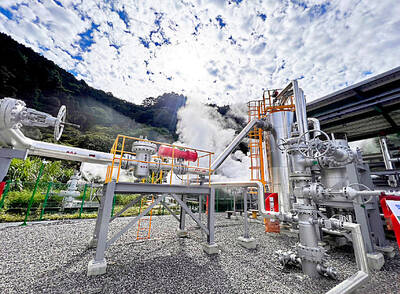
Taiwan’s semiconductor industry consumes electricity at rates that would strain most national grids. Taiwan Semiconductor Manufacturing Co (TSMC) alone accounted for more than 9 percent, or 2,590 megawatts (MW), of the nation’s power demand last year. The factories that produce chips for the world’s phones and servers run around the clock. They cannot tolerate blackouts. Yet Taiwan imports 97 percent of its energy, with liquefied natural gas reserves measured in days. Underground, Taiwan has options. Studies from National Taiwan University estimate recoverable geothermal resources at more than 33,000 MW. Current installed capacity stands below 10 MW. OBSTACLES Despite Taiwan’s significant geothermal potential, the

In our discussions of tourism in Taiwan we often criticize the government’s addiction to promoting food and shopping, while ignoring Taiwan’s underdeveloped trekking and adventure travel opportunities. This discussion, however, is decidedly land-focused. When was the last time a port entered into it? Last week I encountered journalist and travel writer Cameron Dueck, who had sailed to Taiwan in 2023-24, and was full of tales. Like everyone who visits, he and his partner Fiona Ching loved our island nation and had nothing but wonderful experiences on land. But he had little positive to say about the way Taiwan has organized its
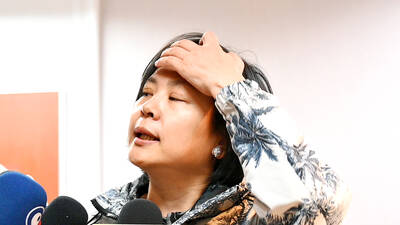
The entire Li Zhenxiu (李貞秀) saga has been an ugly, complicated mess. Born in China’s Hunan Province, she moved to work in Shenzhen, where she met her future Taiwanese husband. Most accounts have her arriving in Taiwan and marrying somewhere between 1993 and 1999. She built a successful career in Taiwan in the tech industry before founding her own company. She also served in high-ranking positions on various environmentally-focused tech associations. She says she was inspired by the founding of the Taiwan People’s Party (TPP) in 2019 by Ko Wen-je (柯文哲), and began volunteering for the party soon after. Ko


 RSS
RSS