


Sonika Kaliraman remembers how her father, Indian wrestling legend Chandgi Ram, used to share newspaper articles among his daughters to inspire them with stories of women doing well in different fields.
One day he showed them a couple of clippings, and said: "This is what you girls are going to be like."
His three daughters were elated, looking at a picture of Bollywood star Priyanka Chopra who was crowned Miss World in 2000.
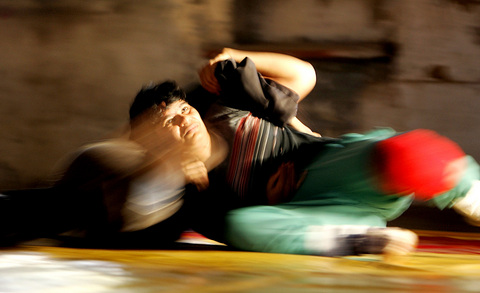
PHOTOS: AFP
"I was so happy, I thought he's going to put us in modeling," recalled the six-foot [1.8m] Kaliraman, 23, wearing a gray shirt, black lycra pants and a bandage on her sprained ankle at her father's wrestling training camp in New Delhi.
But her dad pushed forward two other pictures — of Laila Ali, daughter of boxing champion Muhammad Ali, who was winning boxing bouts in 2000, and south Indian Karnam Malleswari, who won an Olympic gold in Sydney for weightlifting.
Even though she grew up in a wrestling camp, Kaliraman remembers being horrified, thinking she would end up unmarried, and with nothing to show for her sporting life but broken bones.
But at 72kg, she is now one of India's leading female wrestlers and has won championships in neighboring Haryana and Punjab states, where the sport is adored.
"I couldn't have got a better opportunity," said Kaliraman, who says an Indian wrestler can make almost US$14,000 in prize money in a good year.
In India, sport can also be a ticket to a better life, with government agencies and the police forces keen to give good athletes jobs to improve their sports teams.
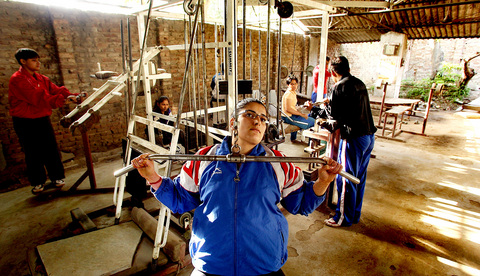
"Winning feels great. How to stop yourself from getting beaten up no matter what — that's wrestling. It's do-or-die, beat or be beaten," said the young wrestler.
She went to the Asian games at Doha, and though she didn't win there, another Indian female wrestler, Geetika Jakhar, came away with a silver medal.
Kaliraman now hopes to make it to next year's Beijing Olympics after women's wrestling became an Olympic event for the first time in 2004.
The Wrestling Federation of India says it has been promoting the women's sport more in recent years, following the lead of the Swiss-based International Federation of Associated Wrestling Styles.
There are now about 200 professional women wrestlers in India, the Indian body said, compared to 1,000 men.
Kaliraman, who loves competing, says the sport transformed her from a timid teenager into someone who can intimidate men into silence.
"In our communities, girls are taught to stay at home, to be scared, as if you are something to be eaten up," said the heavyweight wrestler.
"Now I am so frightening, no boy dares to say a thing to me. This is a rough-tough game and your mind gets rough and tough."
As she and her sisters participated in bouts in Haryana and Punjab, where mud wrestling among men has long been a popular village sport, families would flock to see the famed wrestler's daughters.
PHOTO: AFP
And other girls began to ask how they could take up the sport. Many of the nine or 10 girls staying at Chandgi Ram's camp on the banks of the Yamuna say their parents supported their choice.
"In Haryana everyone knows Chandgi Ram. I heard that his daughters do it and he had a wrestling camp," said short-haired Kamlesh, 22, whose husband also lives at the camp but does not wrestle.
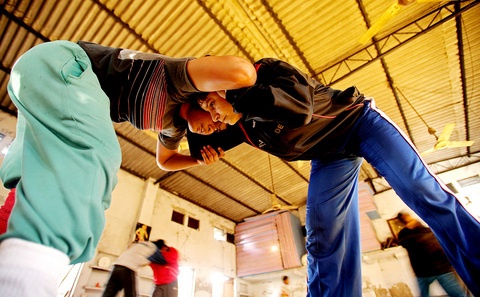
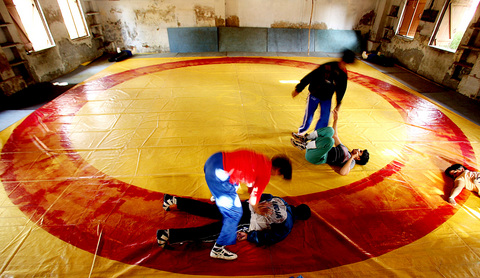
From 4pm to 7pm every evening, as the sun filters through a large ramshackle room with mats on the floor, the girls, wearing T-shirts and track pants, perform warm-ups before doing paired combat, as male coaches supervise.
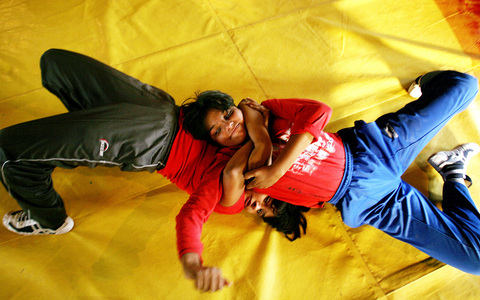
PHOTO: AFP
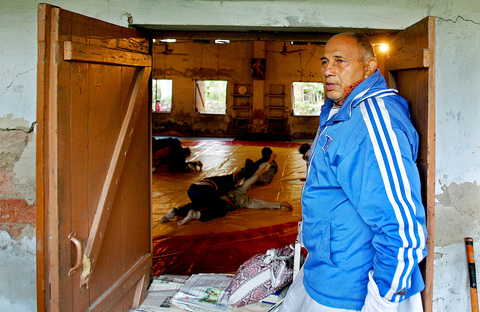
During the training session, Chandgi Ram, who is now in his seventies, sits outside in front of a red Hanuman Temple, dedicated to the vigorous monkey god revered by Indian wrestlers.
"We want medals. If girls can win medals then let's train girls," said Chandgi Ram, matter-of-factly, about his decision to begin training women at his camp.
"In India there's opposition for women everywhere. But we have to go forward."
Sudesh, a 14-year-old from Haryana, said that she had faced some criticism for being a wrestler, though not from her parents.
"Older people get more upset but girls are doing well in it," said Sudesh, who has been training for two years. Unlike many Indian girls, she is far from thinking about marriage.
"Not 'til I bring some medals."
If one asks Taiwanese why house prices are so high or why the nation is so built up or why certain policies cannot be carried out, one common answer is that “Taiwan is too small.” This is actually true, though not in the way people think. The National Property Administration (NPA), responsible for tracking and managing the government’s real estate assets, maintains statistics on how much land the government owns. As of the end of last year, land for official use constituted 293,655 hectares, for public use 1,732,513 hectares, for non-public use 216,972 hectares and for state enterprises 34 hectares, yielding

The small platform at Duoliang Train Station in Taitung County’s Taimali Township (太麻里) served villagers from 1992 to 2006, but was eventually shut down due to lack of use. Just 10 years later, the abandoned train station had become widely known as the most beautiful station in Taiwan, and visitors were so frequent that the village had to start restricting traffic. Nowadays, Duoliang Village (多良) is known as a bit of a tourist trap, with a mandatory, albeit modest, admission fee of NT$10 giving access to a crowded lane of vendors with a mediocre view of the ocean and the trains
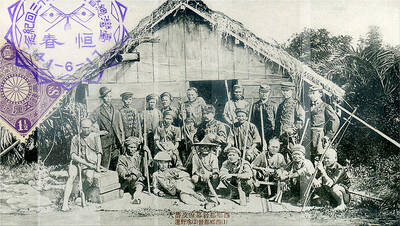
Traditionally, indigenous people in Taiwan’s mountains practice swidden cultivation, or “slash and burn” agriculture, a practice common in human history. According to a 2016 research article in the International Journal of Environmental Sustainability, among the Atayal people, this began with a search for suitable forested slopeland. The trees are burnt for fertilizer and the land cleared of stones. The stones and wood are then piled up to make fences, while both dead and standing trees are retained on the plot. The fences are used to grow climbing crops like squash and beans. The plot itself supports farming for three years.
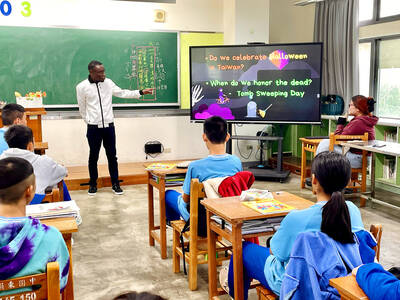
For many people, Bilingual Nation 2030 begins and ends in the classroom. Since the policy was launched in 2018, the debate has centered on students, teachers and the pressure placed on schools. Yet the policy was never solely about English education. The government’s official plan also calls for bilingualization in Taiwan’s government services, laws and regulations, and living environment. The goal is to make Taiwan more inclusive and accessible to international enterprises and talent and better prepared for global economic and trade conditions. After eight years, that grand vision is due for a pulse check. RULES THAT CAN BE READ For Harper Chen (陳虹宇), an adviser


 RSS
RSS