

When Mughal emperor Jahangir first visited Kashmir in the 17th century and saw Dal Lake in Kashmir, he famously exclaimed, "If there is paradise on earth, it is here, it is here, it is here" -- an opinion Indian families over the generations have endorsed by holidaying there at least once in their lifetimes.
But things have changed. Dal Lake surrounded by the snow-capped Himalayas, meadows, pine forests, cherry orchards, and saffron fields, is dying. Pollution from the nearby city of Srinagar and over-development along its shores as well as the hundreds of picturesque houseboats and the expansion of horticultural operations on the lake water itself have all taken their toll. Experts fear unless drastic action is taken, within a 100 years Dal Lake will simply become a marsh.
In a generation, the lake has shrunk by half. From being 5m deep just ten years ago it is now, in places, less than 3m deep as silt and debris from the horticultural operations -- or floating gardens -- have built up and the untreated sewage, flowing into the water from Srinagar, which has only one sewage treatment plant, has promoted a massive growth of choking weeds.
The foul water is also alarming local doctors who have now branded Jahangir's paradise a health hazard.
"We're already seeing rising cases of dysentery, hepatitis and other waterborne diseases," said Bilkees Ara, a senior scientist with the Kashmir State Pollution Control Board.
Which probably will come as no surprise to the many tourists who still flock to the area. For anyone dipping their hands into the lake, the opaque water running through their fingers feels dense, almost alive. The weed, thick as ropes, shifts just beneath the surface like a monster. Fifty thousand tonnes of the stuff is believed to die off each year and sink to the lake floor -- its decomposition adding to the water's pollution load.
"The boat ride was the best part of our trip," said Vanessa Volpato, a visitor from France. "It was so peaceful on the lake and wonderful to see people going about their daily chores in boats -- like Venice. But in some areas it smelt so bad we had to cover our faces."
For a state that has already been ravaged by 16 years of civil strife as militant groups have battled over the Indian state -- either for outright independence or an Anschluss-type union with Pakistan -- the slow death of Dal Lake will be another blow to local pride.
But despite some local fears about funds earmarked for sorting the lake out going astray there are hopes of a cleaner future.
India's high court, ruling on a public interest petition filed by a Kashmiri law student, has ordered the government to get cracking on several fronts: more sewage treatment plants, a dredging program to clear all the weeds, and the removal of the floating gardens and illegal homes.
And the Kashmir government has started to act. Two new sewage plants currently under construction will soon come on line to add to the one already in operation and giant weed harvesters -- a step up from men with nets who over the years have been fighting a losing battle with the thriving vegetation -- now trawl the waters.
Kashmir used to be known as the Switzerland of the East and if a song-and-dance sequence required a Swiss setting, Bollywood directors used to shoot it here. Local people are hoping that, if Dal Lake can be saved, they will be able to lay claim once again to that description.

There was a time when Chinese master Yuan Shimao thought martial arts were all about punching and kicking. As a young practitioner, he focused on speed and strength. “I trained that way for many years without becoming still enough to search within myself,” said Yuan, who founded a kung fu academy in central China in 2004. “But as you gradually settle into stillness, you begin to understand what the scriptures mean by spirit,” he added. “You can begin to rediscover yourself.” That process is known as “entering the Dao” in martial arts. It is a guiding principle at Yuan’s academy in the sacred

There was a time, a few decades ago, when the men who owned the world’s biggest pornography businesses were happy to be famous. They paraded a lifestyle they hoped looked glamorous, appearing in public dressed in silk pajamas or with a woman in swimwear on each arm. Porn moguls like Hustler’s Larry Flynt or Playboy’s Hugh Hefner were household names. “Say what you want about these old perverts, who once set the tone of our sexual culture, but at least you knew who they were and what they were selling,” Patricia Nilsson writes in her new book, Guilty Pleasure: The Pornification

In 1904 the Japanese introduced caning to Taiwan. As a punishment, caning was applied by the Japanese to Taiwanese and Chinese subjects, never to the Japanese themselves (it had been outlawed in Japan in 1882). An imperial and colonial act, caning thus functioned to define and display social class boundaries. So it is with the new legislation permitting caning proposed by Chinese Nationalist Party (KMT) legislators last week. According to the KMT proposal, individuals committing major fraud, aggravated sexual assault, driving under the influence of drugs and child abuse may be subject to caning. These are high-profile offenses that generate great
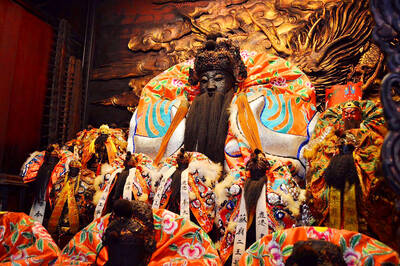
OCT. 5 to OCT. 11 Many worshippers of Taoist deity Lord Su (蘇府王爺) had never witnessed his “north-south grand inspection tour” of central Taiwan. The historic procession last took place in 1969, and before that, in 1893. Lukang’s Fengtian Temple (奉天宮) in Changhua County last Sunday completed Lord Su’s sixth grand inspection tour ever, featuring its three main statues. Why did it take 57 years for the event to happen again? Temple officials say the procession is held only when a spirit medium receives instructions from Lord Su. Folklorist Lee Hsiu-e (李秀娥) writes in a study of Fengtian Temple’s grand


 RSS
RSS