


It was a very strange night last Friday at Taipei's cinemas. A sea of people were crammed in Ximending, Warner Village and Showtime Cinemas to see Kung Fu Hustle (功夫). Tickets for all screenings that night had been booked or were sold out. The huge crowd made Warner Village and Showtime Cinema show extra screenings until 3am.
A cinema owner said it had been a long time since they had stayed up so late for a film. Even more unusual was that was for a Chinese-language film.
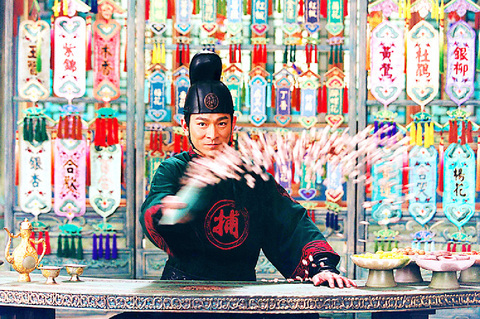
Stephen Chow's (
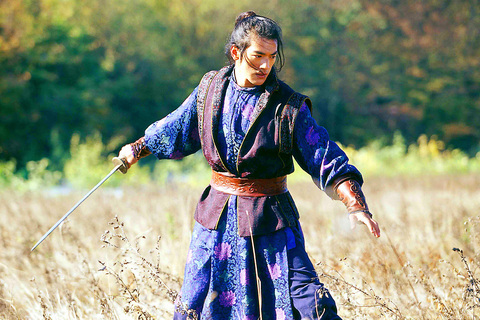
PHOTO COURTESY OF FOX MOVIES
Kung Fu Hustle was the biggest dark horse movie this year. Before the film opened, the best-selling film in Taiwan this year had been the disaster film The Day After Tomorrow. Tomorrow, which grossed NT$180 million in Taiwan and set a first-day box-office record of NT$10 million. But this record was broken last Friday night by Kung Fu Hustle, with the crowds of people on Friday night causing a box office take of NT$15 million.
Kung Fu Hustle will not only beat Hollywood films and top the box office chart for 2004, but it has another record to break -- namely, to overtake the record of Crouching Tiger, Hidden Dragon (

PHOTO COURTESY OF FOX MOVIES
The 2004 box office in Taiwan has slightly improved from a SARS-stricken 2003. The second best-selling foreign film was Harry Potter and the Prisoner of Azkaban, grossing NT$134 million. Spiderman 2 stands at third, taking NT$132 million. And the fourth and fifth place was a battle between The Last Samurai and The Incredibles. The former took NT$102 million and the latter now has taken NT$95 million and is still on general release.
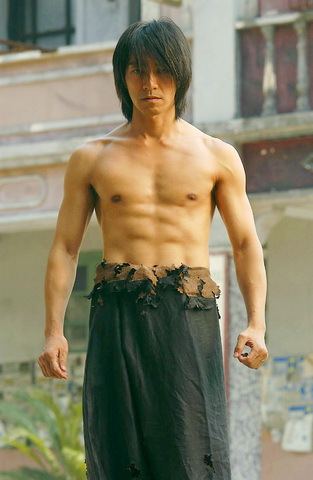
PHOTO COURTESY OF PANDASIA
Such a ranking is not so different from that of the US chart, except for The Last Samurai, which fell out of the top 10 in the US domestic chart but stayed high in Taiwan. Taiwanese audiences are loyal to Tom Cruise.
As for Chinese-language films, Kung Fu Hustle took top place, easily, and pushed Zhang Yi-mou's (
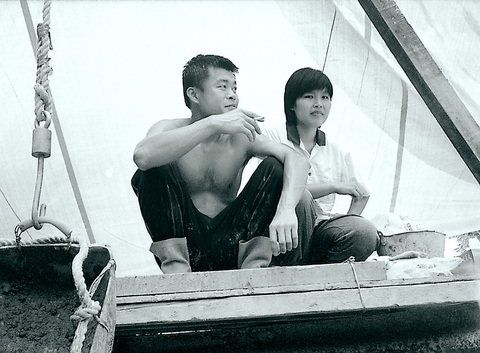
PHOTO COURTESY OF FULL SHOT FOUNDATION
Wang Kar Wai's (
The most surprising film was Taiwanese documentary Gift of Life (
Another source of Taiwanese pride is Formula 17 (
Formula 17 was made with a tiny budget of NT$6 million, but grossed NT$5.3 million in Taiwan. In addition to NT$8 million in overseas sales, selling rights to nine countries including US, Japan, Germany and Benelux, the film was, perhaps, the only profit-making Taiwanese film this year.
Apart from the two Taiwanese films, the rest of the films on the chart are all Hong Kong action or horror films. Horror and action continue to be the selling elements for Chinese-language films. The only exception is Silvia Chang's (
Top 10 Foreign Films
1. The Day After Tomorrow, NT$180 million
2. Harry Potter and the Prisoner of Azkaban,
NT$134 million
3. Spiderman 2, NT$132 million
4. The Last Samurai, NT$102 million
5. The Incredibles, NT$95 million
6. Troy, NT$94 million
7. I, Robot, NT$85 million
8. Shrek 2, NT$76 million
9. Van Helsing, NT$70 million
10. Resident Evil: Apocalypse, NT$49 million
Top 10 Chinese-language films
1. Kung Fu Hustle, NT$100 million (up to Dec. 27)
2. House of Flying Daggers, NT$35 million
3. 2046, NT$11 million
4. Gift of Life, NT$10 million
5. New Police Story (
6. The Eye 2 (
7. Three, Experiences (
8. Jiang Hu (
9. Formula 17, NT$5.38 million
10. 20, 30, 40, NT$4.45 million

Taiwan’s English education system is being pulled apart by three opposing forces. Bilingual Nation 2030 pulls students toward English and global communication. Artificial Intelligence (AI) readiness pulls them toward digital judgment, verification and AI-mediated work. But Taiwan’s old exam culture pulls them back toward memorization, grammar drills, timed reading and correct answers. If the education system keeps using old exams to define success, it risks producing graduates who are neither genuinely bilingual nor genuinely AI-ready, but trained for tasks machines can already perform. The first force is Bilingual Nation 2030. Launched in 2018, the policy aimed to “help Taiwan’s workforce connect

It seems every few days one bumps into one of those “real man” comments in which Taiwan is urged to “face reality” or similar, and “make a deal,” with the speaker implying that soon it will be too late. “Deal” advocates always present themselves as having a superior grip on reality, and the manly ability to make the “hard choice.” Their testosterone-laden language often echoes that of Taiwan sellout advocates. Note that such commentary always specifies a process (“make a deal, work with, make progress”), never the end state of what occupation by a violent authoritarian colonialist state will entail. In

There are shadowy cabals plotting to sell out Taiwan to be annexed by China, by invasion if necessary. Fortunately, they are buffoons. In 2019, former Bamboo Union gangster and founder of the China Unification Promotion Party (CUPP), Chang An-le (張安樂, colorfully known as “White Wolf”), led a protest at the Legislative Yuan against comments made by then-premier Su Tseng-chang (蘇貞昌) that in the event of an attack by China, he would never surrender, but would protect the nation by fighting to the end, even if he only had a broom. Chang had party members bring a wooden casket that they
June 1 to June 7 "If all Taiwanese were as afraid of dying as you, then what would happen?” Physician Shih Chiang-nan (施江南) reportedly said this to his wife Chen Chiao-tung (陳焦桐) after she urged him to stop intervening on behalf of Taiwanese soldiers stranded overseas after serving in the Japanese Army during World War II. Shih had clashed with high-ranking officials over the issue, engaged in several heated arguments with Taiwan governor-general Chen Yi (陳儀) and allegedly shouted at general Ko Yuan-fen (柯遠芬), chief of staff of the Taiwan Garrison Command, over


 RSS
RSS