


If Alex Yang's (
Basically, the story of Taipei 21 is the dialectic between love and bread. Is love something people try to escape from? Or the hardship of earning a crust? Or is bread a necessity for love?
Director Yang tries to ask these questions by telling the story of a 20-something couple, Hsiao-chin (Lin Meng-chin (
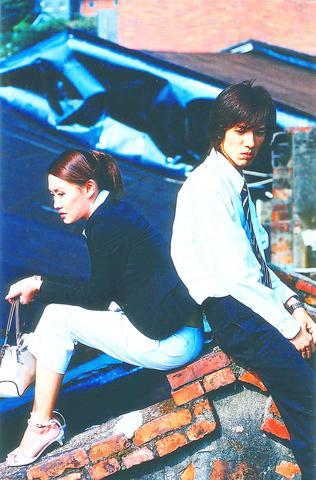
PHOTO COURTESY OF CNPC
A-hong and his girlfriend Hsiao-chin are typical office workers making a living in Taipei. They have been going out for seven years. A-hong is a housing agent and Hsiao-chin is a clerk at a fashion boutique.
Everyday he wears his cheap suit, rides his second-hand motorbike around the streets of Taipei, posting house-for-sale ads on poles. She is always elegantly-clad but in reality she also lives in a shabby house with family debts.
She has a father who is a gambler, a mom having an affair with the father's creditor, a criminal older brother who lives at home with his drug-addict wife and a baby daughter.
In the beginning of the film, one sees the typical scenery of Taipei. People work hard every day, earning just enough to pay the rent. Working class people struggle to run away from the stigma of their class.
This may be too stereotyped and one may find the beginning part boring, but as the movie goes on, more drama, wit and humor come into play.
On A-hong's birthday, Hsiao-chin gives an ultimatum: either buy a house and get married, or she will go abroad to stud. A-hong cannot even afford to rent a decent flat for the two to live in, let alone buy a house. The seven-year relationship immediately faces a crisis.
The latter part of the story tells about how the couple deals with their supposed break-up. By revealing their situations to friends and colleagues, we all realize what kind of problems they can face choosing between bread and love.
There is some witty dialogue between A-hong and his rich Japanese friend. "You rich people are so strange that you like to buy up everything, even memories and friendships and put them into your little private museum.
"You Taiwanese think about money too much! You only know about making money but don't know how to cherish things around you."
There are also humorous subplots, such as Hsiao-chin's short affair with a rich middle-aged man.
Yang used to be the assistant director/script writer and actor for renowned director Edward Yang (
Unfortunately, like the lead characters choosing between love and money, the movie itself looks tentative, switching from social realism to pure entertainment. As such, it occasionally falls between the two. The photography and narrative looks a bit slow but the story tries to attract younger audiences. Young Taiwanese may need a little patience to finish this film about their own lives.

Taiwan’s English education system is being pulled apart by three opposing forces. Bilingual Nation 2030 pulls students toward English and global communication. Artificial Intelligence (AI) readiness pulls them toward digital judgment, verification and AI-mediated work. But Taiwan’s old exam culture pulls them back toward memorization, grammar drills, timed reading and correct answers. If the education system keeps using old exams to define success, it risks producing graduates who are neither genuinely bilingual nor genuinely AI-ready, but trained for tasks machines can already perform. The first force is Bilingual Nation 2030. Launched in 2018, the policy aimed to “help Taiwan’s workforce connect
It seems every few days one bumps into one of those “real man” comments in which Taiwan is urged to “face reality” or similar, and “make a deal,” with the speaker implying that soon it will be too late. “Deal” advocates always present themselves as having a superior grip on reality, and the manly ability to make the “hard choice.” Their testosterone-laden language often echoes that of Taiwan sellout advocates. Note that such commentary always specifies a process (“make a deal, work with, make progress”), never the end state of what occupation by a violent authoritarian colonialist state will entail. In

There are shadowy cabals plotting to sell out Taiwan to be annexed by China, by invasion if necessary. Fortunately, they are buffoons. In 2019, former Bamboo Union gangster and founder of the China Unification Promotion Party (CUPP), Chang An-le (張安樂, colorfully known as “White Wolf”), led a protest at the Legislative Yuan against comments made by then-premier Su Tseng-chang (蘇貞昌) that in the event of an attack by China, he would never surrender, but would protect the nation by fighting to the end, even if he only had a broom. Chang had party members bring a wooden casket that they
June 1 to June 7 "If all Taiwanese were as afraid of dying as you, then what would happen?” Physician Shih Chiang-nan (施江南) reportedly said this to his wife Chen Chiao-tung (陳焦桐) after she urged him to stop intervening on behalf of Taiwanese soldiers stranded overseas after serving in the Japanese Army during World War II. Shih had clashed with high-ranking officials over the issue, engaged in several heated arguments with Taiwan governor-general Chen Yi (陳儀) and allegedly shouted at general Ko Yuan-fen (柯遠芬), chief of staff of the Taiwan Garrison Command, over


 RSS
RSS