


In the latter half of the 19th century, thousands of young men came to Asia to seek their fortune, find adventure or to preach the word of God. Some of these intrepid figures ended up playing pivotal roles in the region's history. Among such figures as Richard Hart and Chinese Gordon is George Leslie Mackay who left his mark on Taiwan at his far-away outpost of Tamsui.
Taiwan, as it has sought to establish a stronger national identity over the last 10 years, has elevated Mackay to become a respected person of considerable importance to the nation. No doubt aiding his rise in status to historical icon is his missionary work for the Presbyterian Church, which has nurtured a number of leading Taiwanese political figures, not least former president Lee Teng-hui (
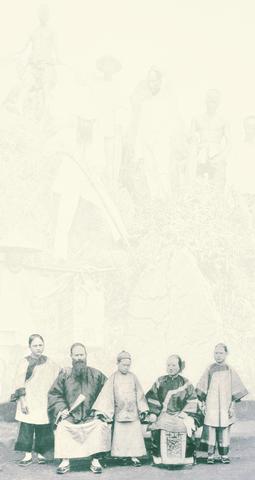
June 3 will mark the 100th anniversary of Mackay's death from throat cancer. Since May, various organizations have held activities to commemorate his life and work, ranging from academic seminars to church services. These events will culminate on June 2 in the opening of the an exhibition of Mackay's collection of Aboriginal artifacts from the Royal Ontario Museum at the Shung Ye Museum of Formosan Aborigines (
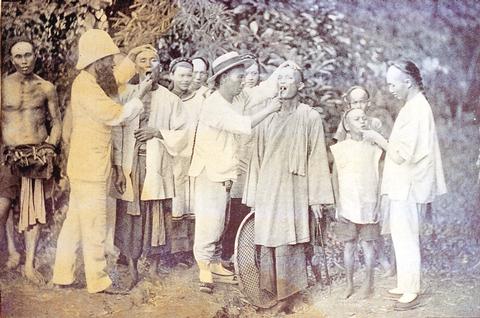
PHOTO COURTESY OF THE TAIWAN PRESBYTERIAN CHURCH
Mackay's influence in northern Taiwan, while considerable during his lifetime, did not endure long after his death. The reason, according to Michael Stainton of York University, is that he was a distinctly odd fellow and had few of the dashing qualities that made his fellow Canadian, Norman Bethune, such a popular hero in China. Belonging to one of the most established missionary networks in Asia -- the Presbyterian Church -- Mackay was nonetheless not an establishment figure, and the church has avoided associating itself too closely with a man who had little patience for the church's attempts to control him.
Chen Chi-rong (
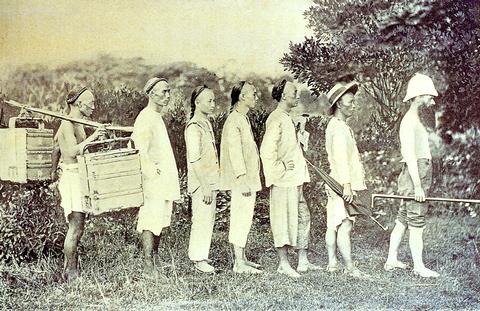
PHOTO COURTESY OF THE TAIWAN PRESBYTERIAN CHURCH
Walking through the shaded courtyard, Chen spoke of Mackay as a kind of grandfather figure rather than a national icon. Mackay identified very closely with Taiwan, which led him, in contravention of the moral code of his time, to marry a "Chinese lady." On Dec. 17, 1877, Mackay wrote in a letter justifying his controversial marriage that, "as I from my heart believe that Chinese and Canadian's are exactly the same in the presence of our Lord I act accordingly." Such principled thinking has helped make Mackay a foreigner who can be safely venerated in Taiwan without evoking controversial memories of colonialism.
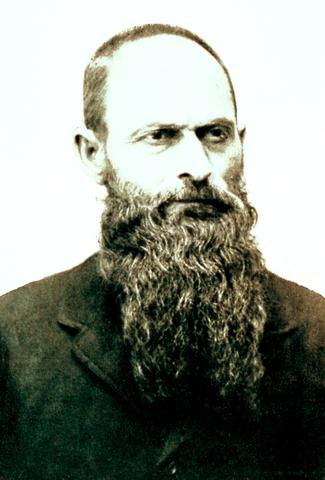
PHOTO COURTESY OF THE TAIWAN PRESBYTERIAN CHURCH
"He was very committed to this land, in a way that was different from that of other missionaries," said Chen.
Pastor Lin Chang-hua (林昌華), who is currently working on a bilingual edition of Mackay's diaries, agreed it was Mackay's degree of assimilation -- often to the outrage of his superiors -- which led to the missionary being embraced by the contemporary architects of a Taiwanese consciousness.
"Mackay had been in China and had worked with the mission in southern Taiwan. It was not until he came [to Tamsui] that he felt he had found the place God intended for him," Lin said. "His anxiety about [whether he would] find such a place was evident from his earlier writings."
"While in Taiwan, his diary shows that he wanted to be much more than just a missionary. His ambition was to have an encyclopedic knowledge of Taiwan." This may explain why, unlike most missionaries who were happy enough to master Hokkien, Mackay decided to conduct research into the language. By creating a written form of Taiwanese using a Romanized script to the relatively barbarous north, he was creating the foundations of a Taiwanese intelligentsia.
A product of this literate class was former president Lee Teng-hui, who in 1997, during a celebration of the 125th anniversary of Mackay's arrival in Taiwan expressed the "deepest gratitude for the selflessness Dr Mackay exhibited toward our land and the people of Taiwan."
Stainton speculates that the building up of Mackay's status was, in part at least, an attempt to undermine the ethnic elements that plagued efforts to promote a Taiwanese identity by emphasizing instead a heartfelt commitment to Taiwan.
Prior to the late 1980s, Mackay had no place within the KMT's state-sponsored "history." Ironically, the most common appearance of the surname Mackay is in the Mackay Memorial Hospital (馬偕紀念醫院), which in fact refers to a different Mackay -- a ship's captain from Windsor, Ontario whose widow made a donation for the construction of a hospital. George Leslie Mackay, though acquiring fame among trivia buffs for pulling over 22,000 teeth during his career in Taiwan, used medicine simply as a tool in his evangelical work.
His contribution to education was much more significant, with the foundation of Oxford College -- the endowment raised in Mackay's home of Oxford, Ontario -- and the creation of the Tamsui Girl's School in 1883, a revolutionary step at that time.
But if this had been his only achievements, it is unlikely that his name would have been resurrected with such fanfare. As Chen commented, "we remember him for our own contemporary reasons, which may be very different from the reasons he had as his own purpose." Current political considerations aside, Mackay's writings are an invaluable resource for learning more about Taiwan in the second half of the 19th century and the upcoming celebrations are giving some impetus to the long-delayed publication of Mackay's diaries.
Publication of the 12-volume diary is currently being discussed with the Lantien (
The most widely read book by Mackay is On Far Formosa, which is a compilation of notes taken by the missionary during a return visit to Canada to report to his superiors in 1880. His talks on Formosa generated such interest that the Reverend J. A. Macdonald compiled the book, which is still widely available.
Pastor Lin Chang-hua said he began work on the hand-written manuscripts of Mackay's diaries in 1988, but only last year began to dedicate himself full-time to the task, giving up all his pastoral responsibilities.He attributes the lack of previous research on Mackay to the Presbyterian Church's disinterest in its own history. It was not until the 1980s, when there was a greater interest in Taiwan's past, did the possibility of publishing the journals even emerge, and even then there was resistance by members within the church who maintained that the diaries were private documents.
Translation of the diaries, some written in what must have once been elegant bound volumes and others on tattered exercise books, is no easy task for the compiler given Mackay's wild handwriting. The greatest difficulty Lin now faces is in "identifying people [mentioned in the diaries], for there is not much [corroborative] information."
But now that moves to commemorate Mackay are going ahead, information about the man has become much more available. The Presbyterian Church has established a Web site providing extensive information about Mackay and his activities in Taiwan. The Web site is located at http://mackay.pctmedia.com.tw
For your information:
Activities in honor of George Leslie Mackay:
June 1: issue of commemorative NT$25 stamps by the Directorate General of Posts, MOTC.
June 2 to Sept. 13: an exhibition of Mackay's collection of Aboriginal artifacts from the Royal Ontario Museum at the Shung Ye Museum of Formosan Aborigines.


Taiwan’s English education system is being pulled apart by three opposing forces. Bilingual Nation 2030 pulls students toward English and global communication. Artificial Intelligence (AI) readiness pulls them toward digital judgment, verification and AI-mediated work. But Taiwan’s old exam culture pulls them back toward memorization, grammar drills, timed reading and correct answers. If the education system keeps using old exams to define success, it risks producing graduates who are neither genuinely bilingual nor genuinely AI-ready, but trained for tasks machines can already perform. The first force is Bilingual Nation 2030. Launched in 2018, the policy aimed to “help Taiwan’s workforce connect

“Taiwan’s Opposition Leader Comes to US With a Message Straight Out of Beijing” read a May 31 headline in the Wall Street Journal. Top US administration officials and members of Congress almost certainly read the WSJ, and if there was a bullet point takeaway that people in Washington should absorb ahead of Chinese Nationalist Party (KMT) Chair Cheng Li-wun’s (鄭麗文) arrival in DC on June 9, that headline is it. The last few columns have discussed this very topic, and the timing is not coincidental. While those top officials likely do not read the Taipei Times, judging by the number
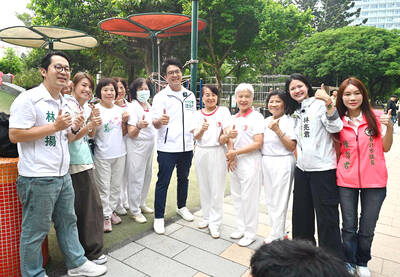
With weighty, anxiety-inducing geopolitical topics dominating the headlines, checking in on the wild and weird state of local politics can take some of the edge off. This November’s elections will determine who will be in charge of fixing potholes in your neighborhood, not the potholes in Taiwan’s complicated geopolitical space. Recently, after an online interview with a Taipei-based journalist, I commented that Taipei journalists never go further than the MRT can take them. He laughed and agreed. Naturally, the Taipei mayoral race is eating up much of the press attention. TAIPEI CITY Democratic Progressive Party (DPP) candidate Puma Shen (沈伯洋) has
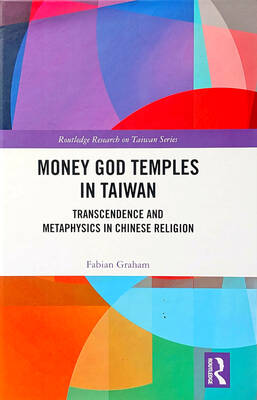
As someone who normally steers clear of books with “transcendence” or “metaphysics” in their subtitles, this reviewer — a casual observer of local belief systems since the 1990s — found Fabian Graham’s Money God Temples in Taiwan a challenging read. Those who’ve only dipped their toes into temple culture will likely need to parse several sections with special care if they’re to keep up with the author, a British ethnographic researcher whose previous books have investigated religious practices among ethnic Chinese in Southeast Asia. This scholarly volume examines a facet of Taiwan’s religious landscape that didn’t exist a century ago, and


 RSS
RSS