


Hidden Whisper (小百無禁忌), Vivian Chang's (章蕙蘭) feature film debut, which will open at the Majestic Theater tomorrow, will be given two screenings with English subtitles on Nov. 16 and Nov. 17.
Foreign residents in Taiwan have long complained that they are not able to enjoy local films unless they have advanced Chinese language skills. In July, the Central Motion Picture Corporation (
According to Mingson Chou (
Hidden Whispers is divided into three segments that present a child of five years old, an adolescent of 17, and a woman of 30. The movie avoids answering whether these characters are the same person or different people, whether one segment affects another, and which elements are fantasy or reality.
Vivian Chang has considerable experience as a producer of short films, and received her leg up into features working on Sylvia Chang's Tonight Nobody Goes Home and Tsai Ming-liang's The Hole. She will be present for a 20-minute Q&A session at the end of the two special screenings.
The film was nominated for the Camera d'Or award for cinematography at the Cannes Film Festival in May this year and has since received mention at the Edinburgh Film Festival and at the Pusan International Film Festival.
The English language subtitled version will be shown at the 8pm screening on Thursday Nov. 16 and Friday Nov. 17 at the Majestic Theater.
The film with regular Chinese subtitles will be shown at the Majestic Theater from tomorrow until Nov. 24.
INFO: For more information, contact Mingson Chou at tel: (02) 2381-2742 or check out additional information at url: http://www.oriented.org/index.shtml.
WHERE: The Majestic Theater is located at 7F, 116 Hanchung Street, Taipei (
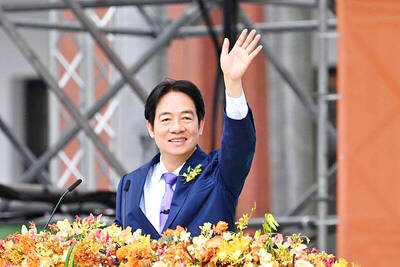
President William Lai (賴清德) yesterday delivered an address marking the first anniversary of his presidency. In the speech, Lai affirmed Taiwan’s global role in technology, trade and security. He announced economic and national security initiatives, and emphasized democratic values and cross-party cooperation. The following is the full text of his speech: Yesterday, outside of Beida Elementary School in New Taipei City’s Sanxia District (三峽), there was a major traffic accident that, sadly, claimed several lives and resulted in multiple injuries. The Executive Yuan immediately formed a task force, and last night I personally visited the victims in hospital. Central government agencies and the
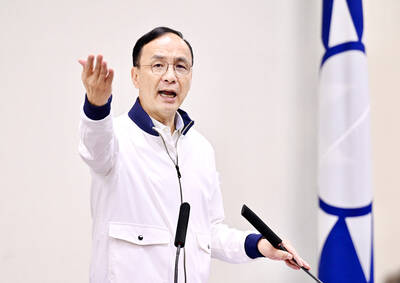
Australia’s ABC last week published a piece on the recall campaign. The article emphasized the divisions in Taiwanese society and blamed the recall for worsening them. It quotes a supporter of the Taiwan People’s Party (TPP) as saying “I’m 43 years old, born and raised here, and I’ve never seen the country this divided in my entire life.” Apparently, as an adult, she slept through the post-election violence in 2000 and 2004 by the Chinese Nationalist Party (KMT), the veiled coup threats by the military when Chen Shui-bian (陳水扁) became president, the 2006 Red Shirt protests against him ginned up by
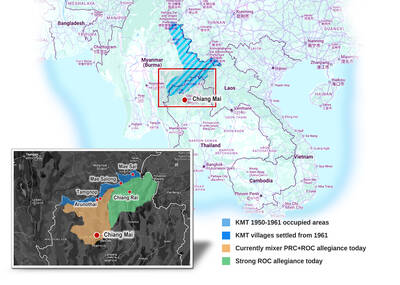
As with most of northern Thailand’s Chinese Nationalist Party (KMT) settlements, the village of Arunothai was only given a Thai name once the Thai government began in the 1970s to assert control over the border region and initiate a decades-long process of political integration. The village’s original name, bestowed by its Yunnanese founders when they first settled the valley in the late 1960s, was a Chinese name, Dagudi (大谷地), which literally translates as “a place for threshing rice.” At that time, these village founders did not know how permanent their settlement would be. Most of Arunothai’s first generation were soldiers
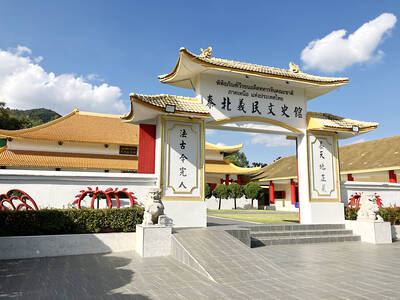
Among Thailand’s Chinese Nationalist Party (KMT) villages, a certain rivalry exists between Arunothai, the largest of these villages, and Mae Salong, which is currently the most prosperous. Historically, the rivalry stems from a split in KMT military factions in the early 1960s, which divided command and opium territories after Chiang Kai-shek (蔣介石) cut off open support in 1961 due to international pressure (see part two, “The KMT opium lords of the Golden Triangle,” on May 20). But today this rivalry manifests as a different kind of split, with Arunothai leading a pro-China faction and Mae Salong staunchly aligned to Taiwan.


 RSS
RSS