

China’s new entry and exit regulations officially took effect on Tuesday, and the Mainland Affairs Council (MAC) has warned that the new rules expand authorities’ discretion in enforcing entry and exit controls.
Matters such as import and export controls, and national security could serve as grounds for restricting a person’s departure. In certain cases involving national security or investigations, authorities might even withhold from someone the fact that they have been barred from leaving the country, as well as the reasons and avenues for appeal. For Taiwanese businesspeople, high-tech workers and semiconductor professionals who frequently travel across the Taiwan Strait, what they should consider is not whether they can get into the country, but whether they would be allowed to return home.
Every country has the right to control its borders, and national security can be a legitimate reason to restrict freedom of movement. The question is what constraints are placed on that power. Administrative agencies are generally required to justify any unfavorable actions. This is because if the parties involved do not know what conduct was deemed problematic or what legal basis was invoked, it is difficult to present evidence or challenge the application of the law. When the reasons are withheld, avenues for legal recourse become meaningless.
This issue is particularly important for Taiwan’s technology industry. When tech workers cross borders, they carry more than just luggage — they carry smartphones, laptops, cloud accounts, work e-mails and technical documents. When export and import controls, and national security are incorporated into exit restrictions, companies can no longer treat the risk of traveling to China as a mere matter of business trip management. They should first establish what data can be carried across the border, which files cannot be downloaded onto personal devices and how employees should respond if they are asked to provide electronic data.
The government should also provide more detailed risk advisories. Tourists, semiconductor research and development managers, sales staff with access to customer data and civil servants who have handled sensitive government operations face different legal and information security risks. The government could develop specific guidelines based on industry, job responsibilities and sensitivity of information to which people have access — including who should avoid carrying work devices, which data should be removed in advance and where family members and employers can seek assistance when someone is barred from leaving China.
Businesses should also incorporate this issue into their corporate governance frameworks. Semiconductor, artificial intelligence, information and communications technology and precision manufacturing companies should review their policies on business travel to China and assess whether meetings could instead be conducted in a third country or via video conference. If travel to China is absolutely necessary, companies should provide dedicated devices that do not contain sensitive data and establish daily check in and emergency response procedures. This is not a call for companies to halt all cross-strait business dealings, but to assess the risks in light of the changing legal environment.
For cross strait exchanges to be sustainable, participants must be able to reasonably predict their legal situation. Following the implementation of China’s new regulations, the government should continue to issue risk warnings, and companies should re-evaluate their travel and information security policies.
Eason Chen is an engineer.
Translated by Kyra Gustavsen

Taiwan’s domestic political situation is following recognizable political rhythms, while the international environment surrounding Taiwan is undergoing a major transformation. Within Taiwan, there are ongoing battles between the legislative and executive branches over the budget, and between cities and the central government over resources. Tensions between political parties dominate headlines and consume much of the attention of party leaders. Jockeying is underway for local elections this November and national elections in 2028. And the longstanding philosophical debate inside Taiwan over how best to protect Taiwan and promote the good life remains unresolved. Amidst all of this, Taiwan continues to function well. It
In an article published on Tuesday in The Atlantic, titled “Will Taiwan Just Give Up?”, journalist Simon Shuster emphasizes the unpredictability of the US as an ally under US President Donald Trump and cites diminishing faith in the US as a contributor to what he sees as waning determination to resist China. As the title suggests, Shuster views a deal between Taiwan and China as an increasingly inevitable alternative to a costly war — one that Taiwan, lacking reliable allies and military capabilities, would eventually be destined to lose. He focuses on Chinese Nationalist Party (KMT) Chairwoman Cheng Li-wun (鄭麗文) — her
With candidate registration for this year’s local elections closed on Sept. 4 and the elections less than 80 days away, Democratic Progressive Party (DPP) Legislator and Taipei mayoral candidate Puma Shen’s (沈伯洋) rapidly growing popularity has become the focus of political talk shows and online discussions over the past week, heating up the mayoral election race in Taipei. Local media headlines and political pundits have picked up his supporters’ slogan “ocean current” (洋流) — a play on the last character of Shen’s name, which literally means “ocean” (洋), and the character (流), which can mean “current,” “flow” or “trend” — to
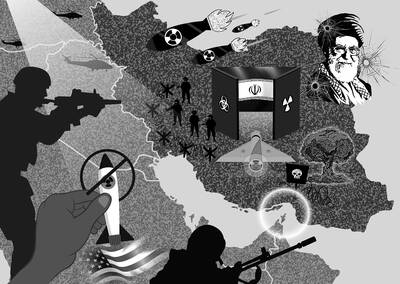
When was the last time you heard a meaningful proposal to prevent Iran from developing a nuclear arsenal? There has been nothing on the subject since the June Memorandum of Understanding between the US and Iran; the promised 60 days of talks to settle questions around Tehran’s uranium-enrichment program never began and have long since expired. When the war was launched, on Feb. 28, a resolution of the nuclear dispute was prominent among the dizzying array of US and Israeli aims to explain the attack. But as should be clear by now, the attempt was entirely reliant on achieving regime change. That


 RSS
RSS