

China’s military activities in the Taiwan Strait and South China Sea are becoming increasingly aggressive and provocative. Retired US admiral James Ellis Jr, who led two US Navy carrier strike groups to stabilize the situation in the waters surrounding Taiwan during the 1996 Taiwan Strait missile crisis, last week warned that the power struggle has not ended, but has significantly intensified and spread to other regions.
Ellis supported the proposal of President William Lai’s (賴清德) administration to increase defense spending and modernize the armed forces, with emphasis on uncrewed aerial vehicles (UAV) and drones.
He also warned that: “If national defense is used as a tool to pursue short-term partisan interests, the only beneficiary is the adversary.”
Although Ellis did not specify a party, his statement highlighted growing international concerns over the opposition-controlled legislature’s obstruction of Taiwan’s defense budgets.
The Chinese Nationalist Party (KMT) and the Taiwan People’s Party delayed the review of this year’s general budget for more than 300 days and blocked several military procurement funds, severely affecting military planning.
A proposed NT$1.25 trillion (US$39.21 billion), eight-year special defense budget to boost Taiwan’s UAV industry was also slashed; instead, the opposition forced through an act that incorporated drone-related funding into the annual budget, making budget allocation much more time consuming and uncertain.
Although the Cabinet countersigned the act, the change has triggered worries and criticisms that it would undermine Taiwan’s drone development, especially as proposals for this year’s supplementary defense budgets and next year’s general budget are still stuck in the legislature, with further deliberation uncertain.
As China’s escalating military activities threaten stability in the First Island Chain and in the Indo-Pacific region, countries such as Japan, South Korea and the Philippines have raised defense spending.
The Japanese government ordered the rapid enhancement of its asymmetric warfare capabilities; announced an “Interceptor Drone Early Acquisition Program” to speed and scale up mass production of domestic drone airframes; and shortened the timeline of drone procurement and production from years to just 80 days — an astonishingly efficient mechanism and policy shift to upgrade the country’s combat ability.
Meanwhile, Taiwan’s opposition parties are politicizing and blocking defense budgets and military procurements, impeding the armed forces’ modernization, and exacerbating the military imbalance across the Taiwan Strait and raising international allies’ concerns about Taiwan’s resolve to defend itself. Ultimately, such actions benefit only China and its ambition to take Taiwan.
With US President Donald Trump and Chinese President Xi Jinping (習近平) set to meet for another summit next week, Beijing has been generating media buzz to emphasize that the Taiwan issue is a “red line” and that the meeting could be canceled if Washington approves new arms sales to Taipei. That shows Chinese pressure to weaken Taiwanese defense would continue and intensify.
A nation’s defense and deterrence should not be weakened by political division or party interests. Taiwan’s stability and security should be a common goal among Taiwanese.
US Representative John Moolenaar, who previously warned that “Taiwan’s cuts to its defense budget is sending the wrong message to international allies,” on Tuesday told a delegation of visiting KMT legislators in Washington that “political disputes and delays over higher defense spending had raised concerns among Taiwan’s partners.”
“It will be essential for the KMT to follow through and provide the resources needed to deliver on Taiwan’s plans to build critical defense capabilities,” he said.
Ellis said that in 1996, in the face of China’s missile launches, Taiwan completed its first direct presidential election and showed the world that missiles could not prevent Taiwanese from choosing their own future.
Thirty years on, Ellis believes Taiwan could again counter China’s growing threats with its determination and resilience.
An Institute for National Defense and Security Research survey found that the majority of Taiwanese believe that “investment in defense is an investment in national security.”
The government and political parties should overcome their differences and work together to bolster national defense. Otherwise, the public would again remove obstructions to Taiwan’s defense through ballots, and demonstrate their determination to fight for the nation’s security and sustainability.

Taiwan’s domestic political situation is following recognizable political rhythms, while the international environment surrounding Taiwan is undergoing a major transformation. Within Taiwan, there are ongoing battles between the legislative and executive branches over the budget, and between cities and the central government over resources. Tensions between political parties dominate headlines and consume much of the attention of party leaders. Jockeying is underway for local elections this November and national elections in 2028. And the longstanding philosophical debate inside Taiwan over how best to protect Taiwan and promote the good life remains unresolved. Amidst all of this, Taiwan continues to function well. It
In an article published on Tuesday in The Atlantic, titled “Will Taiwan Just Give Up?”, journalist Simon Shuster emphasizes the unpredictability of the US as an ally under US President Donald Trump and cites diminishing faith in the US as a contributor to what he sees as waning determination to resist China. As the title suggests, Shuster views a deal between Taiwan and China as an increasingly inevitable alternative to a costly war — one that Taiwan, lacking reliable allies and military capabilities, would eventually be destined to lose. He focuses on Chinese Nationalist Party (KMT) Chairwoman Cheng Li-wun (鄭麗文) — her
With candidate registration for this year’s local elections closed on Sept. 4 and the elections less than 80 days away, Democratic Progressive Party (DPP) Legislator and Taipei mayoral candidate Puma Shen’s (沈伯洋) rapidly growing popularity has become the focus of political talk shows and online discussions over the past week, heating up the mayoral election race in Taipei. Local media headlines and political pundits have picked up his supporters’ slogan “ocean current” (洋流) — a play on the last character of Shen’s name, which literally means “ocean” (洋), and the character (流), which can mean “current,” “flow” or “trend” — to
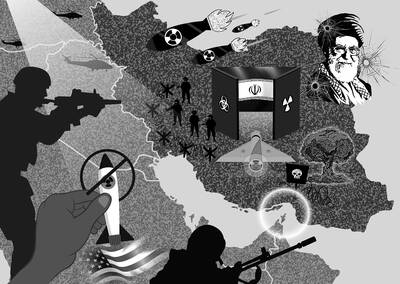
When was the last time you heard a meaningful proposal to prevent Iran from developing a nuclear arsenal? There has been nothing on the subject since the June Memorandum of Understanding between the US and Iran; the promised 60 days of talks to settle questions around Tehran’s uranium-enrichment program never began and have long since expired. When the war was launched, on Feb. 28, a resolution of the nuclear dispute was prominent among the dizzying array of US and Israeli aims to explain the attack. But as should be clear by now, the attempt was entirely reliant on achieving regime change. That


 RSS
RSS