

The flurry of new defense agreements signed by Japan suggests Tokyo is attempting to reshape its own security posture. This shift would come in response to China’s geopolitical advances, compounded by the growing unreliability of the US and the associated risks of strategic disengagement.
New security alignments among US allies and partners, which affect various strategic arenas, are increasingly viewed as a reaction to the purported decline of US global leadership during US President Donald Trump’s administration.
The “Mecca Joint Defense Agreement,” signed last month by Saudi Arabia, Turkey and Pakistan, is seen in a similar light: as an effort by key US allies in the greater Middle East to establish self defense mechanisms against Iran (and Israel) outside the traditional US security umbrella.
However, it remains unlikely that Japan is truly hedging against a future post-US world order dominated by China, even if Tokyo is undoubtedly developing and expanding a complex, multilayered network with allied and like-minded countries.
Japan has deployed fighter aircraft to India for the first time to participate in joint exercises running until Monday next week.
The deployment follows a visit to New Delhi last month by Japanese Minister of Defense Shinjiro Koizumi, who agreed with Indian Minister of Defence Rajnath Singh to deepen cooperation through joint drills amid growing security concerns in the Indo-Pacific region.
Similarly, beginning on Tuesday, Japan’s Air Self-Defense Forces is hosting a joint exercise with French forces on Japanese territory. In April, the two countries signed a defense roadmap providing for more joint military training and maneuvers to support regional stability.
In the past few months, Tokyo reinforced bilateral security cooperation with Australia, the Philippines, New Zealand, South Korea and Canada.
All countries that have enhanced military ties with Japan have conducted maritime transits through the Taiwan Strait or the South China Sea — where the Philippines is locked in territorial disputes with China — transits that consistently draw indignant reactions from Beijing. These nations are reinforcing military cooperation among themselves, rather than just with Tokyo.
Riho Aizawa, a Japanese Ministry of Defense researcher, does not view Tokyo’s efforts to boost regional defense ties with partners as a hedge against dwindling US engagement. She does not see these initiatives as a response to the Trump administration’s demands for increased military spending.
Rather, in her personal capacity, she told me that “Japan’s growing defense cooperation with these like-minded countries is better understood as part of a longstanding effort to respond to an increasingly severe security environment by maintaining the alliance with America as the cornerstone of its security policy.”
Indeed, Japan’s forces, even in combination with those of its regional partners, might not have the weight to stand against major threats from China without US support.
For instance, Starlink’s use would be vital for Tokyo. Much like its role in supporting Ukraine against Russia’s invasion, the satellite Internet service could keep Japanese and allied forces connected even if ground infrastructure were destroyed by Chinese attacks.
No US Indo-Pacific ally has an operational, fully deployed domestic equivalent to Starlink, although Japan, South Korea and Taiwan are building sovereign low Earth orbit satellite networks for the future.
Europe finds itself in a remarkably similar position, despite its drive to increase defense autonomy from Washington. NATO’s European members would be unable to support Ukraine without US intelligence, satellite and geospatial support.
Japan should build a united front of Indo-Pacific middle powers rather than relying solely on bilateral or trilateral interactions. This should include Taiwan, even though all these actors usually refrain from open cooperation with it.
Even this appears daunting. Just as there are doubts regarding whether NATO’s Article Five on collective defense would trigger an immediate response from member countries — a scenario that many suspect Russian President Vladimir Putin is probing at — it is equally uncertain that solidarity would materialize between Japan and its partners in the event of a crisis with China.
It seems unlikely that India would rush to help Japan if it finds itself embroiled in a conflict with Beijing over Taiwan or the China seas.
At the same time, it is unlikely that Tokyo would swoop to the rescue of India during a possible border conflict between New Delhi and the Chinese.
In the same way, the Mecca deal is already showing its limitations: Despite voicing support, Turkey and Pakistan have so far abstained from direct military intervention against Yemen’s pro-Iran Houthi rebels following the group’s attacks on Saudi Arabia.
Meanwhile, Riyadh is set to receive a US$5.75 billion US arms package, including tank engines and Joint Direct Attack Munitions-Extended Range kits.
Any new security framework developed by Japan, or another US ally, can only complement, rather than replace, the alliance with Washington.
Emanuele Scimia is a journalist and analyst covering foreign affairs and defense issues.
Taiwan’s domestic political situation is following recognizable political rhythms, while the international environment surrounding Taiwan is undergoing a major transformation. Within Taiwan, there are ongoing battles between the legislative and executive branches over the budget, and between cities and the central government over resources. Tensions between political parties dominate headlines and consume much of the attention of party leaders. Jockeying is underway for local elections this November and national elections in 2028. And the longstanding philosophical debate inside Taiwan over how best to protect Taiwan and promote the good life remains unresolved. Amidst all of this, Taiwan continues to function well. It
In an article published on Tuesday in The Atlantic, titled “Will Taiwan Just Give Up?”, journalist Simon Shuster emphasizes the unpredictability of the US as an ally under US President Donald Trump and cites diminishing faith in the US as a contributor to what he sees as waning determination to resist China. As the title suggests, Shuster views a deal between Taiwan and China as an increasingly inevitable alternative to a costly war — one that Taiwan, lacking reliable allies and military capabilities, would eventually be destined to lose. He focuses on Chinese Nationalist Party (KMT) Chairwoman Cheng Li-wun (鄭麗文) — her
With candidate registration for this year’s local elections closed on Sept. 4 and the elections less than 80 days away, Democratic Progressive Party (DPP) Legislator and Taipei mayoral candidate Puma Shen’s (沈伯洋) rapidly growing popularity has become the focus of political talk shows and online discussions over the past week, heating up the mayoral election race in Taipei. Local media headlines and political pundits have picked up his supporters’ slogan “ocean current” (洋流) — a play on the last character of Shen’s name, which literally means “ocean” (洋), and the character (流), which can mean “current,” “flow” or “trend” — to
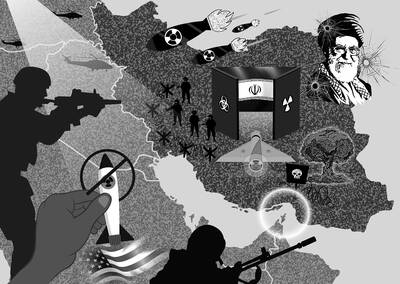
When was the last time you heard a meaningful proposal to prevent Iran from developing a nuclear arsenal? There has been nothing on the subject since the June Memorandum of Understanding between the US and Iran; the promised 60 days of talks to settle questions around Tehran’s uranium-enrichment program never began and have long since expired. When the war was launched, on Feb. 28, a resolution of the nuclear dispute was prominent among the dizzying array of US and Israeli aims to explain the attack. But as should be clear by now, the attempt was entirely reliant on achieving regime change. That


 RSS
RSS