

It might be hard to imagine that the Middle East is looking beyond Washington at the precise moment it is being massively disrupted by a US-led war. Yet that is exactly what is happening — most recently through this month’s signing of the Mecca Agreement, a mutual defense pact between Mohammed bin Salman of Saudi Arabia, Recep Tayyip Erdogan of Turkey and Shehbaz Sharif of Pakistan.
This pact is simultaneously less and more than it seems. On the one hand, the agreement insists that “an attack on one is an attack on all,” deliberately echoing NATO’s Article 5. It binds together major regional powers, each of which brings significant strengths to the table: bottomless funds, in the Saudis’ case; a muscular defense-industrial complex, in Turkey’s; and, in Pakistan’s, ample trained manpower and a nuclear deterrent.
However, regardless of what the paperwork says, this is no Sunni NATO. True alliances are more than treaties. Pakistan and Saudi Arabia signed one on mutual defense last year, but it did not seem to be triggered when Iran started firing missiles across the Gulf, nor did it appear to deter Tehran from escalation.
In this case, it is hard to understand exactly where and when these countries would come to one another’s aid. Would it happen if the Houthis violated Saudi borders? Or if India and Pakistan had another confrontation? Alliances require countries to be willing to fight for each other — and the sad truth is that, in the past few decades, only the US has been willing to run that risk.
These three countries have relied on that US backstop for decades. Turkey remains in NATO, although the bilateral relationship is fraught; Riyadh has always viewed Washington as its primary security guarantor; and the US’ on-again, off-again embrace of Pakistan has shaped that country’s worldview, rarely for the better.
As Washington makes it clear that it is willing to disrupt the Middle East rather than stabilize it, the Mecca Agreement is best seen as a formal admission that all three capitals are going to have to find new partners and alignments.
This is not easy. They do not have that many stability-loving friends to draw upon, partly because of their own poor choices. Turkey has its hands in multiple messes across the Caucasus and Mediterranean, Pakistan is far too comfortable thinking of terrorists as ideological fellow travelers and Saudi money has long supported religious extremists around the world, even though it has tried to dial that down in the past few years. These are revisionist powers, ill-at-ease heirs to an order that they never really loved.
Yet the purpose of this pact is not to upend the regional order. Instead, it is conservative in intent, an attempt to freeze or reverse the current turmoil. None of these three is interested in accelerating the chaos, the way Iran might be. Turkey, Saudi Arabia and Pakistan might resent the regional arrangements they have inherited, but they also know that a permanently ungovernable Middle East does not benefit them.
Powers unhappy with their status quo would meddle in each other’s affairs, bully their neighbors, and pursue imperial or revanchist dreams — but most of them would stop viewing such provocations as useful the moment they threaten trade routes, energy access or their own domestic legitimacy. At that point, even restless leaders begin to look for someone willing to share the burden of stabilizing their neighborhood.
For decades, that has been the US. Washington’s retreat from that role would inevitably produce this kind of faux alliance: a middle-power attempt to recreate the US’ role piecemeal, with every partner throwing something into the pot in the vague hope that whatever emerges is lasting and effective.
So questions about what the Mecca Agreement would look like in practice, however sensible, tend to miss the larger point. With no secretariat, no unified command and insufficient trust, it might survive only as a platform to talk shop, but even an obligation that Riyadh, Islamabad and Ankara consult one another in a crisis is not nothing. Over time, such self-interested improvisation might create a new geometry of restraint in one of the world’s most troubled regions.
However, I am not that hopeful. The problem with middle powers is that they all want to be great powers. Pakistan’s self-image, as the only Muslim-majority nuclear power, is elevated enough. Meanwhile, the Saudis and Turkey have long assumed that they, and they alone, deserve to lead the Sunni world. The House of Saud believes that its role in Mecca and Medina gives it certain privileges, but Istanbul remembers the four centuries when it was the seat of the caliphate.
The reason they have been complaisant allies in the past is that each was willing, regardless of these supposed claims to prominence, to accept the US as a senior partner. However, that does not mean they would accept each other as equals. If they ever do, then the Mecca Agreement stands a chance of success.
Mihir Sharma is a Bloomberg Opinion columnist. A senior fellow at the Observer Research Foundation in New Delhi, he is author of Restart: The Last Chance for the Indian Economy. This column reflects the personal views of the author and does not necessarily reflect the opinion of the editorial board or Bloomberg LP and its owners.
For the last 15 years, China has relied on gray zone operations to advance its territorial ambitions across Asia. And for 15 years, the US has struggled to respond. But the open door on which China has been pushing may finally be closing. Gray zone operations involve the assertive use of a variety of tools in ways that create conditions that can be described as neither peace nor war. Military forces might act provocatively — even dangerously — while carefully avoiding violence, whereas law enforcement employs nonlethal violence as a first resort. Such an approach creates difficult calculations for its targets.
EDITORIAL CARTOON
President William Lai (賴清德) late last month received a delegation of Polish members of the European Parliament at the Presidential Office — the first single-party, single-nation delegation from the EU legislature to visit Taipei in nearly two terms. The group, led by former Polish prime minister Beata Szydlo, also met Legislative Yuan Speaker Han Kuo-yu (韓國瑜), a gesture spanning Taiwan’s political divide. For most Taiwanese observers, this was a pleasant, if minor, diplomatic event. It was much more than that — and the timing matters. Within the same fortnight, Hudson Institute senior fellow Ken Moriyasu said in the Washington Examiner
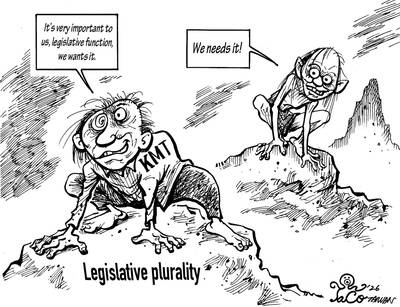
It was shocking to hear Legislative Speaker Han Kuo-yu (韓國瑜) say that the legislative branch is somehow now under the control of “dark forces.” Frustrated at the glacial pace of the passage of the government’s annual budget for this year — it was finally passed at 6:08pm on Friday after a record delay of 266 days — Han had lost his temper during a cross-caucus negotiation meeting on Tuesday. The target of his ire was Chinese Nationalist Party (KMT) caucus whip Fu Kun-chi (傅崐萁), who was absent that day. Fu had failed to attend the cross-caucus negotiations on a total of


 RSS
RSS