

The opposition-controlled Legislative Yuan on Friday last week approved three referendum proposals. One of the questions is: “Do you agree that the government should abolish its ‘nuclear-free homeland’ energy policy to ensure public health, stabilize power supply, lower electricity prices, enhance national defense resilience and support the development of the artificial intelligence (AI) industry?” To prevent this biased and politically coercive referendum from interfering with the nine-in-one elections in November, the Central Election Commission should reject this wasteful exercise.
For one, the referendum lacks objectivity and neutrality. Article 9 of the Referendum Act (公民投票法) states that the main text of a referendum proposal must be “concise, clear and objectively neutral.” No consensus has been achieved in policy discussions on whether nuclear power could serve as a means of stimulating economic growth, yet its proponents — Chinese Nationalist Party (KMT) and Taiwan People’s Party (TPP) lawmakers — have deliberately linked the two by equating the use of nuclear power with the development of the AI industry. This is absolutely misleading rhetoric and completely lacks objectivity.
Second, this referendum is a clear attempt to undermine a previous referendum. As Article 32 of the Referendum Act stipulates: “No proposal on the same matter may be resubmitted within two years of the date on which the competent authority announces the results of the referendum.” Although last year’s vote on restarting the Ma-anshan Nuclear Power Plant was defeated, President William Lai (賴清德) — out of respect for public opinion — instructed Taiwan Power Co (Taipower) to conduct independent safety inspections and assessments of the plant’s units. Taipower complied with the policy directive and on March 27 submitted its “Third Nuclear Power Plant Reactivation Plan.” Taiwan’s return to nuclear power is already under way — the question is whether the plan to restart the Ma-anshan plant would pass its review. Is it legal for the KMT and the TPP to put forward another referendum on the same matter within such a short period?
Third, this referendum is being maliciously abused. The Referendum Act also stipulates that referendums may be held on matters such as laws, initiatives on legislative principles and initiatives on major policies. It also empowers the legislature to propose referendums on the initiation of major policies. As laws and legislative principles already fall within the legislature’s purview, the law limits its direct power to initiate referendums to matters concerning legislative principles. In other words, the legislature should not use a referendum to circumvent the ordinary legislative process.
The KMT and the TPP’s joint referendum proposal to abolish the government’s “nuclear-free homeland” policy is a position that they have advocated since early last year. They know well that removing the “nuclear-free homeland” provisions from the Basic Environment Act (環境基本法) and the Climate Change Adaptation Act (氣候變遷因應法) would be a straightforward matter. Yet, for the sake of political mobilization, they have deliberately slipped the policy’s abolition — a matter that falls under the category of “initiatives on legislative principles” — into the referendum process to achieve their political objectives, abusing a system designed to allow for the direct exercise of civil rights.
Shieh Jyh-cherng is a retired National Taiwan University professor.
Translated by Kyra Gustavsen

For the last 15 years, China has relied on gray zone operations to advance its territorial ambitions across Asia. And for 15 years, the US has struggled to respond. But the open door on which China has been pushing may finally be closing. Gray zone operations involve the assertive use of a variety of tools in ways that create conditions that can be described as neither peace nor war. Military forces might act provocatively — even dangerously — while carefully avoiding violence, whereas law enforcement employs nonlethal violence as a first resort. Such an approach creates difficult calculations for its targets.
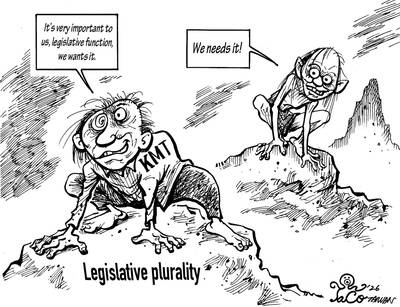
EDITORIAL CARTOON
President William Lai (賴清德) late last month received a delegation of Polish members of the European Parliament at the Presidential Office — the first single-party, single-nation delegation from the EU legislature to visit Taipei in nearly two terms. The group, led by former Polish prime minister Beata Szydlo, also met Legislative Yuan Speaker Han Kuo-yu (韓國瑜), a gesture spanning Taiwan’s political divide. For most Taiwanese observers, this was a pleasant, if minor, diplomatic event. It was much more than that — and the timing matters. Within the same fortnight, Hudson Institute senior fellow Ken Moriyasu said in the Washington Examiner
It was shocking to hear Legislative Speaker Han Kuo-yu (韓國瑜) say that the legislative branch is somehow now under the control of “dark forces.” Frustrated at the glacial pace of the passage of the government’s annual budget for this year — it was finally passed at 6:08pm on Friday after a record delay of 266 days — Han had lost his temper during a cross-caucus negotiation meeting on Tuesday. The target of his ire was Chinese Nationalist Party (KMT) caucus whip Fu Kun-chi (傅崐萁), who was absent that day. Fu had failed to attend the cross-caucus negotiations on a total of


 RSS
RSS