

With the November nine-in-one elections drawing closer, the collaboration between the Chinese Nationalist Party (KMT) and the Taiwan People’s Party (TPP) is once again drawing public attention. The KMT Taipei chapter has reportedly decided to focus on winning an outright majority in the council. As such, Taipei Mayor Chiang Wan-an (蔣萬安) will not appear in individual campaign events for TPP councilor candidates, and instead only attend joint campaign rallies.
The question is whether this blue-white “alliance” can hold, with the TPP not having a mayoral candidate and both parties pursuing their own interests in the council races. Despite their professions of cooperation, the KMT’s priority is to win a majority amid concern that the TPP could hurt its candidates’ electoral prospects. If they cannot even lend one another a hand on the campaign trail, what kind of alliance is this?
If Chiang hopes to win the support of TPP voters in the mayoral race, he cannot simply enjoy the electoral benefits of the blue-white alliance while refusing to bear any political cost. Asking voters in the white camp to support him while keeping his distance from TPP councilor candidates creates the impression that he wants a boost from the TPP, but is unwilling to offer anything in return.
Political cooperation is not one-sided. For the KMT to ask the TPP for support while imposing restrictions of its own would only erode mutual trust. Political parties can negotiate and coordinate, but they cannot force voters to cast their ballots according to the parties’ calculations. If the two parties cooperate on one hand while trying to block each other on the other, it would reduce the alliance to nothing more than an empty slogan.
The KMT and the TPP are, after all, distinct parties whose principles and interests do not always align, making genuine cooperation all the more dependent on sincerity. As much as Chiang would like to have his cake and eat it too, he should not merely expect votes from the white camp; he should also demonstrate commitment to cooperation through his actions. Otherwise, what kind of alliance does he claim to run?
Tsai Jr-keng is a retired elementary-school principal.
Translated by Gilda Knox Streader

For the last 15 years, China has relied on gray zone operations to advance its territorial ambitions across Asia. And for 15 years, the US has struggled to respond. But the open door on which China has been pushing may finally be closing. Gray zone operations involve the assertive use of a variety of tools in ways that create conditions that can be described as neither peace nor war. Military forces might act provocatively — even dangerously — while carefully avoiding violence, whereas law enforcement employs nonlethal violence as a first resort. Such an approach creates difficult calculations for its targets.
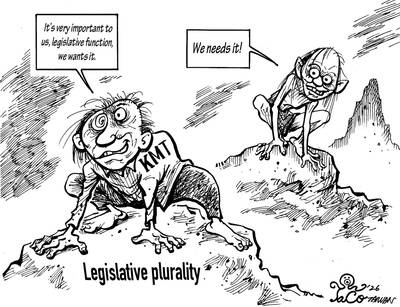
EDITORIAL CARTOON
President William Lai (賴清德) late last month received a delegation of Polish members of the European Parliament at the Presidential Office — the first single-party, single-nation delegation from the EU legislature to visit Taipei in nearly two terms. The group, led by former Polish prime minister Beata Szydlo, also met Legislative Yuan Speaker Han Kuo-yu (韓國瑜), a gesture spanning Taiwan’s political divide. For most Taiwanese observers, this was a pleasant, if minor, diplomatic event. It was much more than that — and the timing matters. Within the same fortnight, Hudson Institute senior fellow Ken Moriyasu said in the Washington Examiner
It was shocking to hear Legislative Speaker Han Kuo-yu (韓國瑜) say that the legislative branch is somehow now under the control of “dark forces.” Frustrated at the glacial pace of the passage of the government’s annual budget for this year — it was finally passed at 6:08pm on Friday after a record delay of 266 days — Han had lost his temper during a cross-caucus negotiation meeting on Tuesday. The target of his ire was Chinese Nationalist Party (KMT) caucus whip Fu Kun-chi (傅崐萁), who was absent that day. Fu had failed to attend the cross-caucus negotiations on a total of


 RSS
RSS