

Amid strong economic growth fueled by the artificial intelligence (AI) boom, President William Lai (賴清德) on Monday announced that the government would distribute a NT$10,000 (US$314) cash handout to all citizens next year — a move the Chinese Nationalist Party (KMT) characterized as the “ultimate political irony.”
Over the past year and a half, universal cash handouts have become one of Taiwan’s most politically contentious issues.
The dispute began last year, when the KMT proposed giving every citizen NT$10,000 after the Ministry of Finance reported that tax revenue for 2024 had exceeded its budget estimate by a record NT$528.3 billion, arguing that the money belonged to the public and should thus be returned to them.
At the time, the Democratic Progressive Party (DPP) argued that the surplus tax revenue would better serve the public if it were invested in areas such as social welfare, national defense and economic development, rather than simply being distributed as cash.
When the government proposed a special budget in response to US tariff threats, the KMT and the Taiwan People’s Party used their legislative majority to push through a version that increased the budget ceiling to include NT$235 billion for the handouts, despite government warnings that it would add NT$101.4 billion to borrowing.
The KMT’s argument was simple: Taiwan had accumulated a substantial tax surplus, and ordinary people should share in the country’s economic gains. The party packaged the handouts as a way to help families cope with rising costs and uncertainty, accusing the government of withholding money from the public and insisting that returning surplus revenue was the responsible thing to do.
However, there was an obvious blind spot in this logic: If surplus tax revenue should be “returned to the people,” why should that principle apply only to the central government?
When DPP lawmakers urged KMT-led municipalities to practice what they preach and distribute their own surplus funds, the enthusiasm faded.
The Taipei City Government insisted the issue was a matter for the central government, while Taichung Mayor Lu Shiow-yen (盧秀燕), who had previously called on the central government to “return the money to the public,” rejected reports that her city had a NT$12 billion surplus. She further threatened legal action against people who spread online rumors about possible tax rebates.
Now that Lai has announced a new round of payments, one might reasonably expect the KMT to celebrate. After all, this is precisely the kind of policy it has spent so long advocating for.
Instead, the party accused Lai of appropriating its idea, using the AI boom to repackage it as an “AI dividend.” It also criticized the timing of the announcement, given that local elections are approaching in November.
Then, just one day later, it changed tack again. Rather than simply welcoming or condemning the policy, it demanded that the Lai administration double the payments to NT$20,000, arguing that the government has the fiscal capacity to do so.
This behavior is anything but subtle.
If the KMT genuinely believes that cash handouts are the best way to ensure that citizens share in economic growth, then Lai’s announcement should be welcome news. After all, the ruling party is adopting a policy the KMT has repeatedly demanded.
At a time when cross-party cooperation seems increasingly difficult, this should have been an opportunity to put partisan differences aside and achieve a common goal. Instead, the KMT appears determined to oppose the government even when the government does what the party itself has demanded.
This is a troubling approach to politics. The goal of elected officials should be to serve their constituents and promote policies to improve people’s lives. If a policy is truly beneficial to the public, its merits should not depend on whether it was conceived by the ruling party or the opposition.
If the KMT views the proposed NT$10,000 as insufficient, it could make a more substantive case for a larger payment than simply arguing that the government can afford it, or propose a reasonable alternative. Better still, KMT-led local governments could demonstrate their commitment to citizens by providing additional cash payments of their own — something they have shown little inclination to do.
Citizens deserve better than a political tug-of-war over who gets the credit for which policy. They deserve lawmakers willing to set aside their differences when necessary to make meaningful progress, rather than arguing for argument’s sake.
In the end, the only group that stands to lose from these political games is the public.
For the last 15 years, China has relied on gray zone operations to advance its territorial ambitions across Asia. And for 15 years, the US has struggled to respond. But the open door on which China has been pushing may finally be closing. Gray zone operations involve the assertive use of a variety of tools in ways that create conditions that can be described as neither peace nor war. Military forces might act provocatively — even dangerously — while carefully avoiding violence, whereas law enforcement employs nonlethal violence as a first resort. Such an approach creates difficult calculations for its targets.
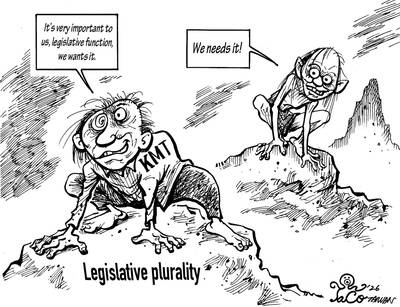
EDITORIAL CARTOON
President William Lai (賴清德) late last month received a delegation of Polish members of the European Parliament at the Presidential Office — the first single-party, single-nation delegation from the EU legislature to visit Taipei in nearly two terms. The group, led by former Polish prime minister Beata Szydlo, also met Legislative Yuan Speaker Han Kuo-yu (韓國瑜), a gesture spanning Taiwan’s political divide. For most Taiwanese observers, this was a pleasant, if minor, diplomatic event. It was much more than that — and the timing matters. Within the same fortnight, Hudson Institute senior fellow Ken Moriyasu said in the Washington Examiner
It was shocking to hear Legislative Speaker Han Kuo-yu (韓國瑜) say that the legislative branch is somehow now under the control of “dark forces.” Frustrated at the glacial pace of the passage of the government’s annual budget for this year — it was finally passed at 6:08pm on Friday after a record delay of 266 days — Han had lost his temper during a cross-caucus negotiation meeting on Tuesday. The target of his ire was Chinese Nationalist Party (KMT) caucus whip Fu Kun-chi (傅崐萁), who was absent that day. Fu had failed to attend the cross-caucus negotiations on a total of


 RSS
RSS