

The tragic death of Jason Arday raises serious questions about race, institutional authority and what happens to people in a society increasingly organized around public reputation.
Arday, who resigned earlier this month as a professor at the University of Cambridge, was found dead at his home last week. He was 41. His family and friends have lost somebody they loved and cared for.
Arday had publicly said that the scrutiny of allegations concerning his academic work and claims he had made about his life was taking a profound toll. That he then died amid an intense and continuing media examination of his life is deeply troubling.
British Prime Minister Andy Burnham was right to call this “a moment for reflection.” That does not mean suppressing difficult questions, ignoring why there remain a pitifully small number of black professors in British universities, or attacking legitimate journalism.
However, in a polarized world it should see the media ask how proper scrutiny can widen into something more encompassing; how race affects the meaning attached to an individual’s alleged failings; and whether separate valid stories can, through social media, have an overwhelming effect.
In Arday’s case, alleged shortcomings in his record rapidly became weaponized by the right in an argument about diversity and black academic advancement.
Arday’s story — an autistic child from a council estate who became a Cambridge professor at 37 — was remarkable. The university publicized the symbolic dimensions of his appointment as a young, black, neurodivergent man.
He had been accused of plagiarism in his doctoral thesis — allegations an earlier Liverpool John Moores University investigation had not upheld. His latest accuser, Nathan Cofnas, had advanced ideas widely condemned as racist, making it impossible to regard his intervention as neutral. However, there was a clear public interest case for investigating such allegations.
The Guardian sought to establish what was true. That is the proper function of journalism. Reporters were contacted by Arday more than a year ago and worked extensively to verify what he had told them. In many instances, they could not.
It was right for the Guardian to publish its investigation, and it is wrong that the journalists who did their job responsibly are now being subjected to an onslaught of abuse.
Cambridge, which has many of its own questions to answer, announced that it would hold an internal inquiry. In its journalism, the Guardian sought to meet tests of importance and proportionality, covering the issue with nuance. That could not be said of much of the right-wing media and its social media outriders.
Arday became an exhibit in an ideological, almost Trumpian campaign against diversity and inclusion. The allegations were no longer simply about one academic’s behavior or his past record. They were used to suggest that Arday had never deserved to be there — and that he had only been advanced because of his race. The attacks were relentless, often partisan and amplified without respite online.
This is racism at work. White academics are generally allowed to fail as individuals. Black ones are not. Arday might have had questions to answer; that did not make black academics collectively answerable for him. A society committed to equality must allow black people the same freedom as everyone else: to be flawed, to make mistakes and even to fail, without their failure becoming an indictment of their race.
For the last 15 years, China has relied on gray zone operations to advance its territorial ambitions across Asia. And for 15 years, the US has struggled to respond. But the open door on which China has been pushing may finally be closing. Gray zone operations involve the assertive use of a variety of tools in ways that create conditions that can be described as neither peace nor war. Military forces might act provocatively — even dangerously — while carefully avoiding violence, whereas law enforcement employs nonlethal violence as a first resort. Such an approach creates difficult calculations for its targets.
EDITORIAL CARTOON
President William Lai (賴清德) late last month received a delegation of Polish members of the European Parliament at the Presidential Office — the first single-party, single-nation delegation from the EU legislature to visit Taipei in nearly two terms. The group, led by former Polish prime minister Beata Szydlo, also met Legislative Yuan Speaker Han Kuo-yu (韓國瑜), a gesture spanning Taiwan’s political divide. For most Taiwanese observers, this was a pleasant, if minor, diplomatic event. It was much more than that — and the timing matters. Within the same fortnight, Hudson Institute senior fellow Ken Moriyasu said in the Washington Examiner
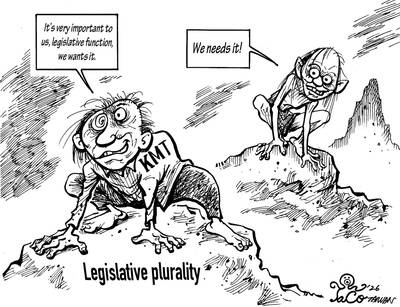
It was shocking to hear Legislative Speaker Han Kuo-yu (韓國瑜) say that the legislative branch is somehow now under the control of “dark forces.” Frustrated at the glacial pace of the passage of the government’s annual budget for this year — it was finally passed at 6:08pm on Friday after a record delay of 266 days — Han had lost his temper during a cross-caucus negotiation meeting on Tuesday. The target of his ire was Chinese Nationalist Party (KMT) caucus whip Fu Kun-chi (傅崐萁), who was absent that day. Fu had failed to attend the cross-caucus negotiations on a total of


 RSS
RSS