

At their first summit in August last year South Korean President Lee Jae-myung, told US President Donald Trump: “If you, Mr President, become the peacemaker, then I will assist you as the pacemaker.”
The remark at the Oval Office captured the thrust of Lee’s approach to North Korea: Dial down the military posturing and make repeated peace overtures to revive dialogue, even if they have been consistently rejected by Pyongyang largely over Seoul’s insistence on denuclearization.
Fast forward to this week, and Trump’s move to cut joint military exercises with South Korea echoes what Lee had himself floated, on several occasions, as a possible tool for drawing Pyongyang back to the table.
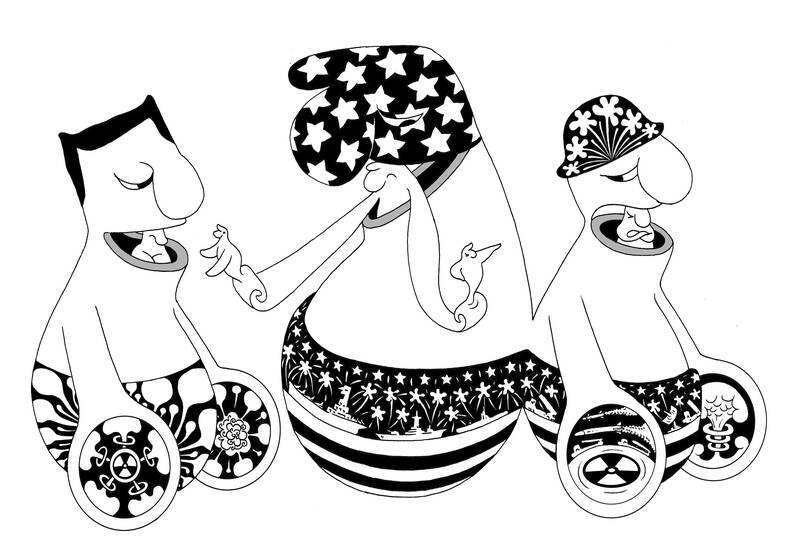
Illustration: Mountain People
Lee’s broader message is that South Korea should take more responsibility for its own defense and reduce its reliance on others. On Tuesday, he used the moment to renew calls for wartime operational control of the military and progress on his country’s nuclear submarine program.
Trump has delivered on the drills, albeit in the blunt, discourteous fashion typical of the president: via social media, hours before the drills were to begin.
Yet the move has inverted South Korea’s usual political lines, where the left-right divide is shaped more by attitudes toward North Korea — hawks vs doves, confrontation vs engagement — than by economic or social values.
Reducing joint drills has long been advocated by some on the South Korean left. A right-wing US president imposing the policy on his center-left South Korean counterpart lands awkwardly for both sides.
While some see the reduction as potentially useful for diplomacy, the louder concern in Seoul is that Trump is weakening a key pillar of deterrence and leaving South Korea with little say over decisions that directly affect its security. That might strain an alliance that has been the bedrock of security on the peninsula since the Korean War.
The opposition conservative People Power Party has called the decision a “security disaster” and warned of a return to “Korea passing,” a term used when Seoul feels sidelined in matters directly affecting it. Conservative newspapers have been almost unanimous in calling the cut reckless. The influential Chosun Ilbo has gone further, blaming Lee’s government directly for inviting it.
The left has not shared that sense of alarm. The Hankyoreh, one of the country’s main progressive papers, raised no objection to the substance of Trump’s decision, only to how it was delivered: unilaterally and disrespectfully on social media, calling it “regrettable.” The Kyunghyang Shinmun took a more positive view, saying the cut could help create an atmosphere for dialogue with North Korea, so long as deterrence held.
Reducing tensions with North Korea and creating space for dialogue are central to Lee’s agenda. The ruling party has been quiet on the move, but openly welcoming Trump’s decision could put it at odds with a base that has viewed Trump with suspicion, if not hostility.
Aside from domestic politics, the episode is likely to deepen doubts about Washington’s commitment to its allies, doubts that have been building for years since Trump’s first term, Sogang University international relations professor Kim Jaechun said.
Trust, he argued, is the foundation of any alliance, and remarks like Trump’s reinforce the impression that the US’ obligations are increasingly viewed “through a highly transactional lens,” one that could shape how South Koreans judge US reliability long after Trump has left office.
Then there is the issue of the nuclear deterrent. South Korea enjoys protection under the US nuclear umbrella, but public support for an independent deterrent among South Koreans and their neighbors has hovered at about 70 percent or more in surveys. The latest news might push that support higher still.
Kim said he expects Pyongyang to welcome any sign of friction within the alliance, but doubts that it views improving relations with Washington as a priority, given the stronger backing it now enjoys from China and Russia compared with during Trump’s first term.
“The irony is that [US] policies intended to reduce American burdens may ultimately strengthen calls for independent nuclear deterrents among US allies,” he said.
For the last 15 years, China has relied on gray zone operations to advance its territorial ambitions across Asia. And for 15 years, the US has struggled to respond. But the open door on which China has been pushing may finally be closing. Gray zone operations involve the assertive use of a variety of tools in ways that create conditions that can be described as neither peace nor war. Military forces might act provocatively — even dangerously — while carefully avoiding violence, whereas law enforcement employs nonlethal violence as a first resort. Such an approach creates difficult calculations for its targets.
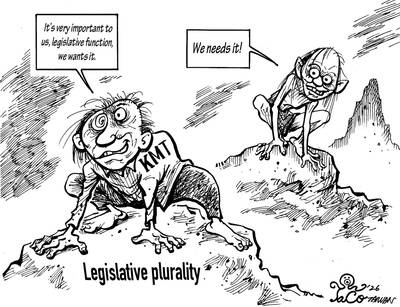
EDITORIAL CARTOON
President William Lai (賴清德) late last month received a delegation of Polish members of the European Parliament at the Presidential Office — the first single-party, single-nation delegation from the EU legislature to visit Taipei in nearly two terms. The group, led by former Polish prime minister Beata Szydlo, also met Legislative Yuan Speaker Han Kuo-yu (韓國瑜), a gesture spanning Taiwan’s political divide. For most Taiwanese observers, this was a pleasant, if minor, diplomatic event. It was much more than that — and the timing matters. Within the same fortnight, Hudson Institute senior fellow Ken Moriyasu said in the Washington Examiner
It was shocking to hear Legislative Speaker Han Kuo-yu (韓國瑜) say that the legislative branch is somehow now under the control of “dark forces.” Frustrated at the glacial pace of the passage of the government’s annual budget for this year — it was finally passed at 6:08pm on Friday after a record delay of 266 days — Han had lost his temper during a cross-caucus negotiation meeting on Tuesday. The target of his ire was Chinese Nationalist Party (KMT) caucus whip Fu Kun-chi (傅崐萁), who was absent that day. Fu had failed to attend the cross-caucus negotiations on a total of


 RSS
RSS