

I was in Taichung when this year’s urban resilience exercises began in central Taiwan on Monday last week.
For the first time, the air raid drills included a mobile Internet “throttling” scenario. This did not mean that mobile Internet was entirely cut off; rather it simulated limited communications through measures such as slowing mobile networks.
Before the exercises began, authorities advised people who needed Internet access to use fixed-line connections or indoor Wi-Fi.
For most people, a half hour of slower Internet would, at most, amount to a minor inconvenience in their daily lives.
It is hard not to wonder: If I was in Kyiv, Moscow, Tehran or Tel Aviv, would slower Internet really be the only thing I have to worry about?
A real air raid would not be announced in advance, nor would it last just 30 minutes. When air raid sirens sound, people could be confronted with explosions, power outages, communication disruptions and even threats to their lives. Seen in this light, the inconvenience people in Taichung experienced was a small price to pay.
It is for this reason that I commend the armed forces, government agencies, the Ministry of Digital Affairs, the National Communications Commission and the telecoms that took part in the exercises. It is precisely because people are willing to prepare, conduct drills and coordinate during peacetime that they know what to do when communications are restricted, even in calm environments.
With the advent of high-tech tactics and strategies, the battlefield is no longer simply about guns and ammunition. The Internet, communications and essential services could all affect the functioning of society. Taiwan cannot predict what methods adversaries would employ, but at the very least, it can ensure the nation is prepared.
This is not just a matter for the military. The government must clearly define responsibilities, businesses must maintain essential services and the public must know what they can do when a crisis occurs. The more Taiwanese understand and practice during peacetime, the less likely they are to panic when a crisis strikes.
In peaceful times, these exercises inevitably bring some inconvenience to our daily lives, but if that inconvenience leads to greater preparedness when a real crisis strikes, it is worth it. We do not know what we might face, but there is one thing we can do: Ensure that Taiwan is prepared.
Hung Yu-jui is a translator and Japanese-language teacher based in Taiwan who writes on public policy and social issues.
Translated by Kyra Gustavsen

For the last 15 years, China has relied on gray zone operations to advance its territorial ambitions across Asia. And for 15 years, the US has struggled to respond. But the open door on which China has been pushing may finally be closing. Gray zone operations involve the assertive use of a variety of tools in ways that create conditions that can be described as neither peace nor war. Military forces might act provocatively — even dangerously — while carefully avoiding violence, whereas law enforcement employs nonlethal violence as a first resort. Such an approach creates difficult calculations for its targets.
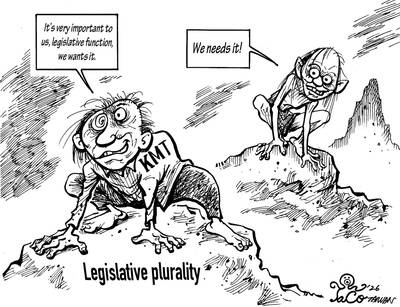
EDITORIAL CARTOON
President William Lai (賴清德) late last month received a delegation of Polish members of the European Parliament at the Presidential Office — the first single-party, single-nation delegation from the EU legislature to visit Taipei in nearly two terms. The group, led by former Polish prime minister Beata Szydlo, also met Legislative Yuan Speaker Han Kuo-yu (韓國瑜), a gesture spanning Taiwan’s political divide. For most Taiwanese observers, this was a pleasant, if minor, diplomatic event. It was much more than that — and the timing matters. Within the same fortnight, Hudson Institute senior fellow Ken Moriyasu said in the Washington Examiner
China’s State Council on July 31 announced the Regulations on Exit and Entry Administration. Set to take effect from Sept. 15, the regulation expands the People’s Republic of China’s powers to restrict people from leaving the country in the name of “safeguarding national sovereignty, security and development interests.” International observers widely regard it as another step back to a closed China. Given Beijing’s insistence that Taiwan is “a part of China,” experts warn Taiwanese traveling to China of increasing risk of indefinite detainment. Mainland Affairs Council (MAC) Minister Chiu Chui-cheng (邱垂正) has likewise warned that China has repeatedly revised


 RSS
RSS