

German journalist and Chinese intelligence researcher Jurgen Kremb said the Ministry of Justice Investigation Bureau has confirmed that he was followed by a suspected Chinese intelligence operative while visiting Alishan last year.
The bureau said the case highlights China’s use of transnational repression against people who oppose its authoritarian system or advocate for democracy and human rights.
The incident is a reminder that Taiwan’s security challenge is not confined to the waters of the Taiwan Strait. If a suspected Chinese operative can follow a foreign journalist inside Taiwan, it raises questions about how effectively the nation monitors intelligence activity and protects itself against China’s extensive espionage efforts and influence. Taiwan also faces the more serious problem of Chinese recruitment and infiltration of its military and political institutions.
Reports showed that 64 people were charged with spying for China last year, three times more than in 2021.
However, Taiwan’s vulnerabilities are political and institutional. Its leaders and legislators spent months deadlocked over defense spending, with the legislature ultimately approving a substantially reduced version of the government’s proposed special defense budget. Now, the ruling and opposition parties are again at odds over funding for military drones. These disputes demonstrate how partisan divisions can delay or dilute measures intended to bolster deterrence.
China’s greatest advantage might therefore not simply be the strength of its army, but Taiwan’s inability to consistently secure its institutions, counter infiltration and build political consensus around defense.
If Taiwan is to protect itself against internal threats while maintaining cross-strait exchanges, it must ensure greater transparency regarding movements between Taiwan and China. Chinese visitors should be properly vetted, including those who enter Taiwan from a third country or territory. Taiwan should also create stronger incentives for people to report approaches by or contacts with suspected Chinese intelligence operatives.
A comprehensive investigation into the woman who allegedly followed Kremb — as well as similar cases — is warranted. Identifying and closing such intelligence leaks might require cooperation with foreign authorities.
Any possibility that Taiwanese collaborators are providing Chinese agents with information about the movements of prominent foreign visitors should likewise be investigated and stopped. Taiwan cannot effectively counter foreign espionage if domestic sources are providing enemies with intelligence.
Taiwan has a uniquely precarious position in its relationship with China, a major trading partner, facing a security dilemma unlike that of other countries.
South Korea, for example, has citizens who support unification with North Korea, but the two are not major trading partners. Russia and Ukraine were economically interconnected before Moscow’s invasion, but their economic relationship has been drastically reduced by the war. Meanwhile, Taiwan must manage an existential security threat posed by a country it has an economically significant relationship with.
Efforts to further reduce that economic dependence are likely to remain difficult, particularly because many Taiwanese do not want complete economic decoupling from China. That makes it even more important for Taiwan to maintain transparency in its relationship with Beijing and carefully scrutinize exchanges, visitors and other forms of cross-strait interaction.
Recent intelligence reports have said that Beijing is recruiting Taiwanese lawmakers to help obstruct defense-related bills in the legislature. That is a threat not only to national defense, but also democracy.
A healthy democracy requires multiple political parties, a strong opposition, and effective checks and balances. However, those checks and balances become dysfunctional if a political party or lawmakers act in the interests of a hostile foreign power.
Allegations of foreign influence must also be investigated transparently and supported by evidence; otherwise, they risk becoming another source of political division that Beijing could exploit.
Taiwan’s ruling and opposition parties must find ways to communicate, even when disagreements are profound. Political competition is essential to democracy, but national security must not be another weapon in partisan battles.
China will continue attempting to drive wedges between Taiwan’s political parties, undermine public trust in the government and exploit divisions within society. Taiwan must remain vigilant, expose coordinated influence and cognitive warfare campaigns, and bolster cooperation across political lines.
The greatest defense against China might be a Taiwan that is difficult to infiltrate, manipulate and divide. Protecting democracy does not mean abandoning legitimate exchanges with China, but ensuring that those exchanges are transparent and do not provide Beijing with opportunities to undermine Taiwan from within.

For the last 15 years, China has relied on gray zone operations to advance its territorial ambitions across Asia. And for 15 years, the US has struggled to respond. But the open door on which China has been pushing may finally be closing. Gray zone operations involve the assertive use of a variety of tools in ways that create conditions that can be described as neither peace nor war. Military forces might act provocatively — even dangerously — while carefully avoiding violence, whereas law enforcement employs nonlethal violence as a first resort. Such an approach creates difficult calculations for its targets.
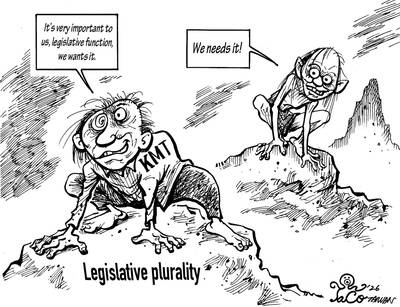
EDITORIAL CARTOON
President William Lai (賴清德) late last month received a delegation of Polish members of the European Parliament at the Presidential Office — the first single-party, single-nation delegation from the EU legislature to visit Taipei in nearly two terms. The group, led by former Polish prime minister Beata Szydlo, also met Legislative Yuan Speaker Han Kuo-yu (韓國瑜), a gesture spanning Taiwan’s political divide. For most Taiwanese observers, this was a pleasant, if minor, diplomatic event. It was much more than that — and the timing matters. Within the same fortnight, Hudson Institute senior fellow Ken Moriyasu said in the Washington Examiner
China’s State Council on July 31 announced the Regulations on Exit and Entry Administration. Set to take effect from Sept. 15, the regulation expands the People’s Republic of China’s powers to restrict people from leaving the country in the name of “safeguarding national sovereignty, security and development interests.” International observers widely regard it as another step back to a closed China. Given Beijing’s insistence that Taiwan is “a part of China,” experts warn Taiwanese traveling to China of increasing risk of indefinite detainment. Mainland Affairs Council (MAC) Minister Chiu Chui-cheng (邱垂正) has likewise warned that China has repeatedly revised


 RSS
RSS