

The Executive Yuan on Thursday approved draft amendments to the Criminal Code and the Criminal Code of the Armed Forces (陸海空軍刑法) that would increase prison sentences and fines for drug-impaired driving and allow courts to impose life sentences on repeat offenders whose actions result in death.
The move is part of a broader crackdown on drugs and drug-impaired driving following a series of high-profile incidents that left several people dead or injured, fueling public concern over road safety.
Premier Cho Jung-tai (卓榮泰) announced 14 measures aimed at curbing drug use, including disrupting drug supply chains, strengthening enforcement and imposing tougher penalties on offenders.
The Ministry of Transportation and Communications (MOTC) has proposed amendments to the Road Traffic Management and Penalty Act (道路交通管理處罰條例) that would revoke the licenses of drug-impaired drivers, substantially increase fines and require offenders to undergo addiction treatment before being allowed to regain driving privileges.
The Ministry of Justice wants to discuss reclassifying etomidate from a Category 2 to a Category 1 narcotic, a move that could make manufacturing, transporting or distributing the substance punishable by death.
The urgency is understandable. National Police Agency data show drug-driving cases more than tripled between 2024 and last year, while the number recorded in the first five months of this year was already three times higher than during the same period last year.
Drivers who operate vehicles under the influence of narcotics endanger not only themselves, but everyone around them. Stronger penalties are therefore justified, particularly when such behavior results in serious injury or death.
However, policymakers should avoid allowing public outrage over recent cases to narrow their focus or rush through measures that are more punitive than necessary. Under proposed Ministry of Transportation and Communications amendments, authorities could also revoke the licenses of people found using Category 1 or Category 2 narcotics, even when they were not driving.
In other words, drivers could face license revocation for traces of marijuana found in their system, while excluding other substances such as ketamine, a Category 3 narcotic linked to 22 percent of this year’s drug driving cases.
Revoking a driver’s license based solely on prior drug use, rather than impaired driving behavior, raises questions of proportionality and risks blurring the line between road safety regulation and punitive measures targeting substance use itself.
Much of the current discussion has centered on etomidate, the active ingredient in so-called “zombie vapes.” The drug deserves attention not only because of its rapidly growing popularity in Taiwan, but because of its side effects, which can include loss of consciousness and impaired motor control. Etomidate has been involved in 17 percent of drug driving cases this year.
Methamphetamine accounts for about 70 percent of this year’s drug-impaired driving cases. Opioids such as heroin are also significant contributors, accounting for 12 percent of cases. In many incidents, drivers have been found to have consumed multiple substances simultaneously. If illegal narcotics remain readily available, substance abuse could continue to translate into dangerous behavior behind the wheel.
The government’s proposed measures acknowledge this to some extent. New enforcement tools, expanded roadside testing and efforts to disrupt drug trafficking networks are all necessary. Greater attention should undoubtedly be paid to preventing narcotics from entering Taiwan in the first place and disrupting the criminal networks that distribute methamphetamine, ketamine, etomidate and other illicit substances.
At the same time, policymakers should not overlook the importance of addressing drug addiction and reducing recidivism.
Many cases of drug-impaired and drunk driving are manifestations of wider patterns of abuse and addiction. Harsher punishments might provide a sense of vindication to victims, their families and the public, but they are unlikely to address the underlying causes of this trend on their own.
Therefore, requiring that drug driving offenders receive addiction treatment before regaining driving privileges might ultimately prove among the most effective elements of the government’s proposed measures. Rehabilitation, long-term monitoring and sustained intervention are more likely to reduce future harm than longer prison terms and higher fines alone.
Lasting improvements in road safety would depend not only on imposing tougher penalties, but also on reducing the availability of illicit substances and mitigating the harmful behaviors that so often place impaired drivers behind the wheel in the first place.
Taiwan’s domestic political situation is following recognizable political rhythms, while the international environment surrounding Taiwan is undergoing a major transformation. Within Taiwan, there are ongoing battles between the legislative and executive branches over the budget, and between cities and the central government over resources. Tensions between political parties dominate headlines and consume much of the attention of party leaders. Jockeying is underway for local elections this November and national elections in 2028. And the longstanding philosophical debate inside Taiwan over how best to protect Taiwan and promote the good life remains unresolved. Amidst all of this, Taiwan continues to function well. It
In an article published on Tuesday in The Atlantic, titled “Will Taiwan Just Give Up?”, journalist Simon Shuster emphasizes the unpredictability of the US as an ally under US President Donald Trump and cites diminishing faith in the US as a contributor to what he sees as waning determination to resist China. As the title suggests, Shuster views a deal between Taiwan and China as an increasingly inevitable alternative to a costly war — one that Taiwan, lacking reliable allies and military capabilities, would eventually be destined to lose. He focuses on Chinese Nationalist Party (KMT) Chairwoman Cheng Li-wun (鄭麗文) — her
With candidate registration for this year’s local elections closed on Sept. 4 and the elections less than 80 days away, Democratic Progressive Party (DPP) Legislator and Taipei mayoral candidate Puma Shen’s (沈伯洋) rapidly growing popularity has become the focus of political talk shows and online discussions over the past week, heating up the mayoral election race in Taipei. Local media headlines and political pundits have picked up his supporters’ slogan “ocean current” (洋流) — a play on the last character of Shen’s name, which literally means “ocean” (洋), and the character (流), which can mean “current,” “flow” or “trend” — to
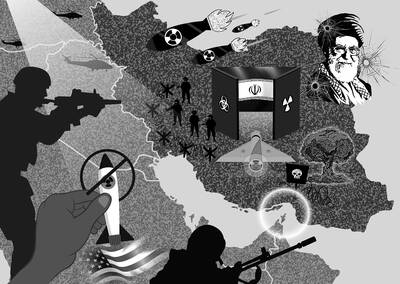
When was the last time you heard a meaningful proposal to prevent Iran from developing a nuclear arsenal? There has been nothing on the subject since the June Memorandum of Understanding between the US and Iran; the promised 60 days of talks to settle questions around Tehran’s uranium-enrichment program never began and have long since expired. When the war was launched, on Feb. 28, a resolution of the nuclear dispute was prominent among the dizzying array of US and Israeli aims to explain the attack. But as should be clear by now, the attempt was entirely reliant on achieving regime change. That


 RSS
RSS