


A proposed monthly NT$5,000 (US$159) subsidy for parents of a child aged 18 or younger is the most significant national childcare policy in the past few years, supporters of President William Lai’s (賴清德) initiative say.
The subsidies are more than welfare checks, more closely resembling a compensatory correction for the hangover from about 18 years of quantitative easing (QE).
Since the 2008 global financial crisis, prolonged low interest rates and monetary expansion worldwide prevented financial collapse, but also led to the decoupling and divergence of asset prices and wage growth. The gap intensified after another round of QE during the COVID-19 pandemic.
From 2020 to last month, Taiwan’s stock market rose from about 12,000 points to more than 40,000, a cumulative increase of more than 233 percent. Housing prices across Taiwan have also continued to soar.
The minimum wage, on the other hand, rose only from NT$23,800 in 2020 to NT$29,500 this year, lagging far behind asset appreciation rates. It is not the wealth of the general public that is growing, but the gap between those who own assets and those who do not.
Taiwan’s housing price-to-income ratio is in the near double digits, and in Taipei it is about 16 — far above what are considered to be reasonable levels. Despite increases in median youth wages, many young people find that their income growth cannot keep up with the speed of asset inflation.
Young families face high housing costs and high childcare expenses. Raising a child from birth through university age is conservatively estimated to cost NT$5 million to NT$8 million. For dual-income households, the expenses for each child’s upbringing might account for 30 to 40 percent of total household spending.
That is also one of the reasons behind Taiwan’s low fertility rate, which fell to about 0.695 last year.
When not having children becomes a rational economic choice for younger people, the issue becomes a national demographic challenge.
Discussion around the government’s monthly child subsidy should not just focus on whether to distribute the funds, but on whether the subsidies can start a shift of resources that have long flowed disproportionately into asset markets back toward wage-earning households that bear the greatest child-rearing burden.
The policy’s success depends not just on its scale, but on its design. Short-term subsidies are likely to be eaten away by inflation, so having part of the NT$5,000 deposited in a growth investment account is a promising step toward turning social assistance into social investment.
When households collectively gain an additional NT$5,000 in purchasing power, markets for childcare services, tutoring and rentals might respond by raising prices and offsetting the subsidy entirely. Without simultaneous reforms in housing, childcare services and taxes, cash transfers alone are unlikely to reverse declining birthrates.
The key issue is not how much money is distributed, but whether it remains in the hands of people who need it or flows back toward asset holders.
When hard work is no longer enough to achieve social mobility, people’s confidence in the future begins to erode. It is not only a problem in Taiwan, but also a shared generational fracture across all post-QE democratic societies.
At its core, the policy is a government attempt to repair imbalances created by nearly two decades of monetary expansion. Its success depends not only on whether the funds are disbursed, but on whether the government can preserve the real purchasing power of the NT$5,000 subsidy and prevent it from again being swallowed by inflation and asset markets.
Hsiao Hsi-huei is a freelancer.
Translated by Gilda Knox Streader
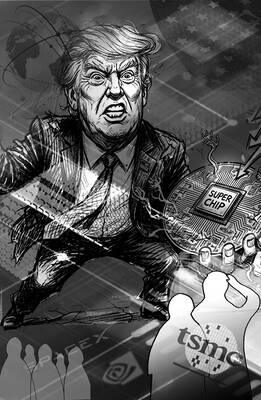
The White House’s decision to take a 9.9 percent stake in Intel Corp is looking like very shrewd business indeed. Since the government bought in at US$20.47 a share last August, the US chipmaker’s surging stock price has delivered the US a US$43 billion return. One of the reasons the investment has so far proved so sound is that the White House has made sure of it. According to The Wall Street Journal, Howard personally pushed deals on Intel’s behalf with some of the most lucrative clients imaginable. They include Nvidia Corp, the company at the heart of the AI
In a Taiwanese university classroom, a lecturer asks in English: “Can anyone give me an example from Taiwan?” Students look down. No one answers. After class, one student writes on the course platform in Mandarin: “I understood the concept, but I didn’t know how to answer in English.” That moment highlights a key issue in Taiwan’s English-medium instruction (EMI) reform: It is not just about more English-taught courses, but whether students can learn, participate and belong. EMI expansion is part of the Bilingual 2030 policy and the Ministry of Education’s BEST Program, aiming to improve English ability, support EMI teaching
The Ministry of the Interior, working with the navy and coast guard, is organizing Taiwan’s first joint exercise simulating escort tankers carrying liquefied natural gas (LNG) and oil through a Chinese blockade. The drills simulate fuel transport along three maritime corridors leading toward Japan, the Philippines and the US. Deputy Minister of the Interior Sawyer Mars (馬士元) said that a blockade of the Taiwan Strait would amount to “almost a 100 percent blockade of the regional energy supply.” Minister of National Defense Wellington Koo said planning to counter a blockade is standard practice in Taipei. While the exercise is limited in
A single photograph can cut through a lot of noise, but it can also be used to misrepresent the truth. At the very least, it can concentrate the mind on something that requires further investigation. On Monday last week, Ma Ying-jeou Foundation CEO Tai Hsia-ling (戴遐齡) and former National Security Council secretary-general King Pu-tsung (金溥聰) held a news conference in which they showed a photograph of former foundation CEO Hsiao Hsu-tsen (蕭旭岑), now Chinese Nationalist Party (KMT) deputy chairman. In the image Hsiao is seated next to Xiamen Taiwan Businessmen Association chairman Han Ying-huan (韓螢煥). The two men were holding


 RSS
RSS