


In 2023, Morocco crossed a critical threshold when the value of its automobile exports surpassed its revenues from phosphates, the mineral resource that had anchored the country’s economy for at least a century. Defying expectations, a country with no oil, no gas and no other obvious resource advantages had become the most dynamic automotive hub in the Mediterranean.
Yet, this was no miracle. It was something more useful — a case study in economic method. When Morocco gained independence in 1956, it inherited a colonial administration designed to extract resources, not to develop the economy. Access to higher education had been ruthlessly rationed. A mere 1,395 students completed secondary school that year, and barely 2,000 university students were enrolled nationwide. There were effectively no lawyers trained to write legislation, no economists to draft a budget and no engineers to run a port.
So, Morocco turned to the one group that the colonial system had not thought to restrict: doctors. Physicians who had studied in France became ambassadors, ministers and even prime ministers. The country built its first state with what it had, not with what it wished it had, and it has stuck with this approach. The lesson is not to wait for ideal conditions, but rather to make improvisation a formal policy and redirect available talent accordingly.
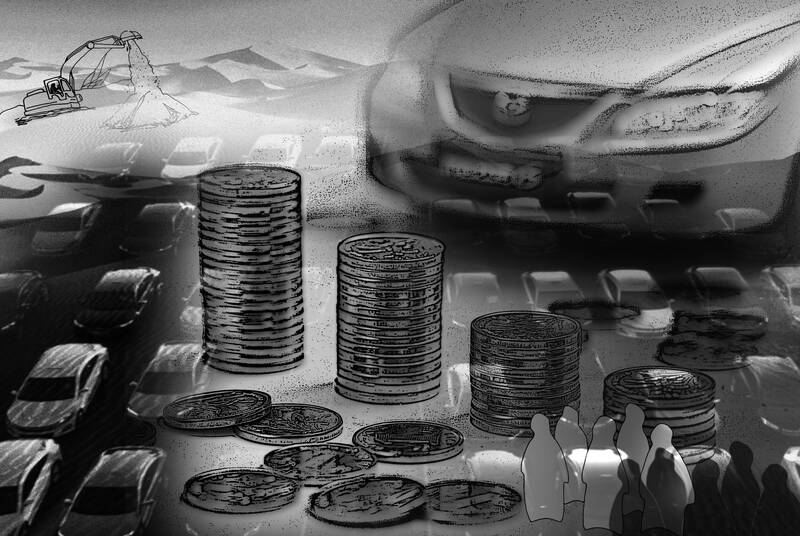
Illustration: Tania Chou
Morocco’s journey since independence looks less like a triumphal march than like a ship keeping its heading no matter what the weather brings. Rather than trying to sail in a straight line, Moroccan leaders have always tacked and adjusted, while never losing sight of the next waypoint.
The results speak for themselves. Between 1990 and 2019, GDP nearly tripled, and extreme poverty was virtually eradicated. From 2000 to 2017, per capita incomes grew faster than almost anywhere else in North Africa and the Middle East. None of this came from a commodity boom or a foreign windfall. Instead, Morocco developed a specific conception of the state’s role in orchestrating economic development. Rather than planning from above or stepping aside entirely, it set the score, brought in the right instruments and held the tempo.
For example, in building its automotive industry, the goal was never to build one factory, but to shape the domestic supply chain. Rather than simply offering tax breaks to foreign assemblers, the state structured the entire ecosystem. One carmaker would rely on about 200 first-tier suppliers, thus drawing 1,000 subcontractors into the chain. By 2023, the sector employed more than 200,000 people, with locally made content exceeding 65 percent.
The same logic drove Morocco’s energy bet. As a country that once imported 97 percent of its energy, Morocco had no choice but to treat the sun and wind as strategic assets. Now, it hosts one of the world’s largest concentrated solar-power complexes, and one of Africa’s largest wind farms. With the government targeting a 52 percent share for renewables in the national grid by 2030, a former liability has been deliberately transformed into a major asset.
Sustaining this approach over many decades benefited from continuity at the top. King Mohammed VI has played a key role in Morocco’s development story, not as an omniscient planner, but as the ultimate guarantor of long-term commitments and institutional stability.
Among other things, the king brought Morocco back into the African Union without preconditions in 2017, turning a decades-long defensive posture into a continental strategy. Then, in 2019, he publicly acknowledged that Morocco’s development model had fallen short in terms of social justice. Following the launch of a national commission that consulted more than 9,700 Moroccans across the country, Morocco embarked on a new cycle of reforms. By the time COVID-19 arrived, Morocco was prepared to mobilize one of Africa’s fastest vaccination campaigns (the king was the first Moroccan to be publicly vaccinated).
These gestures’ symbolic power derives from the institutional foundations they reveal. Having spent decades building trust, Moroccan institutions can be highly effective when they need to be. They have also boosted Morocco’s regional role. The country is now a leading investor in West Africa, with banks, fertilizer suppliers, telecoms and logistics networks spreading across the continent. In September last year, The Economist ran a headline that once would have seemed far-fetched: “Morocco Is Now a Trade and Manufacturing Powerhouse.”
Still, Morocco’s African footprint remains concentrated, and its economy is far from perfect. At home, the richest 10 percent earn 12 times more than the poorest 10 percent. A generation of young Moroccans is still waiting for the economy to work for them. It is a familiar problem. Africa has spent too long searching for external development blueprints. Governments have studied the Asian miracle, the European social compact and the Washington Consensus. Each promised a path to prosperity; none delivered.
Morocco has moved past this futile exercise. It offers not a shortcut but a guiding philosophy. The key is to understand your constraints and build from where you stand. Do not obsess about inherited conditions or the resources you lack. The choices you make, compounded over decades, are what matter.
For centuries, Morocco turned its back on the sea. Today, it faces both shores — the Atlantic and the Mediterranean — and the 2030 FIFA World Cup, cohosted with Spain and Portugal, would only further this shift.
True, the next chapter poses difficult questions. Bloomberg BusinessWeek has described Morocco as a “connector of globalization” — an economy that is absorbing supply chains displaced by US-China tensions — which implies risks as well as opportunities. Morocco must sustain its success through an age of technological disruption and external shocks, and it must do so in a way that reaches the young Moroccans who are still waiting for their time in the sun.
Abdelmalek Alaoui is an economist and the author of Maroc, le defi de la puissance (Editions du Cherche Midi, 2026).
Copyright: Project Syndicate
Reports about Elon Musk planning his own semiconductor fab have sparked anxiety, with some warning that Taiwan Semiconductor Manufacturing Co (TSMC) could lose key customers to vertical integration. A closer reading suggests a more measured conclusion: Musk is advancing a strategic vision of in-house chip manufacturing, but remains far from replacing the existing foundry ecosystem. For TSMC, the short-term impact is limited; the medium-term challenge lies in supply diversification and pricing pressure, only in the long term could it evolve into a structural threat. The clearest signal is Musk’s announcement that Tesla and SpaceX plan to develop a fab project dubbed “Terafab”
In late January, Taiwan’s first indigenous submarine, the Hai Kun (海鯤, or Narwhal), completed its first submerged dive, reaching a depth of roughly 50m during trials in the waters off Kaohsiung. By March, it had managed a fifth dive, still well short of the deep-water and endurance tests required before the navy could accept the vessel. The original delivery deadline of November last year passed months ago. CSBC Corp, Taiwan, the lead contractor, now targets June and the Ministry of National Defense is levying daily penalties for every day the submarine remains unfinished. The Hai Kun was supposed to be
Most schoolchildren learn that the circumference of the Earth is about 40,000km. They do not learn that the global economy depends on just 160 of those kilometers. Blocking two narrow waterways — the Strait of Hormuz and the Taiwan Strait — could send the economy back in time, if not to the Stone Age that US President Donald Trump has been threatening to bomb Iran back to, then at least to the mid-20th century, before the Rolling Stones first hit the airwaves. Over the past month and a half, Iran has turned the Strait of Hormuz, which is about 39km wide at
The ongoing Middle East crisis has reinforced an uncomfortable truth for Taiwan: In an increasingly interconnected and volatile world, distant wars rarely remain distant. What began as a regional confrontation between the US, Israel and Iran has evolved into a strategic shock wave reverberating far beyond the Persian Gulf. For Taiwan, the consequences are immediate, material and deeply unsettling. From Taipei’s perspective, the conflict has exposed two vulnerabilities — Taiwan’s dependence on imported energy and the risks created when Washington’s military attention is diverted. Together, they offer a preview of the pressures Taiwan might increasingly face in an era of overlapping geopolitical


 RSS
RSS