


It is astonishing that, in the 21st century, influential individuals still act as though they were immune to legal consequences. Even more worrying is that they can indeed expect to be shielded from scrutiny over extremely serious crimes. The Jeffrey Epstein scandal is a case in point. Epstein’s crimes were not only vile, they were exacerbated by the failure of US and UK authorities to listen to the many children whom he and his powerful friends exploited and abused.
However, while the Epstein affair is at least receiving global attention, the true scale of human trafficking and modern slavery remains underappreciated. The first corrective is to understand that this scourge does not require border crossing or even movement. It is about the control, coercion and abuse of the vulnerable.
Despite many legal instruments, protocols and commitments from bodies such as the UN, as well as laws in more than 180 countries criminalizing human trafficking, the demand for sexual exploitation, human organs, forced criminality, illegal adoption, forced marriage, child soldiers and exploitative labor continues to rise.
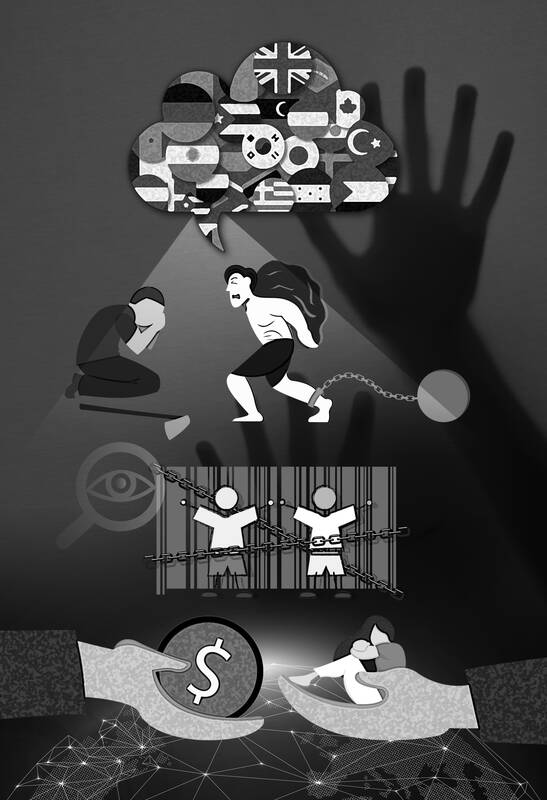
Illustration: Louise Ting
It is no secret why: The exploitation of about 50 million children, women and men generates at least US$236 billion per year in illicit profit. Criminals are thriving from a steady supply of people — often the world’s poorest and most vulnerable — because values such as compassion, respect and equality are increasingly being called into question or perceived as weaknesses. Increasingly cynical politics creates gaps in governance and social unity that criminals are quick to notice and exploit.
For comparison, US$236 billion exceeds the GDP of about two-thirds of the 193 UN member states, and is greater than the total official development assistance from Organisation for Economic Co-operation and Development countries. Given recent reductions in official development assistance budgets, it has become even more important to identify and seize illicit profits from human trafficking to compensate for criminal injuries, provide victim care, return stolen wages, eliminate debt bondage, improve prevention and bolster enforcement.
While campaigns to raise public awareness are important, they do little to disrupt gangs, stop forced labor and child exploitation, curb the illegal organ trade or prompt governments to ensure that their procurement is free from these crimes. Moreover, efforts often fail to recognize the broader impact on individuals, communities and national security.
Consider the example of a 15-year-old girl who leaves Eritrea to avoid national service and a life of rape and servitude at the behest of her military superiors. She escapes to Libya, only to be sold for sex daily until she earns enough for her exploiters to justify a place on an overcrowded boat destined for Italy, where the cycle of exploitation would be renewed.
Then there are the thousands of trafficked Vietnamese who are employed on illegal contracts tied to debt bondage each year. They are directed to jobs in China, then in Russia and finally in Europe. In a UK trafficking case, 39 people died in a freight truck in Essex. Most had paid large sums to secure work. Ten were teenagers, the youngest aged 15. Their families had to pay the debts charged by the traffickers, as well as the high cost of repatriating their loved ones’ remains.
On the high seas, many fishing fleets are crewed by Filipinos or Africans who face persistent racism, dangerous working conditions, low or even no pay and de facto enslavement on their vessels. Many have untreated injuries such as broken bones and deep lacerations.
Despite there being about 50 million victims of criminal exploitation — including 22,000 children who die on average each year performing hazardous work in high-risk industries — the US Department of State reported that only 102,027 victims were identified worldwide in 2024, with just 7,975 convictions. That works out to one conviction for every 6,270 victims. Praeveni Global has said that G20 countries together allocate only US$1.6 billion to combating the problem — less than 1 percent of the US$236 billion in annual illicit profits.
Although many relevant laws and tools are in place, greater follow-through is needed. To their credit, Australia, the UK, France, Germany, Brazil, the US, Canada and the EU have implemented various strategies to boost supply chain transparency. For example, Australia can restrict access to public procurement for businesses believed to have exploitation in their supply chain, the UK has mandatory reporting, and the US and Canada have banned imports linked to exploitation.
However, more needs to be done. The G20 summits in the US this year and in the UK next year offer opportunities for world leaders to commit finances and political will to combating human trafficking and modern slavery. Government-led action must be expanded to include intelligence gathering. Although NGOs have created tools for collecting information, only governments have the necessary authority and capacity to compile intelligence and intervene effectively.
Specifically, G20 governments should focus on six priorities. The first is to ensure accountability in business and government procurement processes. The second is to target the profits derived from criminal activities. That means establishing legal frameworks that allow for the seizure of proceeds — from hotel revenues to large-scale transactions — and for their re-allocation toward reparations, preventive strategies and prosecutions.
The third priority is to mandate that technological advances, such as digital platforms or cryptocurrencies, do not facilitate or contribute to exploitation. Governments must also make greater use of international instruments such as the Global Magnitsky Act or the European Convention on Mutual Assistance in Criminal Matters to promote effective cross-border collaboration. They should encourage international networks and agencies involved in criminal justice, professional associations and intergovernmental bodies such as the G20 and G7 to tackle these issues. Lastly, they need to reinforce ethical standards by empowering faith groups and other segments of civil society who can keep pressure on governments to uphold their responsibilities.
The scourge of modern slavery and criminal exploitation extends far beyond the Epstein case. Lengthy inquiries or further research into the matter are not useful. The problem is well known. What is needed is immediate action to address it.
Kevin Hyland, the UK’s first Anti-Slavery Commissioner, is chief executive officer of Praeveni Global, a non-profit that leads global efforts to prevent modern slavery and human trafficking, and cofounder of the Santa Marta Group.
Copyright: Project Syndicate
The conflict in the Middle East has been disrupting financial markets, raising concerns about rising inflationary pressures and global economic growth. One market that some investors are particularly worried about has not been heavily covered in the news: the private credit market. Even before the joint US-Israeli attacks on Iran on Feb. 28, global capital markets had faced growing structural pressure — the deteriorating funding conditions in the private credit market. The private credit market is where companies borrow funds directly from nonbank financial institutions such as asset management companies, insurance companies and private lending platforms. Its popularity has risen since
The Donald Trump administration’s approach to China broadly, and to cross-Strait relations in particular, remains a conundrum. The 2025 US National Security Strategy prioritized the defense of Taiwan in a way that surprised some observers of the Trump administration: “Deterring a conflict over Taiwan, ideally by preserving military overmatch, is a priority.” Two months later, Taiwan went entirely unmentioned in the US National Defense Strategy, as did military overmatch vis-a-vis China, giving renewed cause for concern. How to interpret these varying statements remains an open question. In both documents, the Indo-Pacific is listed as a second priority behind homeland defense and
Every analyst watching Iran’s succession crisis is asking who would replace supreme leader Ayatollah Ali Khamenei. Yet, the real question is whether China has learned enough from the Persian Gulf to survive a war over Taiwan. Beijing purchases roughly 90 percent of Iran’s exported crude — some 1.61 million barrels per day last year — and holds a US$400 billion, 25-year cooperation agreement binding it to Tehran’s stability. However, this is not simply the story of a patron protecting an investment. China has spent years engineering a sanctions-evasion architecture that was never really about Iran — it was about Taiwan. The
In an op-ed published in Foreign Affairs on Tuesday, Chinese Nationalist Party (KMT) Chairwoman Cheng Li-wun (鄭麗文) said that Taiwan should not have to choose between aligning with Beijing or Washington, and advocated for cooperation with Beijing under the so-called “1992 consensus” as a form of “strategic ambiguity.” However, Cheng has either misunderstood the geopolitical reality and chosen appeasement, or is trying to fool an international audience with her doublespeak; nonetheless, it risks sending the wrong message to Taiwan’s democratic allies and partners. Cheng stressed that “Taiwan does not have to choose,” as while Beijing and Washington compete, Taiwan is strongest when


 RSS
RSS