


One of the world’s largest Web sites for pirated manga, Bato.to, was shut down at the start of this year, sending shock waves through the anime and publishing industries. The site has been accused of causing enormous losses to the global content industry. Japan’s Content Overseas Distribution Association said that the Web site had for years translated and distributed Japanese, Korean and Chinese works, supporting more than 50 languages, and causing estimated losses of about ¥770 billion (US$4.9 billion). Following a transnational investigation, Chinese authorities took action against the service’s operators, and its related Web sites have been gradually shut down since January.
Bato.to was not a single Web site, but rather an online system encompassing about 60 platforms. It monetized traffic through advertising, with monthly ad revenue reaching as much as ¥8 million at its peak. For the operators of pirate sites, there is no need to bear the cost of creation — simply obtaining popular works and translating them quickly is enough to attract large volumes of traffic. This economy enabled many pirate platforms to survive for long periods within the global Internet environment.
For Japan’s manga and anime industries, piracy is no longer an isolated issue, but a structural one. Publishers such as Kadokawa Corp, Kodansha and Shueisha have repeatedly joined forces to crack down on pirate Web sites. Once pirate sites translate and release a work for free ahead of time, legitimate platforms often struggle to attract a readership of the same scale even after launching an official version.
Due to the cross-border nature of such online platforms, it is often difficult for any single country to track down their operators. Only through evidence gathering by industry organizations, cooperation between governments and coordination within judicial mechanisms can operators be identified and legal action be taken. This model is gradually becoming an important trend in the global governance of digital content.
Taiwan is an important market for anime and manga, but piracy and illegal downloading remain rampant. If copyright protections are not strengthened, it would hinder Taiwan’s domestic content industry. The government could bolster policy in three areas.
First, it should enhance cross-border copyright enforcement cooperation to investigate overseas piracy platforms.
Second, it should accelerate blocking mechanisms to shorten the time infringing content remains available.
Lastly, it should support the development of legitimate digital platforms to make it easier for readers to access content legally.
At the same time, it is crucial to change consumer culture. When readers become accustomed to accessing content instantly and at a very low cost, the revenue of creators and the publishing industry would only continue to be eroded. Therefore, striking a balance between protecting creators’ rights and providing convenient services has become a critical issue in digital cultural policy.
Eason Chen is an engineer.
Translated by Kyra Gustavsen
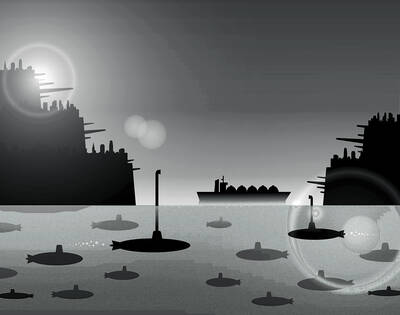
In the event of a war with China, Taiwan has some surprisingly tough defenses that could make it as difficult to tackle as a porcupine: A shoreline dotted with swamps, rocks and concrete barriers; conscription for all adult men; highways and airports that are built to double as hardened combat facilities. This porcupine has a soft underbelly, though, and the war in Iran is exposing it: energy. About 39,000 ships dock at Taiwan’s ports each year, more than the 30,000 that transit the Strait of Hormuz. About one-fifth of their inbound tonnage is coal, oil, refined fuels and liquefied natural gas (LNG),
To counter the CCP’s escalating threats, Taiwan must build a national consensus and demonstrate the capability and the will to fight. The Chinese Communist Party (CCP) often leans on a seductive mantra to soften its threats, such as “Chinese do not kill Chinese.” The slogan is designed to frame territorial conquest (annexation) as a domestic family matter. A look at the historical ledger reveals a different truth. For the CCP, being labeled “family” has never been a guarantee of safety; it has been the primary prerequisite for state-sanctioned slaughter. From the forced starvation of 150,000 civilians at the Siege of Changchun
The two major opposition parties, the Chinese Nationalist Party (KMT) and the Taiwan People’s Party (TPP), jointly announced on Tuesday last week that former TPP lawmaker Chang Chi-kai (張啟楷) would be their joint candidate for Chiayi mayor, following polling conducted earlier this month. It is the first case of blue-white (KMT-TPP) cooperation in selecting a joint candidate under an agreement signed by their chairpersons last month. KMT and TPP supporters have blamed their 2024 presidential election loss on failing to decide on a joint candidate, which ended in a dramatic breakdown with participants pointing fingers, calling polls unfair, sobbing and walking
In recent weeks, Taiwan has witnessed a surge of public anxiety over the possible introduction of Indian migrant workers. What began as a policy signal from the Ministry of Labor quickly escalated into a broader controversy. Petitions gathered thousands of signatures within days, political figures issued strong warnings, and social media became saturated with concerns about public safety and social stability. At first glance, this appears to be a straightforward policy question: Should Taiwan introduce Indian migrant workers or not? However, this framing is misleading. The current debate is not fundamentally about India. It is about Taiwan’s labor system, its


 RSS
RSS