


Months after it was postponed, the International Criminal Court (ICC) on Monday started a hearing to determine whether the charges of crimes against humanity against former Philippine president Rodrigo Duterte should proceed to a full-blown trial.
The war crimes court has granted the 80-year old’s request to skip the proceedings happening nearly a year since his detention at the ICC facility in The Hague, Netherlands, due to his anti-drug campaign that killed thousands.
“Former president Rodrigo Duterte’s long-awaited day in court is a significant step towards delivering justice for victims and survivors of his administration’s deadly so-called ‘war on drugs,’” Amnesty International secretary general Agnes Callamard said in a statement ahead of the hearing.
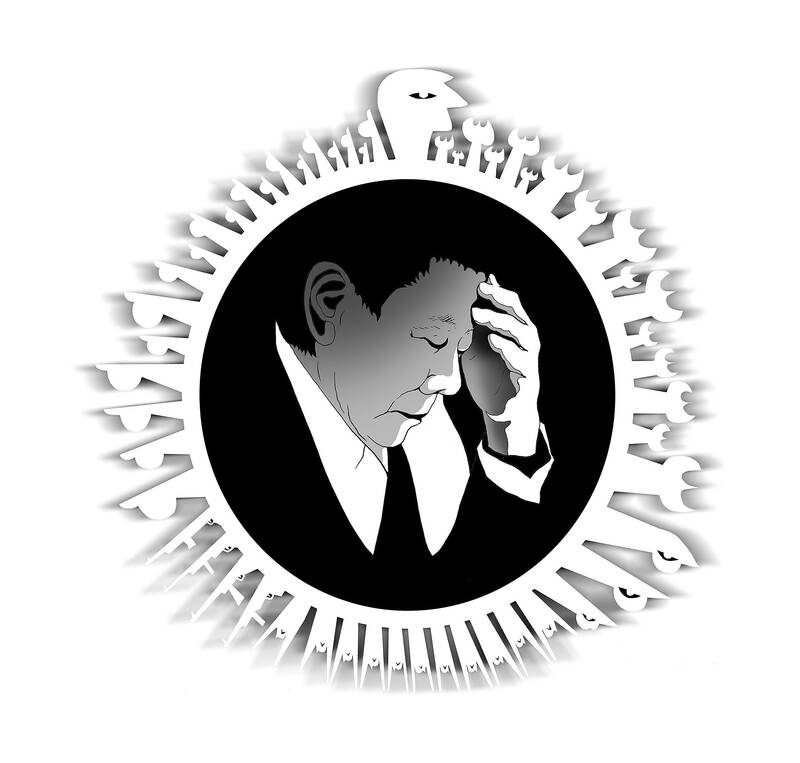
Illustration: Mountain People
The firebrand politician, who once vowed to kill 100,000 criminals and feed their bodies to the fish in Manila Bay, was surrendered by the administration of Philippine President Ferdinand Marcos Jr to ICC custody in March last year as Marcos’ ties with the Duterte family broke down over political differences.
The hearing on the confirmation of charges against the ex-leader is taking place months after a previous schedule in September last year to find out whether he was fit to stand trial. The pre-trial chamber last month ruled that he was after three medical experts examined him.
Still, Duterte said he would skip the proceedings as he continues to reject the ICC’s jurisdiction over him, and that he’s “old, tired and frail.”
The Dutertes still enjoy a loyal following in the Southeast Asian nation of 113 million people and his ICC case remains a polarizing issue at home.
His daughter, Philippine Vice President Sara Duterte, who is facing multiple impeachment complaints over allegations of misuse of public funds and threatening to assassinate Marcos, last week declared her bid for the 2028 presidential election. Analysts say she is a strong contender to succeed Marcos, who is limited to a single six-year term under the constitution.
While this week’s hearing would put a spotlight on the drug war victims, it remains unclear how much it can sway public opinion in the Philippines where Rodrigo Duterte’s crackdown was popular and an ongoing corruption scandal continues to fuel public outrage.
“I don’t expect any shift of sympathy from people in places where support for the Duterte family is strong,” said Sol Iglesias, an associate professor of political science at the University of the Philippines. “If there are any sentiments that might soften, it is really more of people who are undecided.”
“The big issue right now is really the public anger over corruption,” Iglesias said.
The hearings are scheduled to be held daily this week — except Wednesday — and were to include the reading of the charges, as well as oral arguments from the prosecution and defense. The court allowed the drug war victims to participate through their lawyers.
“If the charges are confirmed, totally or partly, the case will be transferred to a Trial Chamber, which will conduct the subsequent phase of the proceedings: the trial,” the ICC said.
The chamber will issue its decision within 60 days after the hearing.
The charges against Rodrigo Duterte, who led the Philippines from 2016 to 2022, include crimes allegedly committed during his term as mayor of southern Davao City, where his “no-nonsense” approach to combating crime helped catapult him to the presidency.
The Philippines withdrew from the ICC during his leadership, but the court said it retains jurisdiction over crimes allegedly committed in the country while it was still a party to the Rome Statute.
A gap appears to be emerging between Washington’s foreign policy elites and the broader American public on how the United States should respond to China’s rise. From my vantage working at a think tank in Washington, DC, and through regular travel around the United States, I increasingly experience two distinct discussions. This divergence — between America’s elite hawkishness and public caution — may become one of the least appreciated and most consequential external factors influencing Taiwan’s security environment in the years ahead. Within the American policy community, the dominant view of China has grown unmistakably tough. Many members of Congress, as
The Hong Kong government on Monday gazetted sweeping amendments to the implementation rules of Article 43 of its National Security Law. There was no legislative debate, no public consultation and no transition period. By the time the ink dried on the gazette, the new powers were already in force. This move effectively bypassed Hong Kong’s Legislative Council. The rules were enacted by the Hong Kong chief executive, in conjunction with the Committee for Safeguarding National Security — a body shielded from judicial review and accountable only to Beijing. What is presented as “procedural refinement” is, in substance, a shift away from
The shifting geopolitical tectonic plates of this year have placed Beijing in a profound strategic dilemma. As Chinese President Xi Jinping (習近平) prepares for a high-stakes summit with US President Donald Trump, the traditional power dynamics of the China-Japan-US triangle have been destabilized by the diplomatic success of Japanese Prime Minister Sanae Takaichi in Washington. For the Chinese leadership, the anxiety is two-fold: There is a visceral fear of being encircled by a hardened security alliance, and a secondary risk of being left in a vulnerable position by a transactional deal between Washington and Tokyo that might inadvertently empower Japan
After declaring Iran’s military “gone,” US President Donald Trump appealed to the UK, France, Japan and South Korea — as well as China, Iran’s strategic partner — to send minesweepers and naval forces to reopen the Strait of Hormuz. When allies balked, the request turned into a warning: NATO would face “a very bad” future if it refused. The prevailing wisdom is that Trump faces a credibility problem: having spent years insulting allies, he finds they would not rally when he needs them. That is true, but superficial, as though a structural collapse could be caused by wounded feelings. Something


 RSS
RSS