


Lists are “an invitation for a conversation,” says James Lindsay at the think tank Council on Foreign Relations. So, he drew up two lists, one for the 10 best decisions in US foreign policy over the past 250 years, and one for the 10 worst. Present company and headlines — the second term of US President Donald Trump, that is — were excluded by design. Yet, how could any conversation about those lists ignore what Trump is doing to the world, and to the US’ role in it?
The lists go back to surveys conducted in 2023, during then-US president Joe Biden’s administration. First, an advisory committee of the Society for Historians of American Foreign Relations (SHAFR), an august body in this field, made a master list of 120 weighty foreign-policy decisions taken between the American Revolution and the first Trump administration. Then SHAFR historians were asked to rank the 10 best and worst.
Many historians, amateur or professional, tend to feel more comfortable the further back in time they venture — I found my life lessons in ancient Carthage and Rome, for instance. So, it is unsurprising, say, that the US’ oldest alliance — with France, dating to 1778 — clocked in at number three in the top 10. Without it, the US probably would not have existed for long. Or that the Indian Removal Act of 1830 and the forced expulsion of the Cherokee in 1838 rank three and six among the worst decisions respectively. Those count as “foreign” policy, because the native tribes were sovereign nations.
Illustration: Mountain People
Even such distant events can provide lessons for us today — that alliances matter, for example, or that quasi-genocidal conquest is never a good idea, whether in the American West or in Ukraine. However, the conversations that Lindsay wants to seed naturally become more relevant to our time when the events in question occurred more recently — once the US was no longer a peripheral part of the New World, but the leading power of the whole world.
As I see it, a pattern jumps out: The US made its best decisions whenever it used its prodigious might to build and maintain an international system that worked for all countries, even small ones, based on laws, rules and norms, and on the assumption that global peace, prosperity and liberty are common public goods, best achieved by a joint (meaning multilateral) effort. The US made its worst decisions whenever it turned its back on that philosophy, sabotaged multilateral organizations or went rogue inside the very international system it built.
The second-best decision the US ever made was the creation of the UN in 1945. The US did not do that alone, of course, but it did play the leading role, after years of effort by then-US president Franklin D. Roosevelt and others (including his widow Eleanor) after his death. Their vision was to correct the legacy of the League of Nations, which was created after World War I but could not prevent World War II. The new UN was to be a forum for the world with a special onus on the great powers, including the US, to guarantee principles such as national sovereignty for all and the peaceful resolution of conflicts.
By contrast, the fifth-worst decision was the US Senate’s rejection of the Treaty of Versailles in 1919, and again in 1920. That treaty not only ended World War I, but also created the ill-fated League of Nations. It was the brainchild of then-US president Woodrow Wilson, but doomed to creeping irrelevance without the US support. We will never know how history might have turned out if the US had not opted out — if the US leadership in this multilateral organization could have stopped totalitarianism much earlier.
The pattern continues with the seventh-best decision, the creation of the Bretton Woods system in 1944. Named after the location in New Hampshire where it was conceived, it came to regulate global lending, currencies and trade roughly as the UN sought to order global security, human rights and other matters. Its institutions survive, in various degrees of health, to this day: the World Bank, the IMF and the General Agreement on Tariffs and Trade, which in 1995 became the WTO.
Like the UN, the Bretton Woods system was meant to correct the failures of the interwar years, and specifically the descent into economic warfare, with policies such the US’ Smoot-Hawley Tariffs, which did not make the list of the 10 worst decisions.
Other decisions that stood for US leadership and engagement — what became known as the Pax Americana or the American Century — include the creation of NATO in 1949 (ranked the sixth-best decision) and the Marshall Plan of 1948, ranked No. 1. Named after then-US secretary of state George Marshall, that program was one of the largest foreign-aid programs in history, as the US gave the equivalent of what would today be about US$180 billion to 16 countries in Western Europe that had been destroyed by World War II and needed help to stave off communism at home and the Soviets in the east. Together, NATO and the Marshall Plan stand for remarkable strategic foresight, and the good that can come when the US shows its power and generosity.
The list of the worst decisions tells the story of US power used wrong. No. 1 is the invasion of Iraq in 2003. Not only was it based on false assumptions — that Iraq had weapons of mass destruction. Unlike the Korean War or the Gulf War of 1990, it also lacked authorization from the UN Security Council — which had passed a resolution demanding inspections, but not allowing force. The US instead proceeded with a “coalition of the willing,” with consequences the historians consider disastrous.
Other bad decisions show the temporary closing of the US mind. At No. 8 on that list are the restrictions on Jewish refugees from Nazi Germany, owing to nativism, and prejudice and condemning tens of thousands to death. At No. 7 is the withdrawal in 2017 from the Paris Agreement, a UN accord to limit global warming. This is the only decision by the first Trump administration to make the lists.
In hindsight, that one was merely a hint of what was to come in his second administration, which in my book reads like its own addendum to the list of worst decisions. Trump keeps showing his contempt for NATO (sixth best in 250 years, remember), even threatening one of its members, Denmark, with seizing the territory of Greenland.
He also disses, boycotts, sabotages and undermines the UN system (second-best ever), withdrawing (again) from the Paris Agreement and from more than 60 other UN bodies. He is even trying to start a “Board of Peace” that seems designed to supplant the UN, with the twist that it is to be not only chaired by him — as long as he lives, apparently — but entirely built around his person, power and whim. International law and global order look different.
Policies that combine US generosity and grand strategy such as the Marshall Plan (No. 1) seem unimaginable in this new US. Under Trump, the US has instead skimped on aid to Ukraine, and on aid generally; the requisite organ, the US Agency for International Development, has in effect been eliminated.
The legacy of Bretton Woods is dead in all but name, as Trump wages trade war on the US’ partners and rivals alike. The Monroe Doctrine (eighth-best policy ever on the list) has under Trump become a brutish “Donroe Doctrine,” projecting truculence for its own sake throughout the Western Hemisphere.
Stand back from James Lindsay’s lists and take them in as a whole. What they seem to say is that the US was at its best whenever it was open to the world and engaged with it, and at its worst when it became closed or even inimical. It made positive history when it defined its own interests in enlightened ways, as a powerful member of an international community, as a country that would thrive when the whole world is safer, freer, healthier, richer and more orderly. It made negative history when it pursued its interests narrowly, in ways that sowed international strife, chaos or misery.
We should draw up these lists more often and then have the necessary conversations. I think the next good time would be in three years.
Andreas Kluth is a Bloomberg Opinion columnist covering US diplomacy, national security and geopolitics. Previously, he was editor-in-chief of Handelsblatt Global and a writer for The Economist. This column reflects the personal views of the author and does not necessarily reflect the opinion of the editorial board or Bloomberg LP and its owners.

A gap appears to be emerging between Washington’s foreign policy elites and the broader American public on how the United States should respond to China’s rise. From my vantage working at a think tank in Washington, DC, and through regular travel around the United States, I increasingly experience two distinct discussions. This divergence — between America’s elite hawkishness and public caution — may become one of the least appreciated and most consequential external factors influencing Taiwan’s security environment in the years ahead. Within the American policy community, the dominant view of China has grown unmistakably tough. Many members of Congress, as
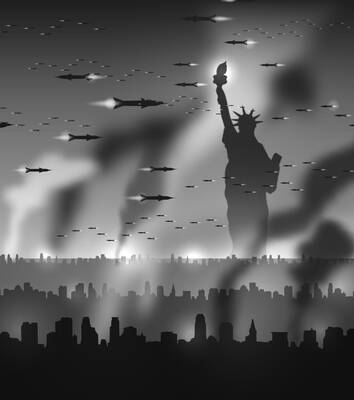
After declaring Iran’s military “gone,” US President Donald Trump appealed to the UK, France, Japan and South Korea — as well as China, Iran’s strategic partner — to send minesweepers and naval forces to reopen the Strait of Hormuz. When allies balked, the request turned into a warning: NATO would face “a very bad” future if it refused. The prevailing wisdom is that Trump faces a credibility problem: having spent years insulting allies, he finds they would not rally when he needs them. That is true, but superficial, as though a structural collapse could be caused by wounded feelings. Something
Former Taipei mayor and Taiwan People’s Party (TPP) founding chairman Ko Wen-je (柯文哲) was sentenced to 17 years in prison on Thursday, making headlines across major media. However, another case linked to the TPP — the indictment of Chinese immigrant Xu Chunying (徐春鶯) for alleged violations of the Anti-Infiltration Act (反滲透法) on Tuesday — has also stirred up heated discussions. Born in Shanghai, Xu became a resident of Taiwan through marriage in 1993. Currently the director of the Taiwan New Immigrant Development Association, she was elected to serve as legislator-at-large for the TPP in 2023, but was later charged with involvement
Out of 64 participating universities in this year’s Stars Program — through which schools directly recommend their top students to universities for admission — only 19 filled their admissions quotas. There were 922 vacancies, down more than 200 from last year; top universities had 37 unfilled places, 40 fewer than last year. The original purpose of the Stars Program was to expand admissions to a wider range of students. However, certain departments at elite universities that failed to meet their admissions quotas are not improving. Vacancies at top universities are linked to students’ program preferences on their applications, but inappropriate admission


 RSS
RSS