


From a certain angle, US President Donald Trump is in a matter of weeks doing what other leaders could never have dreamed about: Assembling an oil cartel with the sway to rival OPEC, and giving himself a kill switch for the energy-importing economy of the US’ prime geopolitical rival, China.
Combine Trump’s supposed hegemony over the Americas since the capture of former Venezuelan president Nicolas Maduro on Jan. 3 with control over a post-revolution Iran, and you are at about 42 percent of global oil production. Add to that the fact that China is the biggest importer of both Venezuelan and Iranian oil, and it looks like Beijing is suddenly vulnerable.
Not so fast. The bigger lesson from Washington’s actions in Venezuela, and from any hypothetical backing of regime change in Iran, is that diplomatic actions might change leaders, but they rarely alter the underlying relationships between oil producers and their customers. Those trading relationships, in turn, influence diplomatic alliances. Since World War II, politicians who have sought to control these flows have almost always failed.
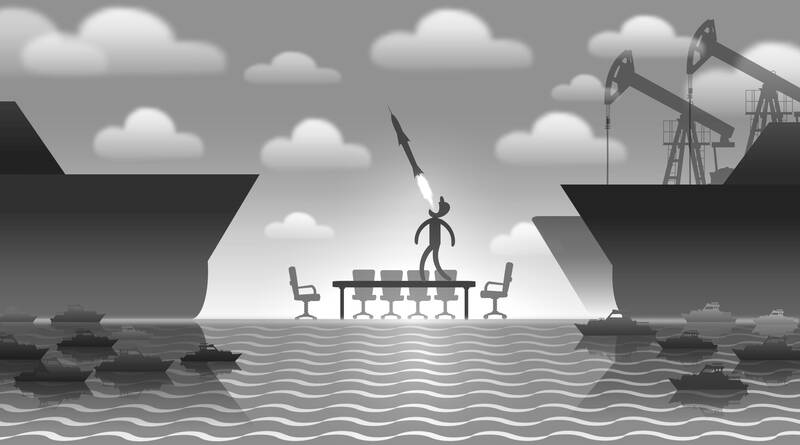
Illustration: Yusha
As we have previously written, China will be central to the next act in Venezuela’s drama. Beijing plays a similar, if not more important role for Iran, and it is one that is unlikely to be diminished by Trump’s latest geopolitical drama.
Even if relations with the US or other Western powers were to improve under a different leadership in Tehran — a very big if — Iran is unlikely to abandon its strategic alignment with China. The two are tied together in a loose web of diplomatic, economic and security networks. They have participated in military exercises, and in 2021 signed a pact outlining US$400 billion of potential Chinese investments over 25 years, providing a lifeline for Iran in the face of international sanctions.
Chinese President Xi Jinping (習近平) has been a huge backer of Tehran’s global south ambitions, encouraging it to join the Shanghai Cooperation Organization in 2023. China also supported its accession to the expanded BRICS bloc, in an attempt to cement groupings that can help Beijing challenge US power in the international arena.
On Jan. 9, warships from Iran, China, South Africa and the United Arab Emirates joined a weeklong naval exercises off the coast of South Africa.
Pragmatism defines much of Beijing’s relationship with Tehran. Chinese officials last week reaffirmed their long-standing position of backing stability in Iran, but nothing beyond a few words of concern in response to protests that have posed the biggest challenge to the Islamic republic since it was founded in 1979.
Beijing has its own problems with imposing geopolitical hegemony through military means, of course. It has adopted an aggressive stance across the region, most overtly, perhaps, toward Taiwan. That hardly makes it a paragon of a rules-based order and multilateral approach to international affairs. Still, Trump’s own swagger, made real in US foreign policy, has given China an opportunity to paint the US as an unreliable, predatory force in the world and itself as the rational actor.
There is also historical precedent for why a longer-term chill between Tehran and Beijing on the oil front is unlikely. For all the fears of petroleum being used as a geopolitical weapon, occasions when fossil fuel producers have frozen out their customers for political reasons are few and far between. The 1973 Arab oil embargo is a rare exception, but the failure of its stated aim — to end Western oil importers’ military support for Israel — illustrates why most have tended to steer clear of ideological fights.
The US continued importing oil from Iran on and off for eight years after the Islamic Revolution, and the EU is not set to completely phase out Russian gas imports until late next year, five years after Moscow invaded Ukraine. Far from getting shut out of Venezuela’s post-Maduro oil exports, China is already being lined up as a principal customer by commodity traders Trafigura Group and Vitol Group.
Expect more of the same in the coming months. Once upon a time, Washington’s restrictions on Asian oil trade could bring an aspiring hegemon to its knees. That is roughly what happened the one time in history when an oil embargo had a genuinely decisive geopolitical impact: In 1941, when the US provided about 90 percent of Japan’s fuel supplies and halted exports in response to its invasion of Southeast Asia, in turn precipitating the attack on Pearl Harbor.
Such leverage is beyond Trump’s grasp this time around. Russia is the only country that provides more than 10 percent of China’s crude, and most major suppliers are aspiring middle powers that would not be easily persuaded to do his bidding. Switching away from oil is another way of diversifying supplies: Electric vehicles and trucks would eliminate about 1.76 million barrels of Chinese oil demand this year, roughly equivalent to every barrel imported from Iran and Venezuela put together.
This slippery liquid always finds its level and can seep through the narrowest cracks to connect buyers with sellers. If you are betting that the law of trade and geopolitics has been upended, you might find yourself disappointed.
Karishma Vaswani is a Bloomberg Opinion columnist covering Asia politics with a special focus on China. Previously, she was the BBC’s lead Asia presenter and worked for the BBC across Asia and South Asia for two decades. David Fickling is a Bloomberg Opinion columnist covering climate change and energy. Previously, he worked for Bloomberg News, the Wall Street Journal and the Financial Times. This column reflects the personal views of the author and does not necessarily reflect the opinion of the editorial board or Bloomberg LP and its owners.
The conflict in the Middle East has been disrupting financial markets, raising concerns about rising inflationary pressures and global economic growth. One market that some investors are particularly worried about has not been heavily covered in the news: the private credit market. Even before the joint US-Israeli attacks on Iran on Feb. 28, global capital markets had faced growing structural pressure — the deteriorating funding conditions in the private credit market. The private credit market is where companies borrow funds directly from nonbank financial institutions such as asset management companies, insurance companies and private lending platforms. Its popularity has risen since
The Donald Trump administration’s approach to China broadly, and to cross-Strait relations in particular, remains a conundrum. The 2025 US National Security Strategy prioritized the defense of Taiwan in a way that surprised some observers of the Trump administration: “Deterring a conflict over Taiwan, ideally by preserving military overmatch, is a priority.” Two months later, Taiwan went entirely unmentioned in the US National Defense Strategy, as did military overmatch vis-a-vis China, giving renewed cause for concern. How to interpret these varying statements remains an open question. In both documents, the Indo-Pacific is listed as a second priority behind homeland defense and
Every analyst watching Iran’s succession crisis is asking who would replace supreme leader Ayatollah Ali Khamenei. Yet, the real question is whether China has learned enough from the Persian Gulf to survive a war over Taiwan. Beijing purchases roughly 90 percent of Iran’s exported crude — some 1.61 million barrels per day last year — and holds a US$400 billion, 25-year cooperation agreement binding it to Tehran’s stability. However, this is not simply the story of a patron protecting an investment. China has spent years engineering a sanctions-evasion architecture that was never really about Iran — it was about Taiwan. The
In an op-ed published in Foreign Affairs on Tuesday, Chinese Nationalist Party (KMT) Chairwoman Cheng Li-wun (鄭麗文) said that Taiwan should not have to choose between aligning with Beijing or Washington, and advocated for cooperation with Beijing under the so-called “1992 consensus” as a form of “strategic ambiguity.” However, Cheng has either misunderstood the geopolitical reality and chosen appeasement, or is trying to fool an international audience with her doublespeak; nonetheless, it risks sending the wrong message to Taiwan’s democratic allies and partners. Cheng stressed that “Taiwan does not have to choose,” as while Beijing and Washington compete, Taiwan is strongest when


 RSS
RSS