

It has been more than 40 years since I was imprisoned in Iran for speaking out against human rights abuses and state executions, and for defending women’s rights. I spent eight years behind bars in Iran’s notorious Evin prison. I was tortured. I remember it as if it happened yesterday.
Every few years, uprisings erupt across Iran — and each wave of resistance is deeper and more widespread than the one before. In 2022, it was women who led the Woman, Life, Freedom movement after the murder of 22-year-old Mahsa Amini by the country’s “morality police,” and it revolutionized my country. Today, women wear what they want, go out in public with their boyfriends — even live with them — without fear of being arrested. Women earned these rights with their lives. In late December last year, the spark was once again lit — this time in an old bazaar in Tehran.
The demands are the same ones we raised in the 1980s: an end to poverty, corruption and unemployment, the right to organize, and freedom from repression. Despite the gains for women’s freedoms made since 2022, workers are still denied basic labor rights. Students are arrested and even executed for peaceful protest. Women are still fighting for fundamental rights. People are still risking their lives to stand up to torture and state violence.
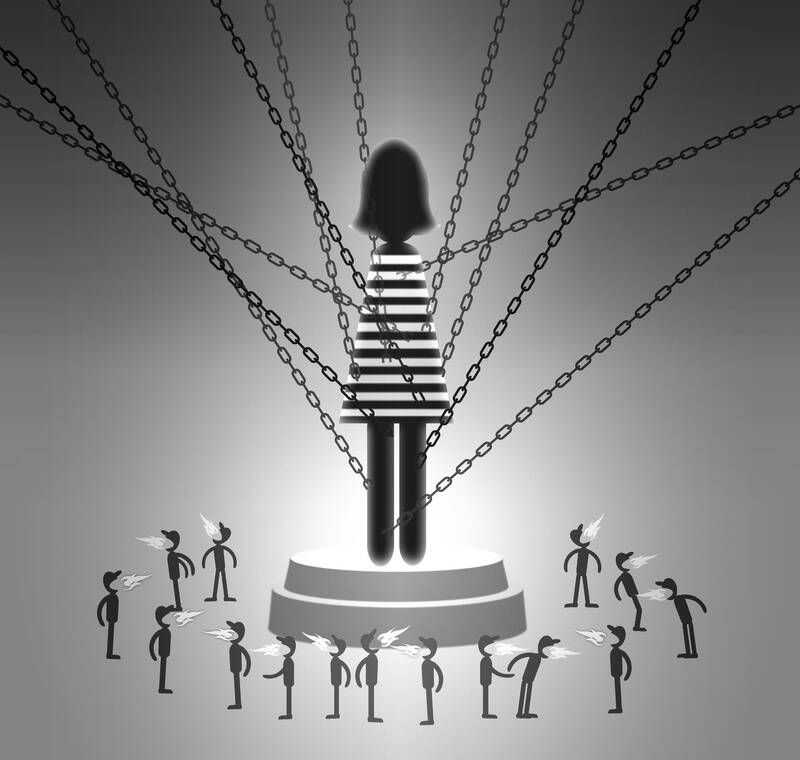
Illustration: Yusha
The regime’s response has been brutal. Human rights organizations report security forces shooting into crowds of largely peaceful protesters. I have seen heartbreaking images of families desperately looking for their loved ones among hundreds of body bags. The true death toll remains unknown, but reports suggested more than 2,000 people have been killed. Given the scale of the protests and the footage of violent clashes, the real number is probably far higher.
The Human Rights Activists News Agency said that by the end of the 17th day of protests, 18,434 people had been arrested and so far, 97 forced confessions have been broadcast on state television. These scenes bring back painful memories of my own imprisonment, where many people were tortured until they “confessed.” For survivors like me, moments like this reopen old wounds. I still see the faces of friends who were executed.
The regime is terrorizing civilians, burning shops and destroying beautiful, historic bazaars. Doctors are reportedly prevented from treating the wounded. Injured protesters are taken away from their hospital beds. Despite the killings, people are still in the street. They say they have nothing to lose but their chains.
However, the situation is changing so quickly. As of Wednesday last week, military vehicles patrol the streets in Tehran day and night, stopping anyone who dares go out. Only bakeries remain open, and people are leaving their homes only to buy the bare necessities.
Iran has been plunged into an Internet blackout. The regime wants to hide its crackdown from the rest of the world and stop Iranians from organizing. For those of us in exile, we wait in agony for news. I have not been able to reach my family and friends for more than a week. Watching the few grainy videos that reach us, survivors like me relive our worst nightmares.
When I fled Iran, I left everything behind — my family, my friends and my home. I was lucky though — I survived. I rebuilt my life. Many others did not.
Freedom from Torture has supported Iranian survivors like me for years, and in 2024 they assisted more people from Iran than any other country. For those who have escaped, the harrowing reports of brutality the world has been hearing since last month are deeply triggering. We know exactly what the regime is capable of.
My heart aches for my country. Iran has gone through half a century of war against its own people. Our society is deeply wounded, but the status quo cannot continue, because Iranians will never give up fighting for their rights and freedoms. Iran’s rulers use torture to silence dissent and instill fear. They tried to take my voice away, because I dared to dream of equality and freedom. Today, I use that voice to speak out about the horrors that continue, and to ask the world to speak up for Iranians.
Since 2022, I have watched with dismay as global attention has drifted away from Iran. Silence only empowers those who torture and kill with impunity. The international community and the media must keep shining a light on what is happening.
We must raise the political cost of executions. We must demand the release of political prisoners. We must insist that the use of torture ends right now. We must stand shoulder-to-shoulder in solidarity with Iranians, in their struggle for what many of us take for granted every day: freedom, dignity and a life without fear.
Nasrin Parvaz is a women’s rights activist and torture survivor from Iran. Her books include A Prison Memoir: One Woman’s Struggle in Iran, and the novel The Secret Letters from X to A.
When Panama severed diplomatic relations with Taiwan and recognized China in 2017, Beijing achieved one of its most important diplomatic victories in Central America. However, nearly a decade later, Panama is demonstrating that diplomatic recognition does not necessarily eliminate Taiwan from a country’s political system. Panama and Taiwan had diplomatic relations for more than 100 years and the goodwill between the countries was displayed last week when Panama’s National Assembly established an interparliamentary exchange group with the Legislative Yuan. Forty-five of the assembly’s 71 lawmakers joined the group, representing more than 60 percent of the legislature. Its members include National Assembly President Shirley
Ten years ago, when I was an undergraduate at National Chung Hsing University (NCHU), there was a referendum on whether to remove a statue of Chiang Kai-shek (蔣介石) from the campus. I wrote to the Liberty Times (the Taipei Times’ sister newspaper) urging faculty, staff and students to vote for its removal. Eventually, the statue was removed from the university. Today, I am filled with emotion at seeing students at Soochow University democratically remove their own statue of Chiang, a figure of authoritarian rule, after it was on display for 48 years The timing is noteworthy, with the nine-in-one local elections approaching.
Beijing has for decades insisted that Taiwan is a matter to be settled between China and the US — or, preferably, by China alone. The strategic environment around Taiwan is making that increasingly difficult. The clearest evidence this week came not from Washington or Beijing, but from Tokyo. Japanese Prime Minister Sanae Takaichi on Tuesday met with US President Donald Trump before his summit with Chinese President Xi Jinping (習近平). Taiwan is expected to feature prominently in US-China talks, particularly as Beijing presses Washington over arms sales to Taipei. However, focusing only on what Trump might or might not concede misses the
On the surface, a radio interview with Democratic Progressive Party and Taipei mayoral candidate Puma Shen (沈伯洋) hosted by television producer Wang Wei-chung (王偉忠) on Sept. 10 came across as an old-time city resident putting questions to a candidate on the campaign trail. Beneath that, however, it was an encounter between two distinct Taiwanese experiences, two generations and two different political vocabularies. Wang grew up in a military dependents’ village. His parents came to Taiwan with the Chinese Nationalist Party (KMT) government, carrying with them the legacy of war, displacement, the loss of a homeland, and an identification with Chinese culture


 RSS
RSS