


Indonesia’s first president, Sukarno, famously titled his 1964 independence day address Tahun vivere pericoloso — the year of living dangerously. The phrase, later immortalized in a book and film, captured a period of deep political and economic turmoil.
More than six decades on, Southeast Asia’s largest economy is again confronting a perilous moment. To be sure, Indonesia is at little risk of the Cold War coup that toppled Sukarno and led to 32 years of dictatorship by a hitherto obscure general, Suharto. However, growth is sluggish, global trade is fragmenting, and new geopolitical tensions — not least an increasingly unpredictable US-China relationship — are complicating policy choices. The top-down governing style of Indonesian President Prabowo Subianto — a military man who was once Suharto’s son-in-law — risks compounding this uncertainty and deterring overseas investment.
The high-profile trial of Nadiem Makarim, a former education minister and founder of popular ride-hailing giant Gojek, is the latest event to cause anxiety. In 2019, then-Indonesian president Joko Widodo, also known as Jokowi, appointed him to modernize the education system in the hope that the dynamic start-up boss who had successfully developed a super app would be able to execute his vision of building a 21st century Indonesia.
Instead, prosecutors last week opened proceedings against Makarim over alleged graft linked to the procurement of Google Chromebooks for schools, saying the project caused 2.1 trillion rupiah (US$125 million) in state losses. They also claim the process involved undisclosed conflicts of interest and improper gains of about 809 billion rupiah for Makarim. He denies all charges and has entered what is known in the Indonesian legal system as an objection plea, challenging the validity of the case.
In a statement to the court, he argued that the case reflects resistance to reform.
“My case is not a criminal case, but rather a narrative of friction between a new group seeking change and old players seeking to preserve the ‘status quo,’” he wrote.
That framing resonates in a country long held back by entrenched interests and a lack of transparency. The trial is being closely watched by investors concerned about legal predictability in the archipelago, home to more than 280 million people and regularly ranked by Transparency International as one of the world’s most corrupt nations. The US Department of State’s latest assessment cites legal and regulatory uncertainty, corruption and vested interests as obstacles to pursuing business opportunities.
Legal experts warn that applying criminal law to policy and procurement decisions, as prosecutors have done in this case, risks creating a chilling precedent. The issue goes beyond one person, said Bert Hofman, a former World Bank official who has advised governments across Asia.
“It speaks to governance, and whether the system attracts or deters young and capable technocrats from entering public service,” he said.
It is becoming a worrying pattern. Former Indonesian minister of trade Thomas Lembong, known for his reformist views, was convicted in a sugar import case in July last year, as speculation grew that the charges leveled against him — a key ally of an opposition figure — were politically motivated. He denied all charges and maintained his innocence, but was sentenced to four-and-a-half years in prison. Prabowo later granted him a full pardon, a rarely used presidential power, meaning that his conviction was overturned. That decision has added to the unease over the president’s expanding influence over legal and political issues.
The former general has brought the military back into civilian life, raising fears of a return to Indonesia’s authoritarian past, when the army played a dual role. Soldiers were used to implement Prabowo’s signature free meal program for school children, and have been deployed in controversial land seizures and forest clearances for a state-backed agricultural project (although the move has been framed as protecting national assets from foreign exploitation). Millions of hectares have already been reclaimed from plantation owners and private companies, with more likely to follow this year.
Civil liberties are also under renewed pressure. A new criminal code came into force on Jan. 2, and includes provisions penalizing insults to the president and state institutions. Human rights groups warn this could be used to stifle dissent, such as last year’s nationwide protests sparked by parliamentarians’ perks, or concerns raised over government failures exposed by disasters such as the recent Aceh floods.
Markets are not happy. Global funds sold Indonesian bonds between September and November last year, erasing billions of dollars in net inflows, following the social unrest. Confidence was further shaken by the dismissal of then Indonesian minister of finance Sri Mulyani Indrawati, who was widely regarded as an anchor of fiscal credibility, but became a particular focus of the protests. Flows stabilized somewhat last month, but only modestly. Foreign investment has also been lackluster.
Jakarta has promised to improve the investment climate, but this would require transparency and institutional reform at a time when Prabowo seems more inclined toward populist programs. He has set an ambitious 8 percent growth target, which would be difficult to achieve without foreign capital, policy credibility and a new set of young, educated technocrats willing to bring change to an arcane bureaucratic system.
Prabowo has earned strong approval ratings. However, power in Indonesia has long been understood through the Javanese concept of wahyu, authority granted on the chosen few, similar to China’s mandate of heaven. The archipelago’s own history has shown power is never permanent. He should remember that authority weakens when it drives away the very people — reformers, investors and technocrats — needed to secure Indonesia’s future.
Karishma Vaswani is a Bloomberg Opinion columnist covering Asia politics with a special focus on China. Previously, she was the BBC’s lead Asia presenter and worked for the BBC across Asia and South Asia for two decades. This column reflects the personal views of the author and does not necessarily reflect the opinion of the editorial board or Bloomberg LP and its owners.
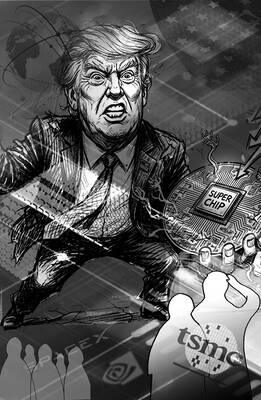
The White House’s decision to take a 9.9 percent stake in Intel Corp is looking like very shrewd business indeed. Since the government bought in at US$20.47 a share last August, the US chipmaker’s surging stock price has delivered the US a US$43 billion return. One of the reasons the investment has so far proved so sound is that the White House has made sure of it. According to The Wall Street Journal, Howard personally pushed deals on Intel’s behalf with some of the most lucrative clients imaginable. They include Nvidia Corp, the company at the heart of the AI
A single photograph can cut through a lot of noise, but it can also be used to misrepresent the truth. At the very least, it can concentrate the mind on something that requires further investigation. On Monday last week, Ma Ying-jeou Foundation CEO Tai Hsia-ling (戴遐齡) and former National Security Council secretary-general King Pu-tsung (金溥聰) held a news conference in which they showed a photograph of former foundation CEO Hsiao Hsu-tsen (蕭旭岑), now Chinese Nationalist Party (KMT) deputy chairman. In the image Hsiao is seated next to Xiamen Taiwan Businessmen Association chairman Han Ying-huan (韓螢煥). The two men were holding
I first met Professor Ray Jiing (井迎瑞) as a film and documentary student at Shih Hsin University’s (SHU) Department of Radio Television and Film in 1988. The following year, he went on to become the director of the Chinese Taipei Film Archive — forerunner of the Taiwan Film and Audiovisual Institute (TFAI). Over his eight-year tenure, Jiing rescued and restored over 200 classic Taiwanese films. In 1997, he established the Graduate Institute of Studies in Documentary and Film Archiving at Tainan National University of the Arts (TNNUA), and I joined the program in his third cohort of students. Beyond a
President William Lai Ching-te’s (賴清德) May 20 second-anniversary address was not just a routine policy review; it was damage control. US President Donald Trump’s remarks — that he did not want to see anyone move toward independence and that the delivery of a major Taiwan arms package could depend on the progress of US-China relations — unsettled Taiwan’s public and created an opening for opposition parties to question whether Taiwan was being treated as a bargaining chip in Washington’s dealings with Beijing. Lai’s speech was designed to close that opening. The address covered the expected ground: sovereignty, cross-strait relations, defense spending,


 RSS
RSS