


Taiwan and the US plan to jointly produce 155mm artillery shells to meet growing demand, Armaments Bureau Director-General Lieutenant General Lin Wen-hsiang (林文祥) said on Monday.
Lin cited strong demand for 155mm shells in Ukraine’s defense against Russia’s invasion, as well as Taiwan’s own defensive requirements. If the cooperation proves successful, it could be expanded to other types of munitions, he added.
The announcement follows remarks by Democratic Progressive Party (DPP) legislators Chiu Chih-wei (邱志偉) and Lin Chun-hsien (林俊憲) in February last year that Taiwan should improve the domestic arms industry by amending Article 22 of the National Defense Act (國防法). Chiu also proposed that Taiwan seek original manufacturer certification, and promote the development of its defense industry through international cooperation and investment, an approach that has received support in Washington.
Alexander Velez-Green, senior adviser to the US undersecretary of defense for policy, said during a US Senate Committee on Armed Services hearing last year — when he was a nominee for US deputy undersecretary of defense for policy — that joint weapons production could proceed by focusing on projects that are less complex and within Taiwan’s existing industrial capabilities.
The cooperation would initially involve drones and artillery shells, before being expanded to precision-guided munitions and artificial intelligence-assisted decisionmaking systems, a source said on Jan. 3.
However, Minister of National Defense Wellington Koo (顧立雄) has cautioned that even the domestic production of relatively simple munitions would likely involve higher per-unit costs than purchasing them overseas. Officials have also warned that no cooperation initiative can move forward if the opposition continues to refuse to review the defense budget.
A special act for improving defense resilience and asymmetric capabilities has already been submitted to the legislature, but it has been blocked by opposition parties and prevented from being placed on the agenda since last month.
The DPP should work to persuade Koo and opposition parties to consider the broader strategic picture. Domestic production of munitions — and potentially other arms — would help meet Taiwan’s own defense needs, while also offering the possibility of supporting US requirements in the Asia-Pacific region or those of its allies.
US officials have suggested building a munitions stockpile in Taiwan to reduce logistical burdens in the event of a conflict in the Taiwan Strait. During a legislative question-and-answer session on March 6, 2023, Chiu said that Taipei was “in talks” with the US military on relocating its East Asia stockpile to Taiwan. Domestic production would facilitate such an arrangement and improve Taiwan’s resilience against a potential blockade.
Building facilities for the domestic production of 155mm artillery shells would require upfront investment, but it would also help lower long-term costs for the military, shorten procurement times and create employment opportunities. Improved access to shells would also enhance military training. The armed forces fired 23.4 million rounds of ammunition in 2021, a figure that more than doubled to 58.81 million rounds by last year, Koo said.
The Chinese Nationalist Party (KMT) has said it wants greater clarity regarding how funds under the special defense budget would be spent, arguing that the government’s proposal was rushed, lacked sufficient consultation and risked bypassing legislative oversight.
The DPP should seek to address those concerns directly and publicly. Doing so could open the door to compromise over spending priorities, and to a substantive discussion of whether domestic munitions production is economically viable and in Taiwan’s long-term interest.
The nation is already engaged in humanitarian and development assistance in Ukraine. Helping to supply munitions for its war effort would be consistent with those commitments.
Joint munitions production with the US could significantly improve Taiwan’s defense self-reliance. However, the initial investment required to make such cooperation possible depends on cross-party consensus. The ruling and opposition parties should engage seriously on the issue, weighing the long-term economic and security benefits to the nation.
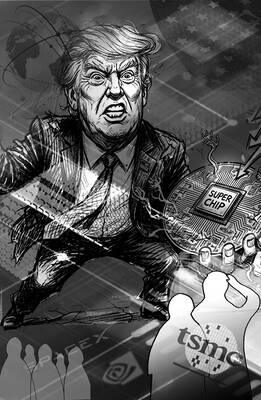
The White House’s decision to take a 9.9 percent stake in Intel Corp is looking like very shrewd business indeed. Since the government bought in at US$20.47 a share last August, the US chipmaker’s surging stock price has delivered the US a US$43 billion return. One of the reasons the investment has so far proved so sound is that the White House has made sure of it. According to The Wall Street Journal, Howard personally pushed deals on Intel’s behalf with some of the most lucrative clients imaginable. They include Nvidia Corp, the company at the heart of the AI
A single photograph can cut through a lot of noise, but it can also be used to misrepresent the truth. At the very least, it can concentrate the mind on something that requires further investigation. On Monday last week, Ma Ying-jeou Foundation CEO Tai Hsia-ling (戴遐齡) and former National Security Council secretary-general King Pu-tsung (金溥聰) held a news conference in which they showed a photograph of former foundation CEO Hsiao Hsu-tsen (蕭旭岑), now Chinese Nationalist Party (KMT) deputy chairman. In the image Hsiao is seated next to Xiamen Taiwan Businessmen Association chairman Han Ying-huan (韓螢煥). The two men were holding
I first met Professor Ray Jiing (井迎瑞) as a film and documentary student at Shih Hsin University’s (SHU) Department of Radio Television and Film in 1988. The following year, he went on to become the director of the Chinese Taipei Film Archive — forerunner of the Taiwan Film and Audiovisual Institute (TFAI). Over his eight-year tenure, Jiing rescued and restored over 200 classic Taiwanese films. In 1997, he established the Graduate Institute of Studies in Documentary and Film Archiving at Tainan National University of the Arts (TNNUA), and I joined the program in his third cohort of students. Beyond a
A recent report concerning a student who is suing his teacher posed the question in its headline: Does failing a student in two subjects constitute bullying? The college student in Chiayi County apparently sought NT$2 million (US$63,603) in state compensation, but a court dismissed the case. The first reaction of many might have been to ask: What has happened to students nowadays? Some say that teachers have lost their authority, while others say students are overindulged. Some even start reminiscing over the days when “whatever the teacher says goes.” However, the real issue might be overlooked if emotional reactions like that are the


 RSS
RSS