


The Ministry of Foreign Affairs on Saturday last week accused China of “digital authoritarianism” and transnational repression after Strait Plus (今日海峽), a Chinese state-controlled media channel, disseminated personal information about Democratic Progressive Party (DPP) Legislator Puma Shen (沈伯洋), including satellite images of his home and workplace in Taipei.
It was the latest escalation in a months-long campaign of intimidation and harassment that has followed Shen well beyond the realm of rhetoric, testing the boundaries of what Taiwan and the international community are prepared to tolerate.
Shen has been under sustained pressure since Chinese authorities last year announced they were investigating him for alleged “secession-related” activities, branding him “wanted” under Beijing’s sweeping and extraterritorial national security framework.
Chinese state media have amplified calls for his arrest, with some commentators even floating the use of Interpol — an idea dismissed by experts, but one intended to intimidate nonetheless.
Rather than receding, the pressure has intensified even as Shen carried out international political outreach with the US, South Korea, Germany and the Netherlands that focused on defending democratic institutions against authoritarian influence.
That persistence is precisely why Shen is being targeted so aggressively.
A former academic with expertise in disinformation and financial crime, he represents a category the Chinese Communist Party (CCP) finds uniquely threatening — a democratically elected lawmaker who understands authoritarian tactics, exposes them publicly and refuses to yield to them.
His appearances before foreign parliaments — including an address to a German committee on authoritarian disinformation — underscore Beijing’s failure to silence him. However, for Chinese state-linked media to publish detailed information of a private residence and workplace marks a dangerous shift.
As the ministry noted, such conduct contravenes basic principles of privacy enshrined in international human rights norms. It is also profoundly irresponsible. Doxxing is not merely an act of digital harassment, it is a deliberate exposure of an individual to foreseeable harm. When carried out by actors tied to a powerful state with a documented record of coercion, it cannot be dismissed as rhetorical excess.
The risks are not hypothetical. Shen last month was confronted on the street by a man who filmed and verbally threatened him while Shen was accompanied by his young daughter. The incident, now under investigation by police, was a reminder that inflammatory discourse can create real-world dangers for public figures and their loved ones.
Publishing the location of Shen’s home and workplace only escalates these risks — not just for Shen, but for anyone in his vicinity. That such escalation comes after months of official vilification should alarm anyone concerned with the safety and dignity of public servants in a democratic society.
Shen’s is far from an isolated case. China’s use of transnational repression — legal threats, surveillance, harassment by proxies and now digital exposure — has been increasingly documented in democracies around the world.
Lawmakers, activists and journalists critical of Beijing have faced similar tactics, from intimidation abroad to pressure exerted on family members at home. The objective is consistent — to export fear and induce self-censorship.
What distinguishes Shen’s case is that it is unfolding in full view of the public, targeting a sitting lawmaker on Taiwanese soil. Its implications are unavoidable.
Regarding the intimidation of elected officials as commonplace would compromise the integrity of democratic participation. If threats against families are met with resignation rather than resolve, the message sent would not be restraint, but vulnerability.
The government’s response so far — swift condemnation, police protection and coordination with international partners — has been appropriate. However, the larger test lies in consistency.
Democracies do not need to respond to coercion with escalation, but with clarity. That means refusing to normalize harassment, resisting the temptation to downplay the risks posed and ensuring that public officials can carry out their duties without fear of personal reprisal.
The CCP’s campaign against Shen is not a sign of strength. It is an admission of anxiety and insecurity over voices it cannot control and systems it cannot replicate. Taiwan should recognize it as such.
Yielding to intimidation, whether through silence or complacency, would only validate the CCP’s tactics. Standing firm, by contrast, would affirm a basic democratic principle — that political disagreement does not justify endangerment.
As Shen emphasized himself, Taiwan should never draw back in fear, but stand resolute in defense of its democracy.

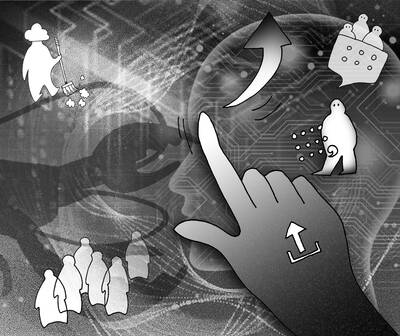
Weeks into the craze, nobody quite knows what to make of the OpenClaw mania sweeping China, marked by viral photos of retirees lining up for installation events and users gathering in red claw hats. The queues and cosplay inspired by the “raising a lobster” trend make for irresistible China clickbait. However, the West is fixating on the least important part of the story. As a consumer craze, OpenClaw — the AI agent designed to do tasks on a user’s behalf — would likely burn out. Without some developer background, it is too glitchy and technically awkward for true mainstream adoption,
On Monday, the day before Chinese Nationalist Party (KMT) Chairwoman Cheng Li-wun (鄭麗文) departed on her visit to China, the party released a promotional video titled “Only with peace can we ‘lie flat’” to highlight its desire to have peace across the Taiwan Strait. However, its use of the expression “lie flat” (tang ping, 躺平) drew sarcastic comments, with critics saying it sounded as if the party was “bowing down” to the Chinese Communist Party (CCP). Amid the controversy over the opposition parties blocking proposed defense budgets, Cheng departed for China after receiving an invitation from the CCP, with a meeting with
Chinese Nationalist Party (KMT) Chairwoman Cheng Li-wun (鄭麗文) is leading a delegation to China through Sunday. She is expected to meet with Chinese President Xi Jinping (習近平) in Beijing tomorrow. That date coincides with the anniversary of the signing of the Taiwan Relations Act (TRA), which marked a cornerstone of Taiwan-US relations. Staging their meeting on this date makes it clear that the Chinese Communist Party (CCP) intends to challenge the US and demonstrate its “authority” over Taiwan. Since the US severed official diplomatic relations with Taiwan in 1979, it has relied on the TRA as a legal basis for all
A delegation of Chinese Nationalist Party (KMT) officials led by Chairwoman Cheng Li-wun (鄭麗文) is to travel to China tomorrow for a six-day visit to Jiangsu, Shanghai and Beijing, which might end with a meeting between Cheng and Chinese President Xi Jinping (習近平). The trip was announced by Xinhua news agency on Monday last week, which cited China’s Taiwan Affairs Office (TAO) Director Song Tao (宋濤) as saying that Cheng has repeatedly expressed willingness to visit China, and that the Chinese Communist Party (CCP) Central Committee and Xi have extended an invitation. Although some people have been speculating about a potential Xi-Cheng


 RSS
RSS