


Venezuela is unlikely to see any meaningful boost to crude output for years even if US oil majors do invest the billions of dollars in the country that US President Donald Trump just hours following Venezuelan President Nicolas Maduro’s capture by US forces
The South American country might have the world’s largest estimated oil reserves, but output has plummeted over the past decades amid and a lack of investment from foreign firms after Venezuela nationalized oil operations in the 2000s, which included assets of Exxon Mobil and ConocoPhillips.
Any companies that might want to invest there would need to deal with security concerns, dilapidated infrastructure, questions about the legality of the US operation to snatch Maduro and the potential for long-term political instability, analysts told Reuters.
US firms will not return until they know for sure they will be paid and will have at least a minimal amount of security, said Mark Christian, director of business development at CHRIS Well Consulting.
Christian also said the companies would not go back until sanctions against the country are removed.
Venezuela would also have to reform its laws to allow for larger investment by foreign oil companies. Venezuela nationalized the industry in the 1970s and in the 2000s ordered a forced migration to joint ventures controlled by its state oil company, PDVSA. Most companies negotiated exits and migrated, including Chevron, while a handful of others did not reach deals and filed for arbitration.
“If Trump et al can produce a peaceful transition with little resistance, then in five to seven years there is a significant oil-production ramp up as infrastructure is repaired and investments get sorted out,” Thomas O’Donnell, an energy and geopolitical strategist, told Reuters, adding that heavy crude produced in the country works well with US gulf coast refineries and can also be blended with lighter oil produced from fracking.
However, that would depend on everything going right, and there is a lot that could go wrong.
“A botched political transition that has a feeling of US dominance can lead to years of resistance,” armed groups of citizens and guerrilla groups that operate in the country, O’Donnell said.
Chevron would be positioned to benefit the most from any potential oil opening in Venezuela, said Francisco Monaldi, director of the Latin America Energy Program at Rice University’s Baker Institute in Houston, Texas.
Other US oil firms would be paying attention to political stability and would wait to see how the operational environment and contract framework unfolded, he said.
“The company that probably will be very interested in going back is Conoco, because they are owed more than US$10 billion, and it is unlikely that they will get paid without going back into the country,” Monaldi said.
Exxon could also return, but is not owed as much money, he added.
“ConocoPhillips is monitoring developments in Venezuela and their potential implications for global energy supply and stability. It would be premature to speculate on any future business activities or investments,” a company spokesperson said in e-mailed comments to Reuters.
Chevron, which exports about 150,000 barrels per day of crude from Venezuela to the US gulf coast, has had to carefully maneuver with the Trump administration in an effort to maintain its presence in the country over the past year.
Chevron chief executive officer Mike Wirth last month said that he had spoken with the Trump administration about what he said was the importance of maintaining an American presence in the country through multiple political cycles.
The oil firm has been in Venezuela for more than 100 years and on Saturday said that it is focused on the safety and well-being of its employees, in addition to the integrity of its assets.
“We continue to operate in full compliance with all relevant laws and regulations,” a Chevron spokesperson said in an e-mailed response to questions.
Exxon did not immediately respond to questions from Reuters.
Ed Hirs, an energy fellow at University of Houston, said recent events in Venezuela would have little impact on US prices for oil and gasoline for now, with much of the country’s production going to Cuba and China at the moment.
He also said that history is full of recent examples of US excursions that did not produce notable results for US companies.
“Trump now joins the history of US presidents who have overthrown regimes of countries. [George W.] Bush with Iraq. [Barack] Obama with Libya. In those cases, the United States has received zero benefit from the oil. I’m afraid that history will repeat itself in Venezuela,” Hirs said.
Oil tankers chartered by Chevron had been among the few to set sail from Venezuela over the past month, following Trump’s announcement last month of a “ blockade.”
That is perhaps where one quick win could emerge, if Trump is able to restart the flow of Venezuelan crude into the gulf coast, potentially boosting refiners like Valero in the process. At the moment, it appears that just the opposite is happening.
A gap appears to be emerging between Washington’s foreign policy elites and the broader American public on how the United States should respond to China’s rise. From my vantage working at a think tank in Washington, DC, and through regular travel around the United States, I increasingly experience two distinct discussions. This divergence — between America’s elite hawkishness and public caution — may become one of the least appreciated and most consequential external factors influencing Taiwan’s security environment in the years ahead. Within the American policy community, the dominant view of China has grown unmistakably tough. Many members of Congress, as
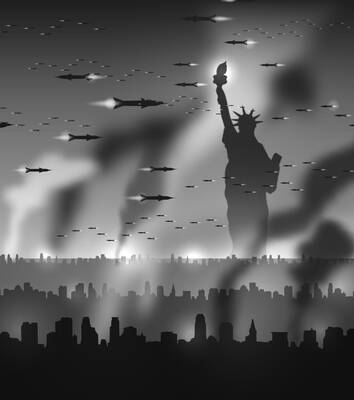
After declaring Iran’s military “gone,” US President Donald Trump appealed to the UK, France, Japan and South Korea — as well as China, Iran’s strategic partner — to send minesweepers and naval forces to reopen the Strait of Hormuz. When allies balked, the request turned into a warning: NATO would face “a very bad” future if it refused. The prevailing wisdom is that Trump faces a credibility problem: having spent years insulting allies, he finds they would not rally when he needs them. That is true, but superficial, as though a structural collapse could be caused by wounded feelings. Something
Former Taipei mayor and Taiwan People’s Party (TPP) founding chairman Ko Wen-je (柯文哲) was sentenced to 17 years in prison on Thursday, making headlines across major media. However, another case linked to the TPP — the indictment of Chinese immigrant Xu Chunying (徐春鶯) for alleged violations of the Anti-Infiltration Act (反滲透法) on Tuesday — has also stirred up heated discussions. Born in Shanghai, Xu became a resident of Taiwan through marriage in 1993. Currently the director of the Taiwan New Immigrant Development Association, she was elected to serve as legislator-at-large for the TPP in 2023, but was later charged with involvement
Out of 64 participating universities in this year’s Stars Program — through which schools directly recommend their top students to universities for admission — only 19 filled their admissions quotas. There were 922 vacancies, down more than 200 from last year; top universities had 37 unfilled places, 40 fewer than last year. The original purpose of the Stars Program was to expand admissions to a wider range of students. However, certain departments at elite universities that failed to meet their admissions quotas are not improving. Vacancies at top universities are linked to students’ program preferences on their applications, but inappropriate admission


 RSS
RSS