


Hosting Israeli Prime Minister Benjamin Netanyahu for the fifth time since returning to the White House 11 months ago, US President Donald Trump gave a performance on Monday that provided a microcosm of his customary disdain for foreign policy protocol.
In an impromptu 15-minute news conference on the steps of Mar-a-Lago, Trump first offered an offhand and vaguely dismissive acknowledgement of the unusual frequency of the Israeli prime minister’s visits by asking journalists: “Do you recognize this guy?”
He then proceeded to cavalierly trample diplomatic convention by saying that he would back Netanyahu “immediately” if he ordered another attack on Iran’s nuclear installations, while confirming that he had asked Israeli President Isaac Herzog to pardon Netanyahu in a bribery and corruption trial — apparently heedless of the appearance of interfering in the affairs of a sovereign state.
More startlingly still, he appeared to accept Russia’s claim that Ukraine had attacked Russian President Vladimir Putin’s residence overnight while acknowledging that he had no independent US intelligence confirmation, preferring to accept the Putin’s word, even as Ukrainian President Volodymyr Zelenskiy, who Trump hosted the day before, denounced the story as a lie.
Almost in passing, Trump crowed about his relationship with another hardline leader, Turkish President Recep Tayyip Erdogan, who long derided Netanyahu and compared him to Hitler. The Israeli leader is fiercely opposed to Turkish forces playing any role in the fragile peace settlement and rebuilding of Gaza.
If Netanyahu was perturbed by that, his poker-faced visage did not display it. He said Trump was the best friend among any US presidents Israel had ever had.
“We’ve never had a friend like President Trump in the White House,” Netanyahu said. “You can judge that by not merely by the frequency of our meetings, but by the content and the intensity. I think Israel is very blessed to have President Trump leading the United States.”
Later, at a lunch between the two, Netanyahu reinforced the amicable air by indulging Trump’s weakness for flattery, telling him that he would be the first non-Israeli to be awarded the Israel Prize, the Jewish state’s highest cultural honor.
That testimonial was, if anything, outmatched by an even more hyperbolic encomium from Trump, who said that Israel would no longer exist if it had been led in the past few years by any other prime minister.
“There could be other wartime prime ministers but they would lose,” he said at a formal news conference after the lunch. “He won. If you had a weak person, a stupid person — and there are plenty of both — you might not have Israel.”
In truth, the meeting came at a time of significant friction between the pair — and the words of praise disguised likely feelings of mutual irritation.
The White House is trying to press Netanyahu into entering into the second phase of Trump’s highly-prized 20-point Gaza peace plan — even as Netanyahu expresses reluctance to go along on the grounds that Hamas has not been properly disarmed.
Trump acknowledged his guest’s concerns, saying “there has to be a disarming of Hamas.” He was less solicitous when asked if reconstruction of the shattered coastal territory would begin before Hamas had been disarmed.
“I think it’s going to begin pretty soon,” he said, before adding: “He’s looking forward to it and so am I. What a mess.”
How to make sense of Trump’s utterances on Iran, whose uranium enrichment facilities in Fordow, Isfahan and Natanz he ordered bombed last June? The US strikes came after Israel had initially launched attacks on Iran’s nuclear facilities, as well as broader assaults that drew Iranian retaliation.
Trump has repeatedly insisted that the US action “obliterated” Iran’s nuclear capabilities. Yet here was Netanyahu back to argue the case for a renewed offensive amid reports that Tehran’s theocratic rulers are upgrading the country’s ballistic missile capabilities and trying to rebuild its damaged nuclear facilities.
In response, Trump acknowledged that “Iran may be behaving badly” but said that “it hasn’t been confirmed.” He hoped Tehran would negotiate a deal.
Would he support Israeli strikes if no deal was forthcoming? “If they continue with [ballistic] missiles, yes; the nuclear [program]? Fast,” he replied, before saying that the US would launch its own attack in the case of a resumed nuclear program. “One will be yes, absolutely. The other will be, we’ll do it immediately.”
Yet he drew the line at regime change, something Israel seemed to be aiming at last summer when it expanded attacks beyond military installations to target several Revolutionary Guard commanders, as well as bombing Tehran’s Evin prison, whose inmates include political prisoners and which has long been seen as a symbol of repression.
“I’m not going to talk about an overthrow of a regime,” Trump said. “They’ve got a lot of problems. They have tremendous inflation, their economy is bust and I know that the people aren’t so happy. But don’t forget, every time they have a riot or somebody forms a group, little or big, they start shooting people.”
It might have been intended as a caution to Netanyahu.
Clearer still was Trump’s message on Syria and its president, Ahmed al-Sharaa, who was hosted at the White House despite his past as a commander in rebel groups that formed part of the Islamic State and explicit hostility from Israel, which has branded his regime as “jihadist Islamist terrorists”.
“I hope he’s going to get along with Syria,” Trump said of Netanyahu. “Because the new president of Syria is working very hard to do a good job. He’s a tough cookie. [But] you’re not going to get a choir boy to lead Syria.”
Asked later if he and Netanyahu had reached an accord on the subject, Trump replied: “We do have an understanding regarding Syria.”
He then passed the baton to Netanyahu, who sounded less than thrilled. “Yeah, well. Our interest is to have a peaceful border with Syria. We want to make sure that the border area right next to our border is safe — that we don’t have terrorists.”
As understandings go, it sounded distinctly open to interpretation.

A gap appears to be emerging between Washington’s foreign policy elites and the broader American public on how the United States should respond to China’s rise. From my vantage working at a think tank in Washington, DC, and through regular travel around the United States, I increasingly experience two distinct discussions. This divergence — between America’s elite hawkishness and public caution — may become one of the least appreciated and most consequential external factors influencing Taiwan’s security environment in the years ahead. Within the American policy community, the dominant view of China has grown unmistakably tough. Many members of Congress, as
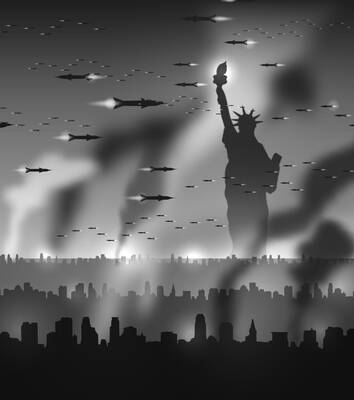
After declaring Iran’s military “gone,” US President Donald Trump appealed to the UK, France, Japan and South Korea — as well as China, Iran’s strategic partner — to send minesweepers and naval forces to reopen the Strait of Hormuz. When allies balked, the request turned into a warning: NATO would face “a very bad” future if it refused. The prevailing wisdom is that Trump faces a credibility problem: having spent years insulting allies, he finds they would not rally when he needs them. That is true, but superficial, as though a structural collapse could be caused by wounded feelings. Something
Former Taipei mayor and Taiwan People’s Party (TPP) founding chairman Ko Wen-je (柯文哲) was sentenced to 17 years in prison on Thursday, making headlines across major media. However, another case linked to the TPP — the indictment of Chinese immigrant Xu Chunying (徐春鶯) for alleged violations of the Anti-Infiltration Act (反滲透法) on Tuesday — has also stirred up heated discussions. Born in Shanghai, Xu became a resident of Taiwan through marriage in 1993. Currently the director of the Taiwan New Immigrant Development Association, she was elected to serve as legislator-at-large for the TPP in 2023, but was later charged with involvement
Out of 64 participating universities in this year’s Stars Program — through which schools directly recommend their top students to universities for admission — only 19 filled their admissions quotas. There were 922 vacancies, down more than 200 from last year; top universities had 37 unfilled places, 40 fewer than last year. The original purpose of the Stars Program was to expand admissions to a wider range of students. However, certain departments at elite universities that failed to meet their admissions quotas are not improving. Vacancies at top universities are linked to students’ program preferences on their applications, but inappropriate admission


 RSS
RSS