


It was a tough year for science in the US. Thousands of research grants, including more than 3,800 from the US National Institutes of Health and the National Science Foundation alone, were frozen or canceled. NASA was threatened with sweeping budget cuts. Top scientists are leaving the US in search of better opportunities. And misinformation about vaccines and other important scientific matters continues to spread.
However, despite these setbacks, scientists around the world produced amazing discoveries every day — some of which made a big splash, while others did not get nearly the attention they deserved.
Here is a sample of findings that were perhaps more significant than some of the major headline-makers.
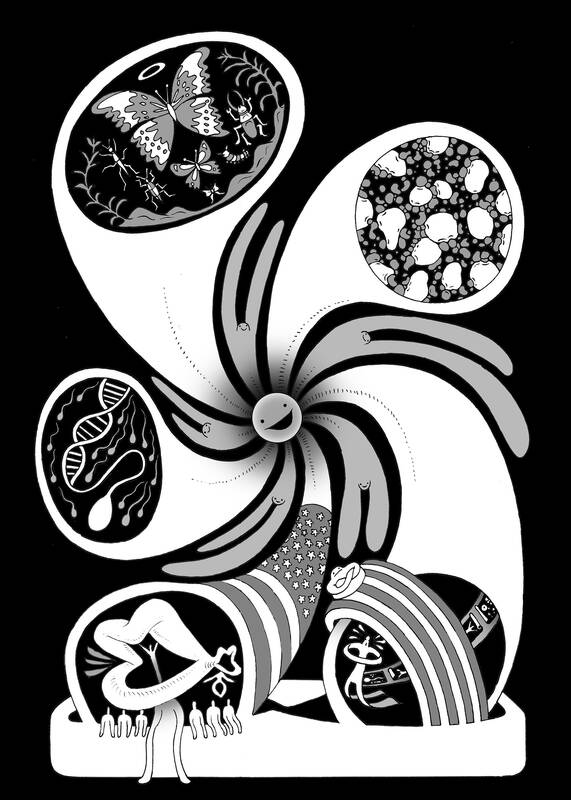
Illustration: Mountain People
‧ ‘De-extinct’ dire wolves are cute,
but what about the butterflies?
Spring brought the attention-grabbing claim from Colossal Biosciences that it had “resurrected” dire wolves — a species that had been extinct for 12,500 years. At about the same time, a group of researchers published a report documenting a rapid decline in global butterfly populations.
The butterfly report matters because it shows that genetic engineering feats such as “de-extinction” are insufficient to stop the rapid decline of wild species of all kinds, because such efforts cannot restore the ecosystems that support them.
Butterfly populations have declined by 22 percent over the past 20 years. Pesticides are wiping out some species, while others are losing habitat and food sources to humanity’s needs for homes and farmland.
This is part of a broader decline in insect populations worldwide, which means plants are losing pollinators and animals are losing an essential source of food.
Meanwhile, biologists continue to debate whether the dire wolves were really just genetically modified gray wolves. Whatever you call the three pups the company produced, they represent an impressive technological achievement and innovative fundraising effort. Imagine what we could accomplish if we put that same effort and brainpower into inventing new, sustainable ways to grow food without crowding out or poisoning the insects we all depend on.
‧ Humans were super
intelligent 30,000 years ago
This year, it was hard to avoid gloomy pronouncements about human intelligence — from brain fog to shrinking attention spans to declining IQ scores.
However, archeology tells a different story — one of humans possessing similar intellectual abilities for tens of thousands of years.
Here is an IQ test nature posed to Stone Age humans 30,000 years ago: There is a vast stretch of rough, cold ocean in front of you with a raging current cutting across it, and a faint outline of land barely visible from your highest peak. You have only stone tools. How do you get to the other side?
Archeologists know that people must have passed this test to settle the Ryukyu Islands, a chain that stretches from Kyushu, Japan, to what is now Taiwan. Models published earlier this year indicate that 30,000 years ago, this 220km-wide stretch of ocean was driven by the same strong current observed there today. A similar feat of island hopping brought people to Australia about 50,000 years ago, but anthropologist Yousuke Kaifu believes that the Ryukyu Islands trip was the world’s most treacherous Stone Age boating voyage.
The best way to figure out how Stone Age humans might have done it, he reasoned, was to assemble a team of athletic and adventurous modern-day humans to build a boat and attempt the same feat of stellar and solar navigation using nothing but Stone Age technology and local materials.
They built reed and bamboo boats, which either swamped, capsized, or were swept off course by the current. Eventually, they constructed a dugout canoe from a felled cedar tree. After several false starts, a group of paddlers completed the journey in 44 hours and 10 minutes, publishing their findings in Science Advances in June.
Kaifu said he believes people did it for the same reason we build deep-sea submersibles and spacecraft. It is humbling but also reassuring to realize that humanity has likely always had brainpower and grit — and probably will not lose those abilities anytime soon.
‧ Universal blood and experiments
on the recently deceased
If you are okay with having your organs removed for transplant when you die, how would you feel about doctors implanting organs into your recently deceased body as part of an experiment? That is what happened earlier this year when doctors in Canada and China collaborated to transplant a kidney into a brain-dead man to test a new way to avoid organ rejection.
For those of us who have read Robin Cook’s thriller Coma, the experiment evokes the book’s chilling fictional portrayal of comatose patients being exploited — people who are in no position to advocate for themselves.
However, in real life, experts say it is relatively easy to distinguish between patients who have been declared brain-dead — and therefore legally considered dead — and those who are comatose or in a persistent vegetative state, said Arthur Caplan, head of the department of bioethics at New York University’s Grossman School of Medicine.
Caplan said he was an early advocate of using people who have irreversibly lost all brain function, not just for organ donation, but also as test subjects.
You could think of it as donating your immune system to science. Not everyone who wants to donate their organs will be able to, Caplan said, and the person whose body was used for this kidney transplant experiment probably did more good for humanity than he could have with an organ donation.
The technique promises to increase not only the number of available organs, but also the blood supply for transfusions.
There are four blood types — A, B, AB and O — and receiving blood or an organ from a mismatched type can trigger rejection. The one exception is type O, which is universal.
However, people with type O blood can only receive type O. So, it was a significant finding when researchers identified an enzyme that can convert type A to O. The enzyme was used on the kidney transplanted into the brain-dead recipient.
Human bodies are likely to be better research models than animals and using deceased humans makes more ethical sense than killing dogs or monkeys.
The finding, published in Nature Biomedical Engineering in October, deserves more attention — because it is an impressive achievement and because the ethical questions it raises are worth public discussion.
‧ Sperm can pass down
infections and physical fitness
It was a rough year for moms. First, US President Donald Trump made an unsupported claim that in utero exposure to acetaminophen — the active ingredient in Tylenol — can cause autism. Then, even those debunking the claim pointed out that mothers could harm their kids with other painkillers or just by developing a fever.
However, we paid insufficient attention to several recent findings regarding fathers and sperm. These studies revealed a surprisingly powerful influence a father’s health and environment can have on his offspring. Sperm, despite being tiny, carry more than just a package of genes. They also carry RNA fragments that play a role in fetal development and these are affected by a wide range of environmental factors, including viral infections and even physical fitness.
In one study, published in October in Nature Communications, scientists infected mice with a virus similar to SARS-CoV-2, then let them mate. They observed that the virus altered RNA in sperm and that the offspring exhibited more anxious behavior.
An even more unusual study in mice — published in November in Cell Metabolism — tested the effects of exercise on their sperm. Researchers put male mice on a regimen of intense treadmill exercise for two weeks before they were allowed to mate.
The result: The offspring of the fit fathers showed better endurance and healthier metabolic markers than the offspring of a control group of sedentary males. The scientists identified a specific RNA molecule, called a microRNA, and found that they could improve the health of mice by injecting it into embryos from sedentary fathers.
While these effects might not translate directly to humans, the findings suggest that a father’s environment, health habits and drug use can affect his sperm in ways that might affect the health, behavior and even athletic abilities of his children.
‧ Some fat might make you healthier
Polls show that more than 13 percent of Americans are taking Ozempic or other GLP-1 drugs — about twice as many as last year.
However, doctors still struggle to understand the health implications of fat — especially among people who are overweight by standard BMI charts, but not obese.
Some overweight patients are frustrated that they cannot go to a doctor for a rash without being lectured about their weight, even though they show no signs of diabetes or heart disease. Others in the same situation are angry that they cannot get reimbursed for GLP-1 injections.
Americans bring some Puritanical cultural baggage to this topic, making it easy to dismiss findings that seem counterintuitive, such as the striking 2013 study that showed overweight (but not obese) people lived as long as those of normal weight. Americans also tend to be skeptical of the idea that people can be overweight yet metabolically healthy.
However, a study published in August, based on more than 21,000 volunteers, found that women with extra weight around the hips and thighs had healthier hearts than slimmer women.
The study, which used multiple types of medical imaging, also reinforced the finding that visceral fat, which surrounds vital organs, is the most dangerous type of fat. From reporting on a column several years ago, I learned that visceral fat is part of the immune system. Those most prone to it are people who had a low birth weight.
Its function is to protect infants’ organs from infection, but later in life it can promote chronic inflammation and cause organs to age prematurely.
All this might eventually help explain the many side benefits people are discovering with GLP-1 drugs — protection from cancer, heart disease and even Alzheimer’s disease — although the latest research says they cannot actually reverse dementia.
There is still much to learn, not just about the drugs, but about the human body itself, and why it comes in so many different shapes and sizes.
F.D. Flam is a Bloomberg Opinion columnist covering science. She is host of the “Follow the Science” podcast. This column reflects the personal views of the author and does not necessarily reflect the opinion of the editorial board or Bloomberg LP and its owners.
In the US’ National Security Strategy (NSS) report released last month, US President Donald Trump offered his interpretation of the Monroe Doctrine. The “Trump Corollary,” presented on page 15, is a distinctly aggressive rebranding of the more than 200-year-old foreign policy position. Beyond reasserting the sovereignty of the western hemisphere against foreign intervention, the document centers on energy and strategic assets, and attempts to redraw the map of the geopolitical landscape more broadly. It is clear that Trump no longer sees the western hemisphere as a peaceful backyard, but rather as the frontier of a new Cold War. In particular,
When it became clear that the world was entering a new era with a radical change in the US’ global stance in US President Donald Trump’s second term, many in Taiwan were concerned about what this meant for the nation’s defense against China. Instability and disruption are dangerous. Chaos introduces unknowns. There was a sense that the Chinese Nationalist Party (KMT) might have a point with its tendency not to trust the US. The world order is certainly changing, but concerns about the implications for Taiwan of this disruption left many blind to how the same forces might also weaken
As the Chinese People’s Liberation Army (PLA) races toward its 2027 modernization goals, most analysts fixate on ship counts, missile ranges and artificial intelligence. Those metrics matter — but they obscure a deeper vulnerability. The true future of the PLA, and by extension Taiwan’s security, might hinge less on hardware than on whether the Chinese Communist Party (CCP) can preserve ideological loyalty inside its own armed forces. Iran’s 1979 revolution demonstrated how even a technologically advanced military can collapse when the social environment surrounding it shifts. That lesson has renewed relevance as fresh unrest shakes Iran today — and it should

As the new year dawns, Taiwan faces a range of external uncertainties that could impact the safety and prosperity of its people and reverberate in its politics. Here are a few key questions that could spill over into Taiwan in the year ahead. WILL THE AI BUBBLE POP? The global AI boom supported Taiwan’s significant economic expansion in 2025. Taiwan’s economy grew over 7 percent and set records for exports, imports, and trade surplus. There is a brewing debate among investors about whether the AI boom will carry forward into 2026. Skeptics warn that AI-led global equity markets are overvalued and overleveraged


 RSS
RSS