


Taiwan has had a tax revenue surplus every year since 2021, with last year’s figure reaching NT$528.3 billion (US$16.8 billion), which brought the cumulative surpluses of the past four years to NT$1.87 trillion, Ministry of Finance data showed.
That was why legislators from the opposition earlier this year demanded that the surpluses be returned to taxpayers. The Legislative Yuan then passed revisions to a special resilience act in August, setting the stage for the NT$10,000 cash handout to all residents, which began last month. However, it might be different this year.
From January to last month, the government collected NT$3.58 trillion in tax revenue, 0.3 percent higher than the same period last year and representing 94.2 percent of its full-year budget.
However, that suggested a shortfall of NT$220.6 billion compared with the government’s target, the ministry said on Dec. 11. Preliminary estimates showed that full-year tax revenue could fail to meet the government’s target by between NT$30 billion and NT$50 billion, the first shortfall in five years, the ministry said, attributing the gap to sluggish car and housing markets, which resulted in substantial decreases in revenues from commodity, deed and land value increment taxes.
The ministry’s remarks raised questions from some people, as the Directorate-General of Budget, Accounting and Statistics (DGBAS) last month revised its economic growth forecast for this year to 7.37 percent — the highest in 15 years — about why there would be a tax revenue shortfall this year. Is this a sign of the nation’s deteriorating financial health?
It is natural for some people to have such questions, as they mistakenly believe that tax revenue surplus means the government has extra income, but that is not the case. Tax revenue surplus simply means that the tax collected by the government exceeds the amount it projected. It does not automatically mean a healthy treasury. By the same token, a shortfall in tax revenue does not indicate a worsening in the whole financial picture.
Judging from the central government debt ratio, Taiwan’s fiscal situation remains sound.
The central government’s long-term debt — outstanding debt with a maturity of more than one year — was NT$5.84 trillion as of the end of last month, which is equivalent to 24.27 percent of average GDP over the past three years, ministry data showed. It had estimated the government debt-to-GDP ratio this year could hit a 27-year low and fall far below the limit stipulated in the Public Debt Act (公共債務法) of 40.6 percent. Compared with other countries where debt ratios are often two or three times higher, Taiwan’s fiscal situation has continued to improve since 2012, when it posted a peak government debt-to-GDP ratio of about 39.2 percent, not to mention that the nation has hardly any external debt.
What is important for the nation is not the debt ratio, but whether the government’s spending budgets and the tax revenue it collects could drive economic growth and further national development effectively, which in turn would generate more tax revenue and put the government in a better position to repay its debt. Unfortunately, it does not appear that the ruling and opposition parties are on the same page on this issue, but have instead often accused each other of a lack of fiscal discipline in spending plans that run counter to their interest. What warrants the public’s attention is whether weak tax revenues and growing expenditures become the norm, potentially allowing the shortfall to evolve from short-term fluctuations to a long-term structural problem.
On the other hand, this year’s tax revenue shortfall might signal a correction in the structural inaccuracy of the government’s tax revenue forecasting model. In the past, the ministry and the DGBAS tended to adopt a highly conservative estimate when preparing budgets, deliberately lowering the tax revenue target. The result was that actual tax revenue consistently exceeded the expected amount, creating a structural, excess tax revenue trend that continued year after year.
If the discrepancy between estimated and actual revenue is only 1 to 2 percent this year and remains so over the following years, regardless of whether it is a revenue surplus or shortfall, it would mean that it is not a warning sign of worsening public finances or economy, but rather that the government is taking a more realistic approach in preparing budgets and that its fiscal governance is returning to the right track.
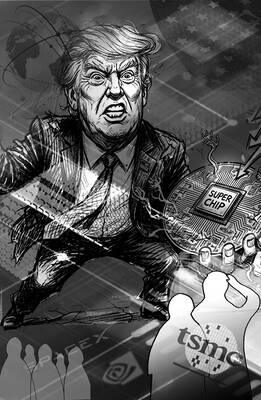
The White House’s decision to take a 9.9 percent stake in Intel Corp is looking like very shrewd business indeed. Since the government bought in at US$20.47 a share last August, the US chipmaker’s surging stock price has delivered the US a US$43 billion return. One of the reasons the investment has so far proved so sound is that the White House has made sure of it. According to The Wall Street Journal, Howard personally pushed deals on Intel’s behalf with some of the most lucrative clients imaginable. They include Nvidia Corp, the company at the heart of the AI
The Ministry of the Interior, working with the navy and coast guard, is organizing Taiwan’s first joint exercise simulating escort tankers carrying liquefied natural gas (LNG) and oil through a Chinese blockade. The drills simulate fuel transport along three maritime corridors leading toward Japan, the Philippines and the US. Deputy Minister of the Interior Sawyer Mars (馬士元) said that a blockade of the Taiwan Strait would amount to “almost a 100 percent blockade of the regional energy supply.” Minister of National Defense Wellington Koo said planning to counter a blockade is standard practice in Taipei. While the exercise is limited in
A single photograph can cut through a lot of noise, but it can also be used to misrepresent the truth. At the very least, it can concentrate the mind on something that requires further investigation. On Monday last week, Ma Ying-jeou Foundation CEO Tai Hsia-ling (戴遐齡) and former National Security Council secretary-general King Pu-tsung (金溥聰) held a news conference in which they showed a photograph of former foundation CEO Hsiao Hsu-tsen (蕭旭岑), now Chinese Nationalist Party (KMT) deputy chairman. In the image Hsiao is seated next to Xiamen Taiwan Businessmen Association chairman Han Ying-huan (韓螢煥). The two men were holding
I first met Professor Ray Jiing (井迎瑞) as a film and documentary student at Shih Hsin University’s (SHU) Department of Radio Television and Film in 1988. The following year, he went on to become the director of the Chinese Taipei Film Archive — forerunner of the Taiwan Film and Audiovisual Institute (TFAI). Over his eight-year tenure, Jiing rescued and restored over 200 classic Taiwanese films. In 1997, he established the Graduate Institute of Studies in Documentary and Film Archiving at Tainan National University of the Arts (TNNUA), and I joined the program in his third cohort of students. Beyond a


 RSS
RSS