


As a musician and music lover, the artificial intelligence (AI) revolution terrifies me in many ways. AI apps such as Suno have already shown extraordinary potential to generate catchy and professionally produced music in certain genres. So it is not hard to imagine a world in which, for example, session musicians, jingle writers and purveyors of educational music for kids could soon lose their livelihoods to machines.
At the same time, I am fairly optimistic that jazz — one of the most commercially underappreciated of all the musical styles, and the one closest to my heart — will survive and thrive in the new AI ecosystem.
A 2024 year-end music report by Luminate ranked jazz 10th out of 11 “selected top genres” in the US, where it was nestled between classical and children’s music and commands less than 1 percent of total on-demand streams.
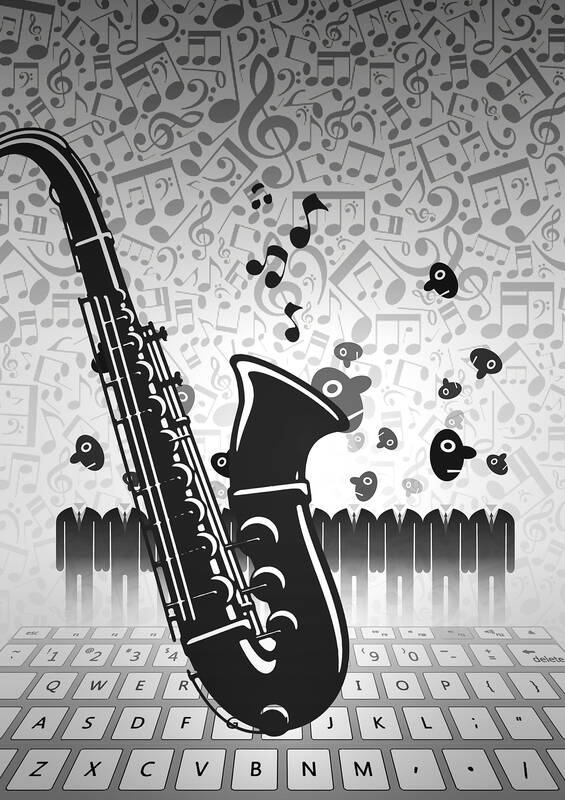
Illustration: Yusha
AI might be the key to improving on those abysmal numbers by highlighting what I call the “jazz model”: a way of making music that puts live, verifiably human performance at the center. That model might point to a path of survival for other human artists looking to carve out a niche in our AI future.
To see why, it helps to look at what generative AI actually does well — and what it struggles with. It can mine vast troves of patternistic text, images, audio and video, then turn it into something you might want to consume. That works quite well for pop and rock music, in which songs tend to clock in at about three to four minutes and follow the predictable pattern “verse-chorus-verse-chorus-bridge-chorus-end.”
However, great jazz has two things that help set it apart. First, it is often harmonically groundbreaking (Miles Davis’ Kind of Blue, which introduced the world to modal jazz; John Coltrane’s Giant Steps, which cycles through mind-boggling key changes). Second, the genre experiments with novel song forms (Ornette Coleman’s Free Jazz: a Collective Improvisation). More than a century after the birth of jazz, my favorite contemporary players — including the guitarists Julian Lage and Kurt Rosenwinkel — continue to push the boundaries of timbre and harmony.
I have tried to test AI’s ability to replicate the depth of the sound and have been disappointed in the output. Suno prompts such as “create an instrumental jazz recording that pushes boundaries of form and harmony; experiment with dissonance and key changes” result in something I might play on my stereo at a polite holiday party with extended family. However, there was not anything novel or boundary-pushing about it, nor did it hit me on an emotional level.
Obviously, it is premature to say that the technology would never be able to create good jazz. Yet even if that happens, it is likely that we would start to distinguish more sharply between craft — polished, repeatable style — and art, which we would reserve for creative work that is visibly, even vulnerably, human.
A recent Pew Research Center report on how US adults viewed AI found that 53 percent of people thought the technology would worsen the ability to think creatively, which suggests many would be looking for ways to believe that creativity still exists.
What genre can do that better than jazz? Imagine piling into clubs such as the Village Vanguard, where people can sit so close as to watch the performers sweat and where each performance is improvised, unique and imperfect. In that moment, they can marvel at the way human lungs produce expressive trumpet solos and the human fingers sliding up and down the upright bass. Virtuosos would be celebrated, much as great athletes are, as living celebrations of what can be accomplished with hard work, even without machines.
I suspect similar dynamics would extend to other art forms as well. AI would excel at making pastiche — knocking out competent genre fiction, portraits and decorative sculpture. However, the work we prize the most would be the avant-garde, the risky and idiosyncratic, and there would be greater demand for methods to authenticate that it was produced by human hands.
Even creators whose art is not traditionally performance-based might have to show their process, perhaps by livestreaming from their studios or sharing unedited drafts, precisely so audiences can experience and reward the distinctively human labor behind the finished piece.
Long before becoming a markets columnist (my day job for this publication), my dream was to become a jazz guitarist. Seeing how hard it was for working players to earn more than a modest middle-class income eventually pushed me toward another career, but I have never stopped cheering for the people who stayed in the music.
It has been nearly a century since jazz dominated popular music and six decades since the massive hit albums of Davis, Coltrane, Dave Brubeck and others. Yet, as scary as AI is for musicians on the whole, I would love to believe that the upheaval will finally bring about a renewed appreciation for the jazz performers that I hold so dear — a group of artists that the world has long taken for granted.
Jonathan Levin is a columnist focused on US markets and economics. Previously, he worked as a Bloomberg journalist in the US, Brazil and Mexico. This column reflects the personal views of the author and does not necessarily reflect the opinion of the editorial board or Bloomberg LP and its owners.
In the US’ National Security Strategy (NSS) report released last month, US President Donald Trump offered his interpretation of the Monroe Doctrine. The “Trump Corollary,” presented on page 15, is a distinctly aggressive rebranding of the more than 200-year-old foreign policy position. Beyond reasserting the sovereignty of the western hemisphere against foreign intervention, the document centers on energy and strategic assets, and attempts to redraw the map of the geopolitical landscape more broadly. It is clear that Trump no longer sees the western hemisphere as a peaceful backyard, but rather as the frontier of a new Cold War. In particular,
When it became clear that the world was entering a new era with a radical change in the US’ global stance in US President Donald Trump’s second term, many in Taiwan were concerned about what this meant for the nation’s defense against China. Instability and disruption are dangerous. Chaos introduces unknowns. There was a sense that the Chinese Nationalist Party (KMT) might have a point with its tendency not to trust the US. The world order is certainly changing, but concerns about the implications for Taiwan of this disruption left many blind to how the same forces might also weaken
As the Chinese People’s Liberation Army (PLA) races toward its 2027 modernization goals, most analysts fixate on ship counts, missile ranges and artificial intelligence. Those metrics matter — but they obscure a deeper vulnerability. The true future of the PLA, and by extension Taiwan’s security, might hinge less on hardware than on whether the Chinese Communist Party (CCP) can preserve ideological loyalty inside its own armed forces. Iran’s 1979 revolution demonstrated how even a technologically advanced military can collapse when the social environment surrounding it shifts. That lesson has renewed relevance as fresh unrest shakes Iran today — and it should

As the new year dawns, Taiwan faces a range of external uncertainties that could impact the safety and prosperity of its people and reverberate in its politics. Here are a few key questions that could spill over into Taiwan in the year ahead. WILL THE AI BUBBLE POP? The global AI boom supported Taiwan’s significant economic expansion in 2025. Taiwan’s economy grew over 7 percent and set records for exports, imports, and trade surplus. There is a brewing debate among investors about whether the AI boom will carry forward into 2026. Skeptics warn that AI-led global equity markets are overvalued and overleveraged


 RSS
RSS