


This was the year that the remaining pillars of the late 20th century order were shattered, exposing the hollow core of what passed for a global system. Three blows sufficed.
The first was Russia’s impending victory in Ukraine over Europe’s combined leadership. For almost four years, the EU and NATO engaged in a perilous double game. On one hand, they committed rhetorically to a Ukrainian victory they were unwilling to bankroll. On the other, they exploited this never-ending war to advance a new political and economic domestic consensus: Military Keynesianism would be their last-ditch stand against Europe’s deindustrialization.
In a continent where debilitating political constraints forbade significant deficit-funded green investments or social policies, the war in Ukraine provided a powerful rationale for funneling public debt into the defense-industrial complex. The unspoken truth was that a forever war served a critical function: It was the perfect engine for Keynesian pump-priming of Europe’s stagnating economy.
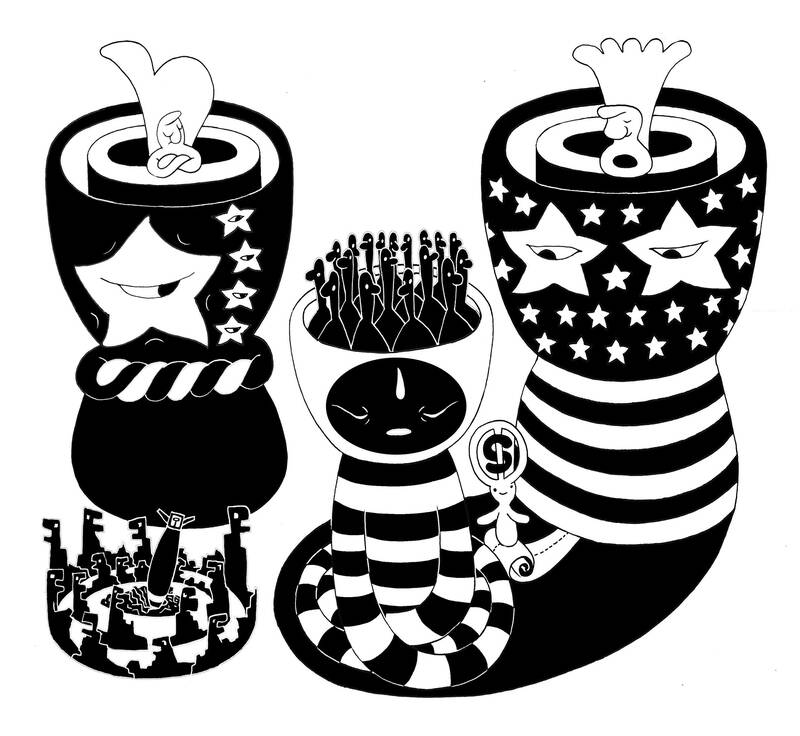
Illustration: Mountain People
The contradiction was fatal: If the Ukraine war ended with a peace deal, it would be hard to sustain this economic pump-priming. Yet to achieve a victory that would justify the spending was deemed too expensive financially and too risky geostrategically. Therefore, Europe settled on the worst possible strategy: Sending just enough equipment to Ukraine to prolong the bleeding without altering its course.
Now that Russia is set to prevail (a predictable result that US President Donald Trump merely brought forward), the EU’s best-laid plans lay in ruins. Europe has no plan B for peace because its entire strategic posture had become dependent on the war’s continuance. Whatever grubby peace deal the Kremlin and Trump’s men ultimately impose on Ukraine would do more than redraw a border. Whether Russia remains a threat to Europe or not, Europe is about to lose the pretext for its nascent military-industrial boom, foreshadowing a new austerity.
The second shock was that China won the trade war against the US. The US strategy, initiated under Trump’s first administration and intensified under former US president Joe Biden, was a pincer move — tariff barriers to cripple Chinese access to markets, and embargoes on advanced semiconductors and fabrication tools to cripple its technological ascent. This year, this strategy met its Waterloo, and Europe was again the primary collateral damage.
China responded with a masterful two-part response. First, it weaponized its dominance over rare earths and critical minerals, triggering a supply-chain seizure that paralyzed not so much US, but European and East Asian green manufacturing. Second, and most injuriously for the US’ standing as the global technology leader, China mobilized its “whole-nation system” toward a single goal — technological autarky. The result was a staggering acceleration in domestic chip production, with Semiconductor Manufacturing International Corp and Huawei Technologies Co achieving breakthroughs that rendered the US-led Western embargo not just obsolete, but counterproductive.
This is probably the shock with the longest-lasting repercussions. This year, the US proved incapable of slowing China’s rise and, instead, unwittingly propelled its technology sector toward full independence, and Europe, having dutifully imposed on China the sanctions dictated by the White House, was left with the worst of all worlds: Increasingly shut out of the lucrative Chinese market for its high-value goods, yet receiving none of the lavish subsidies and on-shoring benefits of the now rescinded US Inflation Reduction Act. By choosing to act as a strategic subcontractor to the US, the EU accelerated its own deindustrialization.
This was not a loss in a trade war; it was a geopolitical checkmate, and Europe featured only as the losing side’s pawn.
The third shock was the ease with which Trump won his tariff war with the EU. At the end of their meeting at one of Trump’s golf clubs in Scotland, choreographed by his men to maximize her humiliation, European Commission President Ursula von der Leyen struggled to portray a surrender document as a “landmark agreement.” Tariffs on European exports to the US jumped from about 1.2 percent to 15 percent, and in some cases to 25 percent and 50 percent. Long-standing EU tariffs on US exports were canceled. Last but not least, the commission committed to US$600 billion of European investment in US industry on US soil — money that can come only from diverting mainly German investments to chemical factories in Texas and car plants in Ohio.
This was more than a bad deal. It was an unprecedented capital extraction treaty. It formalizes the EU’s transition from an industrial competitor to a supplicant. Europe is to be a source of capital, a regulated market for US goods, and a technologically dependent junior partner. To add insult to injury, this new reality was codified in a binding commitment, to which all 27 EU member states have now agreed, stripping the bloc of any pretense of sovereignty. Part of the capital Trump needs to consolidate his vision of a G2 world structured around the Washington-Beijing axis is now contractually obligated to flow from Europe westward.
These three shocks form a synergistic trilogy.
Europe’s defeat in Ukraine has revealed its strategic blind spots and punctured its military Keynesian project. Trump’s acquiescence to Chinese President Xi Jinping (習近平) has triggered a flood of Chinese exports to the EU. The shakedown in Scotland has cost Europe its accumulated capital and any lingering hope of parity.
In the G2 world, the imagined global village is a gladiatorial arena where the EU and the UK now wander aimlessly. A new, harder, colder world order has been erected on the grave of European ambition. The year’s enduring lesson is that in an age of existential contests, strategic dependency is the prelude to irrelevance.
Yanis Varoufakis, a former Greek minister of finance, is leader of the MeRA25 party and professor of economics at the University of Athens.
Copyright: Project Syndicate
In the US’ National Security Strategy (NSS) report released last month, US President Donald Trump offered his interpretation of the Monroe Doctrine. The “Trump Corollary,” presented on page 15, is a distinctly aggressive rebranding of the more than 200-year-old foreign policy position. Beyond reasserting the sovereignty of the western hemisphere against foreign intervention, the document centers on energy and strategic assets, and attempts to redraw the map of the geopolitical landscape more broadly. It is clear that Trump no longer sees the western hemisphere as a peaceful backyard, but rather as the frontier of a new Cold War. In particular,
When it became clear that the world was entering a new era with a radical change in the US’ global stance in US President Donald Trump’s second term, many in Taiwan were concerned about what this meant for the nation’s defense against China. Instability and disruption are dangerous. Chaos introduces unknowns. There was a sense that the Chinese Nationalist Party (KMT) might have a point with its tendency not to trust the US. The world order is certainly changing, but concerns about the implications for Taiwan of this disruption left many blind to how the same forces might also weaken
As the Chinese People’s Liberation Army (PLA) races toward its 2027 modernization goals, most analysts fixate on ship counts, missile ranges and artificial intelligence. Those metrics matter — but they obscure a deeper vulnerability. The true future of the PLA, and by extension Taiwan’s security, might hinge less on hardware than on whether the Chinese Communist Party (CCP) can preserve ideological loyalty inside its own armed forces. Iran’s 1979 revolution demonstrated how even a technologically advanced military can collapse when the social environment surrounding it shifts. That lesson has renewed relevance as fresh unrest shakes Iran today — and it should
As the new year dawns, Taiwan faces a range of external uncertainties that could impact the safety and prosperity of its people and reverberate in its politics. Here are a few key questions that could spill over into Taiwan in the year ahead. WILL THE AI BUBBLE POP? The global AI boom supported Taiwan’s significant economic expansion in 2025. Taiwan’s economy grew over 7 percent and set records for exports, imports, and trade surplus. There is a brewing debate among investors about whether the AI boom will carry forward into 2026. Skeptics warn that AI-led global equity markets are overvalued and overleveraged


 RSS
RSS