


According to the most recent My Formosa poll released on Dec. 1, 26.4 percent of respondents agreed that “both sides of the Taiwan Strait belong under one China,” up from 17.4 percent in March from the same pollster.
The proportion of those who disagreed fell from 76.4 to 65.7 percent over the same period — nearly 20 percent over just eight short months. This is not a random fluctuation. It is a sign that Taiwan’s social and psychological defenses are fracturing.
Cross-analysis suggests that the shift was primarily driven by supporters of the Chinese Nationalist Party (KMT) and the Taiwan People’s Party (TPP). The proportion of respondents supportive of the KMT who agreed with “one China” increased significantly, likely a reflection of the party’s recent election of Cheng Li-wun (鄭麗文) as its chairwoman.
Cheng has long advocated for a Chinese national identity. Her election has consolidated the party’s base and sent a signal to wider society in Taiwan: The KMT has shifted from an ambiguously defensive position to one that embraces a “one China” narrative.
The Dec. 1 poll, which covered last month, showed that 46.9 percent of respondents view her as inclined toward cross-strait unification, an otherwise exceptionally rare position for a mainstream politician to hold.
When opposition leaders can promote a Chinese identity without incurring a ruinous backlash, their supporters can become psychologically entrenched in their identification with “one China” — a view perhaps once held in private, but now expressed explicitly.
Even more concerning is the rapid shift among supporters of the TPP, a party that brands itself as being rational, pragmatic and outside the traditional blue-green divide, but lacks a clear stance on cross-strait relations. The poll showed that the proportion of respondents supportive of the TPP who agreed with “one China” increased by more than 20 percent from March, suggesting that it is a lack of position itself that might pose the greatest risk.
In the information war, these supporters are among the most vulnerable and are easily swayed by narratives that prioritize pragmatic conflict avoidance and the economy.
A broader issue was revealed when respondents were asked what they see the cross-strait relationship ultimately evolving to. Regardless of voting tendency, 37.4 percent said a business partnership, while only 16.9 percent said enemies. This naive economization of the cross-strait relationship is a primer to the most insidious form of cognitive warfare and neatly avoids acknowledging the risks of annexation or erosion of sovereignty. Some people, who might not be explicitly in favor of unification, are perhaps beginning to feel that it would not be entirely unacceptable.
The fear is that these shifts in polling numbers are just the beginning. When politicians cozy up to China, the social consensus can shift faster than expected. If the proportion of support for “one China” breaches the 30 percent threshold and the effects of the Chinese Communist Party’s “united front” campaign fully take shape, Taiwan’s ability to bargain for sovereignty at the international negotiating table will be severely undermined.
This is no longer a question of party politics — it is about whether Taiwan can still distinguish between true peace and being absorbed. Taiwan cannot afford to sit and watch as its sovereign defenses erode. If the crisis is ignored, it is Taiwanese who will pay the price. As a matter of urgency, we must solidify our defenses by strengthening democratic education and information literacy. Civil society must remain vigilant and come together to defend Taiwanese agency. Once lost, freedom is not easily regained.
Yang Chih-chiang is a teacher.
Translated by Gilda Knox Streader

KMT Chairwoman Cheng Li-wun’s (鄭麗文) recent visit to Beijing and her upcoming visit to Washington will serve as a high-level test of her diplomatic mettle. In Beijing, Cheng was received with symbolic gestures, a warm reception, and high-level access. In Washington, she will receive far less pomp and far sharper questions about the KMT’s vision for the future of Taiwan. Her challenge will be to persuade Washington that the KMT’s engagement with China can coexist with strong deterrence. Cheng’s April 7-12 visit to mainland China coincided with an intense period of conflict in Iran. Despite the strategic significance of Cheng’s trip,
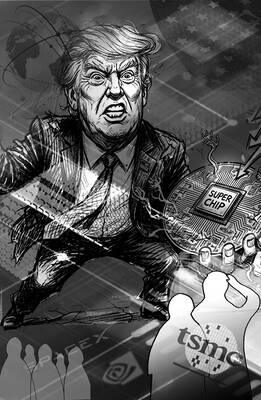
The White House’s decision to take a 9.9 percent stake in Intel Corp is looking like very shrewd business indeed. Since the government bought in at US$20.47 a share last August, the US chipmaker’s surging stock price has delivered the US a US$43 billion return. One of the reasons the investment has so far proved so sound is that the White House has made sure of it. According to The Wall Street Journal, Howard personally pushed deals on Intel’s behalf with some of the most lucrative clients imaginable. They include Nvidia Corp, the company at the heart of the AI

The closure of the Strait of Hormuz has sent the vast Asian chemicals industry into a tailspin. Deprived of the likes of Qatari natural gas and Saudi Arabian oil, the region’s fertilizer and plastics plants are slowing production or even shutting down. Everywhere except China, that is. In petrochemicals, China is unique. As well as a traditional industry that uses oil and gas as feedstock, it has parallel output that relies on its abundant domestic coal. Unsurprisingly, India and other regional powers want to copy and paste the Chinese method. This would not be easy — or climate friendly. The
Indonesian President Prabowo Subianto says he knows how to fix the problems facing Indonesia. Yet his economic mismanagement and authoritarian tendencies are steering the nation toward a familiar mix of currency instability and political chaos. The world’s fourth-most populous nation risks reversing the hard-won democratic and business reforms that came after the Asian Financial Crisis in 1997. At that time, the rupiah collapsed and the political upheaval that followed forced former president Haji Mohamed Suharto from power. Prabowo’s administration is ignoring similar warning signs. That disconnect was apparent in a national address on Wednesday, when Prabowo projected the swagger that has


 RSS
RSS