


Slowing growth, escalating trade wars, tightening cross-border capital flows and intensifying migration pressures have dominated news headlines — and for good reason. Together, these forces threaten to undermine multilateralism and accelerate the rise of blocs such as the BRICS+ group of major emerging economies, setting the stage for a profound reordering of the global economy.
However, five additional structural trends could prove equally, if not more, transformative.
The first is demographic change. While the world’s population is projected to peak at about 10.3 billion by the mid-2080s, that headline figure obscures powerful underlying shifts. The global population is aging rapidly, and with the ratio of working-age individuals to retirees expected to fall from 9.4 in 1997 to just 3.9 by 2050, pension systems and public finances are set to come under growing strain.
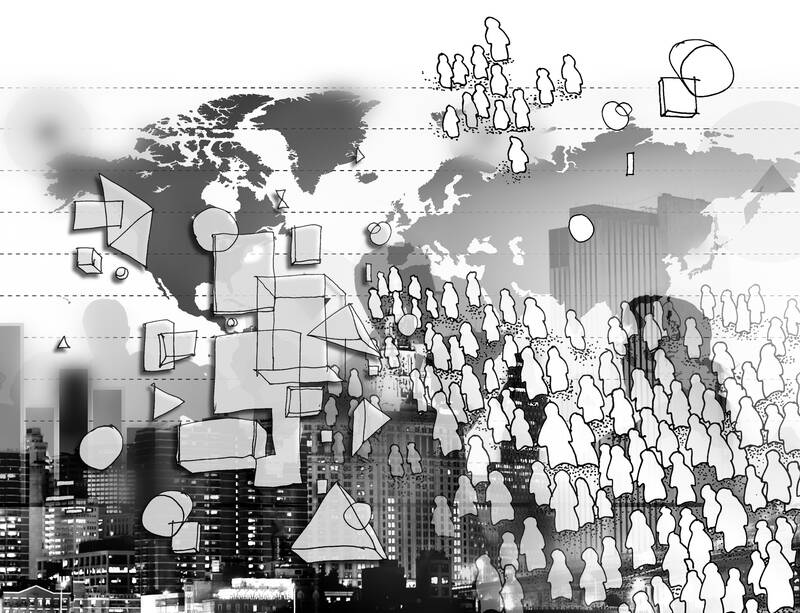
Illustration: Tania Chou
Population trends differ dramatically across nations. India has overtaken China as the world’s most populous country, while China’s population — about 1.4 billion — is expected to drop below 750 million by 2100. Italy’s population is projected to fall from 60 million to 27 million over the same period, while Japan’s could plummet from 128 million to 53 million. Nigeria’s population, by contrast, is set to triple to 791 million, making it the world’s second-most populous country after India.
The economic and geopolitical consequences could be profound. Hundreds of millions of people across the developing world are expected to enter the workforce over the next quarter of a century, just as many advanced economies face long-term demographic decline. The widening gap would intensify labor and economic pressures, fueling migration at a time when global systems are already grappling with record levels of displacement.
These demographic shifts would also alter global consumption patterns, particularly when it comes to energy and foodstuffs. India might be more populous than China, but China’s per capita income — about US$13,300, nearly five times that of India — suggests that population growth is shifting toward lower-income economies consuming lower-value goods.
The second structural trend is artificial intelligence (AI)-driven labor-market disruption. While the AI super-cycle promises to boost productivity and growth, it could also displace millions of workers, particularly those in routine jobs involving repetitive tasks. Although economists’ projections vary, even conservative estimates point to the emergence of a jobless underclass, with serious social and macroeconomic consequences.
Moreover, if AI-driven growth disproportionately benefits capital over labor, inequality would increase and governments would come under pressure to intervene. Consequently, corporations — particularly the technology sector — could face higher tax burdens to fund welfare programs, including universal basic income.
The third structural trend involves natural-resource constraints, which threaten to slow economic growth and widen geopolitical rifts. Copper, for example, is already in structural deficit and the International Energy Agency warns of a 30 percent shortfall by 2035 without significant investment in new mining projects. Other critical inputs such as lithium, nickel and cobalt face similar supply pressures, raising the risk of severe shortages that could cripple battery manufacturing and derail the transition to clean energy.
Water scarcity is another major resource constraint. About 25 percent of global agriculture takes place in high-water-stress areas, leaving food systems vulnerable to shortages and price spikes, and because water is also essential for cooling data centers and semiconductor manufacturing, rapid AI adoption would further strain supplies.
Fourth, risk appetite in the US has risen sharply, fueling a new wave of speculative investment. In contrast to the EU, the US regulatory environment continues to encourage greater risk-taking among both retail and institutional investors. As a result, stock markets remain near historic highs, with the S&P 500 price-to-earnings ratio at about 30x — far above the historical average. Investors are also pouring more money into private equity, private credit, venture capital, cryptocurrencies, meme coins and gold (which has climbed by more than 50 percent over the past year).
The surge in short-term speculation is unlikely to slow, as baby boomers are projected to pass an estimated US$100 trillion to younger generations by 2048. This massive intergenerational wealth transfer would inject more investment capital into financial markets, inflating asset prices, even as the sheer volume of savings puts downward pressure on real interest rates.
The influx of new capital carries significant risks. Leveraged bets are increasingly routed through the shadow-banking system, far from regulatory oversight, creating vulnerabilities that could spill over into the real economy. The migration of credit activity from traditional banks weakens the effectiveness of monetary policy. Even if the US Federal Reserve lowers interest rates, those cuts might never reach borrowers, limiting policymakers’ ability to stimulate growth.
Lastly, heightened risk aversion in the UK and Europe is becoming a structural problem in its own right. For decades, Europe’s growth prospects have been weighed down by bureaucratic hurdles, stringent regulatory requirements and fragmented capital markets. The numbers speak for themselves: Venture-capital investment in the US is typically 8 to 10 times higher than in the EU, and about 70 percent of eurozone households say they are unwilling to take financial risks, compared with fewer than 40 percent of US households.
London’s stock market underscores the depth of this financial malaise. In the first half of this year, companies raised just £160 million (US$214 million) in London listings — a 30-year low — pushing the City out of the world’s top 20 initial public offering markets. UK pension funds have also reduced their domestic equity allocation from 53 percent to 6 percent over the past 25 years, shrinking the pool of capital available to British companies.
This is not simply a financial problem, as Europe’s diminishing economic role is eroding its long-term competitiveness. Without a dramatic shift, the continent risks missing the AI super-cycle and becoming a technology colony rather than a driver of innovation.
Each of these five structural trends could transform the global economy — redrawing trade routes, redirecting investment flows, altering the distribution and pricing of key foodstuffs and critical minerals, and forcing governments to rethink supply-chain management, capital allocation and cross-border investment. The best-prepared decisionmakers would be those who recognize the stakes early and adjust accordingly.
Dambisa Moyo, an international economist, is the author of Edge of Chaos: Why Democracy Is Failing to Deliver Economic Growth – and How to Fix It.
Copyright: Project Syndicate
The conflict in the Middle East has been disrupting financial markets, raising concerns about rising inflationary pressures and global economic growth. One market that some investors are particularly worried about has not been heavily covered in the news: the private credit market. Even before the joint US-Israeli attacks on Iran on Feb. 28, global capital markets had faced growing structural pressure — the deteriorating funding conditions in the private credit market. The private credit market is where companies borrow funds directly from nonbank financial institutions such as asset management companies, insurance companies and private lending platforms. Its popularity has risen since
The Donald Trump administration’s approach to China broadly, and to cross-Strait relations in particular, remains a conundrum. The 2025 US National Security Strategy prioritized the defense of Taiwan in a way that surprised some observers of the Trump administration: “Deterring a conflict over Taiwan, ideally by preserving military overmatch, is a priority.” Two months later, Taiwan went entirely unmentioned in the US National Defense Strategy, as did military overmatch vis-a-vis China, giving renewed cause for concern. How to interpret these varying statements remains an open question. In both documents, the Indo-Pacific is listed as a second priority behind homeland defense and
Every analyst watching Iran’s succession crisis is asking who would replace supreme leader Ayatollah Ali Khamenei. Yet, the real question is whether China has learned enough from the Persian Gulf to survive a war over Taiwan. Beijing purchases roughly 90 percent of Iran’s exported crude — some 1.61 million barrels per day last year — and holds a US$400 billion, 25-year cooperation agreement binding it to Tehran’s stability. However, this is not simply the story of a patron protecting an investment. China has spent years engineering a sanctions-evasion architecture that was never really about Iran — it was about Taiwan. The
In an op-ed published in Foreign Affairs on Tuesday, Chinese Nationalist Party (KMT) Chairwoman Cheng Li-wun (鄭麗文) said that Taiwan should not have to choose between aligning with Beijing or Washington, and advocated for cooperation with Beijing under the so-called “1992 consensus” as a form of “strategic ambiguity.” However, Cheng has either misunderstood the geopolitical reality and chosen appeasement, or is trying to fool an international audience with her doublespeak; nonetheless, it risks sending the wrong message to Taiwan’s democratic allies and partners. Cheng stressed that “Taiwan does not have to choose,” as while Beijing and Washington compete, Taiwan is strongest when


 RSS
RSS