


White flowers at makeshift shrines and messages of support posted in a public square. A rainbow of folded paper cranes. Boxes of donated goods for those in need. Hong Kongers’ responses to the Tai Po fire disaster — in which at least 160 people have died and 31 are still unaccounted for — have, on the surface, resembled similar community expressions of solidarity last seen during the 2019 protests. However, beneath the surface, Hong Kong civil society is struggling to respond to this latest collective trauma in a territory that has deeply changed in the past five years.
The cauterization of Hong Kong’s civil society that has occurred under Beijing’s national security crackdown has meant that the types of grassroots activism that would traditionally have occurred in response to such a tragedy — as they would in any other open society — are no longer possible.
In the past, pro-democracy legislators would have grilled government officials in the legislative council: But in 2021 that changed when 47 pro-democracy politicians proposing to run in elections were charged with subversion, and later jailed. Only Beijing-approved “patriots” are now permitted to run for office, and all of Hong Kong’s pro-democracy political parties have since dissolved.
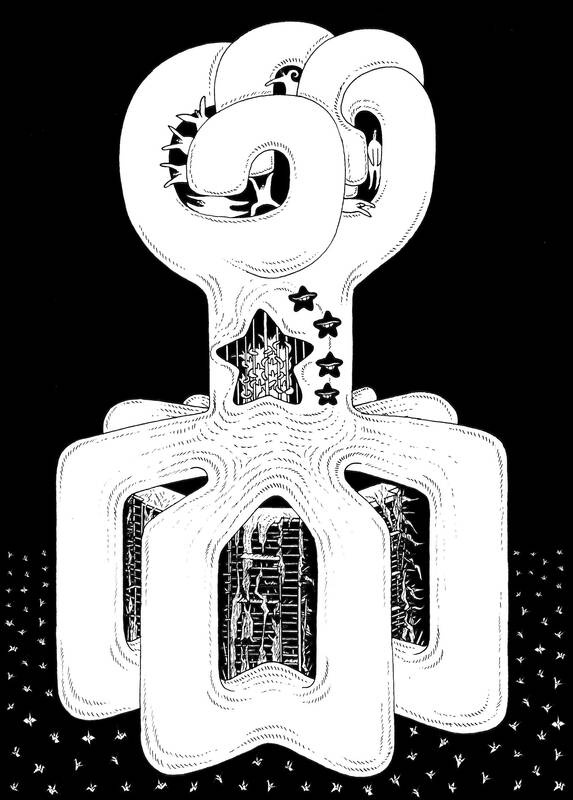
Illustration: Mountain People
Freewheeling independent media outlets, such as Jimmy Lai’s (黎智英) Apple Daily newspaper or online outlet Stand News, would have doggedly pursued investigative reporting to uncover corruption or mismanagement, and seek accountability for the fires. However, those independent media outlets were forced to close, and their editors charged with sedition.
An array of civil society groups would have offered assistance. The Progressive Lawyers Group, for example, would have volunteered legal aid for victims and their families, and provided objective analysis on legal questions such as the difference between a statutory commission of inquiry and the toothless “independent committee” proposed by the Hong Kong government to investigate the disaster. However, that group, and scores of other civil society groups, have either been forced to close by the authorities, or disbanded in fear.
Hong Kong’s creative community might have responded in works of art, film and literature, but artists have also been cowed. Those with a track record of activism or political activity are prevented from exhibiting. Theater groups find their venue bookings abruptly canceled. Films are censored such that the depiction — whether documentary or fictional — of any “sensitive” topic, including Hong Kong’s own protests broadcast widely in 2019, is effectively banned. A work of art on the Tai Po fires such as Steve McQueen’s haunting Grenfell could not be exhibited in today’s Hong Kong, and even making such a film would be considered an act of sedition.
Hong Kong was once a city of lively, sometimes raucous, public debate; now those voices have fallen eerily silent. However, this does not prevent the authorities from being nervous that — as has been the pattern elsewhere in China and globally — the tragedy would become a focal point for anti-government sentiment.
Reports of corruption or regulatory failures being a factor in the fires are one potential target for community anger. The extent to which this tragedy reveals a broken system, dominated by tycoon property developers, cronyism in the construction industry and a bureaucratic, but ineffective government, remains to be seen.
However, it is a somewhat unlikely source of outrage that might become even more potent: bamboo. Initial reports that the bamboo scaffolding covering the buildings had contributed to the fire quickly drew criticism. Subsequent investigations have come to focus on the flammable netting enveloping the scaffolding as well as Styrofoam boards used to cover the windows of the buildings while renovations were under way.
However, in the meantime some in Hong Kong have raised concerns that the tragedy would be used as an excuse to phase out local bamboo scaffolding in favor of mainland-manufactured steel scaffolding. This is not merely a question of fire safety. Bamboo scaffolding is regarded as an example of Hong Kong’s unique cultural heritage, and as such is a deeply political matter. Issues of Hong Kong culture and identity have been at the core of Hong Kong political protest movements, not just in 2019, but over the preceding decades. This makes bamboo capable of becoming a lightning-rod issue.
The authorities’ immediate heavy-handed response to the tragedy betrays their concern: In the first week after the disaster, a university student distributing flyers demanding accountability for the fire was detained, as were a former pro-democracy local councilor providing volunteer support and a lawyer who had been coordinating a news conference of civil society experts. The news conference was canceled.
A YouTuber who allegedly posted asinine and offensive — but not political — comments about the fire online was also arrested, marking the first time that Hong Kong’s national security laws have apparently been used to exercise mainland-style moral (as opposed to political) policing of online content.
However, one point of difference with the mainland has been an apparent contrast in the accountability of leadership. The lines of accountability for local officials in cases of similar disasters in the mainland can be brutal and short. For example, last year 55 officials, including the local mayor and party secretary were removed from their positions or punished after a fire in a Jiangxi commercial building killed 39 people.
One bold reporter was speaking the minds of many of his fellow Hong Kongers — and possibly many in the mainland as well — when he confronted Hong Kong Chief Executive John Lee (李家超) in a news conference earlier this week with the question: “Can you tell us why you deserve to keep your job?”
In any other Chinese city, heads would roll for the negligence and mismanagement that has caused so many deaths.
However, from Beijing’s point of view, there is only one measure that could determine whether Lee would keep his job: would he be able to prevent any protests and snuff out any signs of dissent? By that measure, his performance so far has been faultless.
Antony Dapiran is the author of two books on Hong Kong politics and protest.
KMT Chairwoman Cheng Li-wun’s (鄭麗文) recent visit to Beijing and her upcoming visit to Washington will serve as a high-level test of her diplomatic mettle. In Beijing, Cheng was received with symbolic gestures, a warm reception, and high-level access. In Washington, she will receive far less pomp and far sharper questions about the KMT’s vision for the future of Taiwan. Her challenge will be to persuade Washington that the KMT’s engagement with China can coexist with strong deterrence. Cheng’s April 7-12 visit to mainland China coincided with an intense period of conflict in Iran. Despite the strategic significance of Cheng’s trip,
The closure of the Strait of Hormuz has sent the vast Asian chemicals industry into a tailspin. Deprived of the likes of Qatari natural gas and Saudi Arabian oil, the region’s fertilizer and plastics plants are slowing production or even shutting down. Everywhere except China, that is. In petrochemicals, China is unique. As well as a traditional industry that uses oil and gas as feedstock, it has parallel output that relies on its abundant domestic coal. Unsurprisingly, India and other regional powers want to copy and paste the Chinese method. This would not be easy — or climate friendly. The
US President Donald Trump recently repeated his claim that “Taiwan stole America’s chip industry,” reigniting public debate on the issue. As a former Taiwanese minister of economic affairs and an entrepreneur deeply involved in semiconductor supply chain development, I feel a responsibility to clarify this misunderstanding. From the perspective of global industrial evolution and the economic principle of comparative advantage, such a statement appears overly simplistic and risks obscuring the essence of the issue. The rise of Taiwan’s semiconductor industry was not built on “replacing America,” but rather emerged as a result of countries pursuing different development paths within the
Indonesian President Prabowo Subianto says he knows how to fix the problems facing Indonesia. Yet his economic mismanagement and authoritarian tendencies are steering the nation toward a familiar mix of currency instability and political chaos. The world’s fourth-most populous nation risks reversing the hard-won democratic and business reforms that came after the Asian Financial Crisis in 1997. At that time, the rupiah collapsed and the political upheaval that followed forced former president Haji Mohamed Suharto from power. Prabowo’s administration is ignoring similar warning signs. That disconnect was apparent in a national address on Wednesday, when Prabowo projected the swagger that has


 RSS
RSS